The Next Battlefield of AI Protein Prediction: Making Protein Design as Simple as Chatting
Published on May 19, 2026
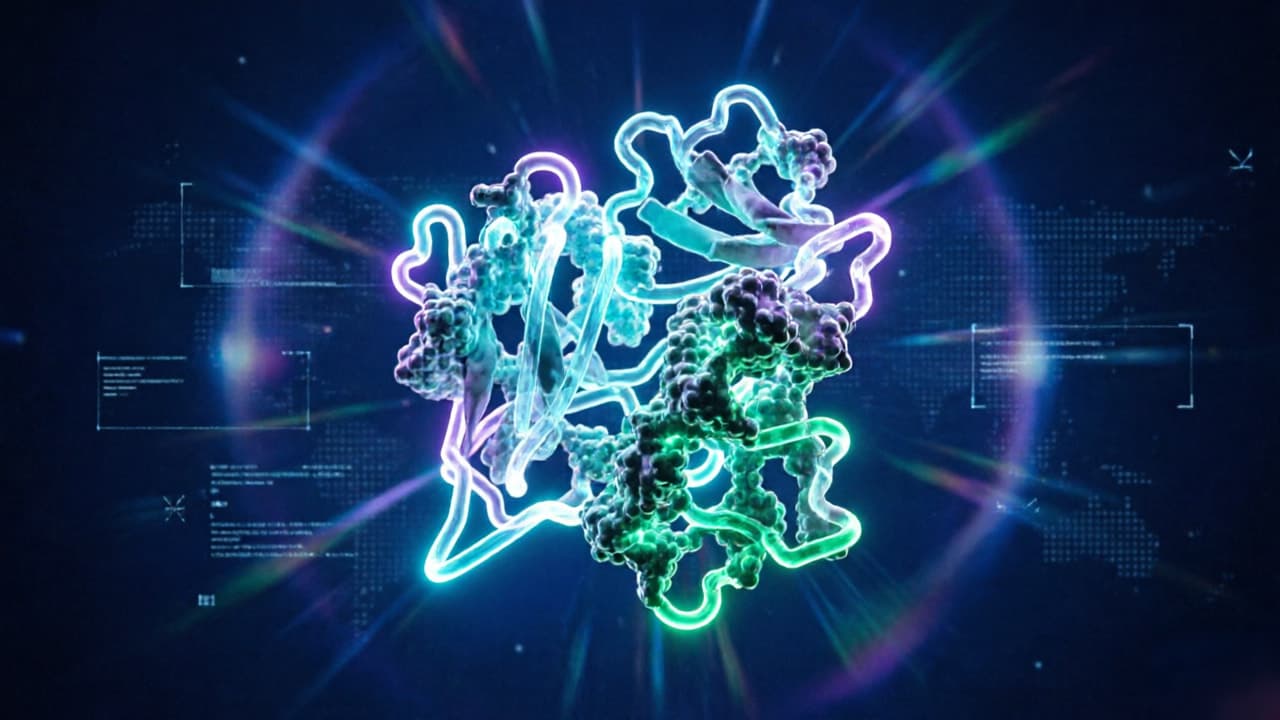
By the end of 2025, the R&D team of a globally renowned pharmaceutical company faced a difficult problem: they needed to design a completely new protein molecule that could precisely bind to a certain immune regulation target, but the target's structure was novel, with almost no similar drugs for reference. Following the traditional path, a project like this would usually take several months and the collaboration of dozens of scientists just to make marginal progress. However, this time, they obtained dozens of new candidate molecules with cellular activity in just a few weeks.
Behind this revolution in efficiency, a 'conversational protein R&D intelligent agent' is quietly rewriting the fundamental rules of protein science.
1. From 'structure analysis' to 'design creation,' the coordinates of protein research have already changed.

protein molecules
Proteins are the core executors of life activities. Understanding proteins and designing proteins has always been one of the most cutting-edge and challenging topics in biology.
In 2020, AI protein structure prediction ushered in its own "moment in the spotlight." Deep learning models represented by AlphaFold2 almost solved the "protein folding problem" that had puzzled the scientific community for half a century — it became possible to predict the three-dimensional structure of a protein from its amino acid sequence with high precision. In 2024, this achievement was recognized with the Nobel Prize in Chemistry, marking AI's leap in biology from a "supporting tool" to a "fundamental capability."
But science does not stop at "seeing clearly." Structure prediction is only the first step; the next challenges are even more demanding and valuable: Can we design proteins that do not exist in nature using AI? Can we precisely control their functions? Can this technology move from top laboratories to the desks of every researcher?
The answer is: it is happening.
In the spring of 2026, in a review published in the Nature sub-journal Communications Biology, researchers pointed out that structural biology is entering a new stage — AI-guided protein design platforms are transforming the development of protein binders into a scalable and engineerable discipline, significantly increasing experimental success rates. This means that protein design is shifting from a "craft" to an "assembly line."
2. Three key technological trends are redefining the rules of the game
If structure prediction was the "first wave" of AI protein research, the current developments represent the "second wave," centered on function prediction, protein generation, and engineering platforms. The following trends are particularly noteworthy:
Trend 1: Protein "language models" are becoming stronger
Scientists regard amino acid sequences as a kind of "language" and use large-scale pre-trained models to learn and predict the properties and functions of proteins. Between 2025 and 2026, protein language models experienced explosive growth — the xTrimoPGLM model developed with the participation of Nanjing University, with 100 billion parameters, surpassed previous best methods in 15 out of 18 protein-related tasks, demonstrating the astonishing potential of large models in protein understanding tasks.
Trend 2: From "Prediction" to "Generation"
Generative AI can not only predict the structure of known proteins but also create entirely new protein molecules from scratch. The MIT research team's BoltzGen model and NVIDIA's Proteína-Complexa method are both driving the practical application of "designing protein binders from scratch." These advances are changing the underlying logic of drug discovery: where previously molecules had to be "searched for" in nature, they can now be "created" on computers.
Trend 3: The global market enters a period of rapid growth
According to the latest report from QYResearch, the global AI protein design market size will reach approximately $610 million by 2025, and is expected to exceed $2 billion by 2032, with a compound annual growth rate of nearly 18.6%. Pharmaceutical giants are collaborating with AI companies more frequently, with several large pharmaceutical firms signing long-term cooperation agreements with AI protein design firms. AI is shifting from an "optional tool" to a "must-have infrastructure."
3. When protein research becomes as simple as "chatting."
The industry is advancing at high speed, but a key question always hangs in the air: Is the strength of technology limited to a handful of top institutions?
To answer this question, let's return to the case at the beginning of the article. The "behind-the-scenes" driver behind the design of dozens of brand-new protein binder molecules is the conversational protein R&D agent MatwingsVenus™ ™, officially launched by Shanghai Matwings Technology in April 2026.
What exactly is Matwings Venus™ (Xiaowu ™)? In short: it is a one-stop protein R&D platform centered on AI agents, but its interaction method is not complex code or professional interfaces, but natural language dialogue.
Users only need to tell MatwingsVenus™ what they want to do—for example, "Help me design a protein that can bind to a specific target"—and the system will automatically break down the task, call up over 200 integrated protein design tools on the platform, search tens of billions ™ of real label protein databases, and complete the entire computation process from industry research, sequence design, structure prediction to functional screening.
But that's not even the most critical point. What truly sets MatwingsVenus™ ™ apart is that it breaks down the barriers between "dry experiments" (calculations) and "wet experiments" (experimental verification). In traditional protein R&D, computational design and experimental validation are often handled by different teams, resulting in low delivery efficiency and long feedback cycles. On the MatwingsVenus™ ™ platform, after AI completes the design, the results can be directly imported into the automated shared laboratory, where robots prepare samples and perform functional testing. The experimental results are then fed back to the next round of AI iterations—forming a closed loop of "design is verification, verification is iteration," completely bridging the "last mile" between computation and experimentation.
To put it more intuitively: in the past, a major pharmaceutical company required multiple teams working in succession for several months to accomplish tasks that today a single researcher can complete on the MatwingsVenus™ (Xiaowu™) platform through conversation. The platform also integrates more than 50 experts certified by the platform in various fields. Users can initiate expert collaboration at any time to provide authoritative insights for design plans, allowing professional judgment and AI capabilities to resonate.
Hong Liang, founder and chief scientist of Matwings Technology, once described his vision this way: when AI and automation tools significantly lower the barriers to scientific research, more individuals and small teams can engage in personalized innovation, which will unleash productivity far beyond what has been seen before.
4. "Real-world validation" that has already been successfully conducted

Performance data after 24 hours of alkali treatment
Is a platform reliable? Ultimately, it comes down to a simple question: can it really deliver results in real projects?
MatwingsVenus™ (Xiaowu ™) answered yes. Taking the "VHH single-domain antibody (binding protein for affinity fillers)" project disclosed on Matwings Technology's official website as an example:
In the separation and purification process of biopharmaceuticals, affinity fillers are among the core consumables, and the binding proteins that play a key role in this process require high affinity, high selectivity, and excellent chemical stability. Traditional methods usually rely on animal immunity or large-scale library screening, resulting in long cycles, high costs, and performance improvements often fall into a multi-indicator dilemma of "pressing the gourd and lifting the ladle."
The Matwings Technology team has input this task into the MatwingsVenus™ ™ platform, where the agent automatically completes the entire computational process of VHH single-domain antibody structural modeling, interface design, sequence optimization, and stability prediction. The design plan is then directly imported into the automated shared laboratory, where robots complete sample preparation and functional testing, and the experimental results are fed back to the next round of AI iterations—within the closed loop of "design verification, validation is iteration," the platform efficiently screens high-performance VHH binding proteins that meet industrial application requirements, significantly shortening the R&D cycle from design to delivery.
On the industrial side, there is precise design of affinity packer binding proteins; on the innovative drug side, antibody design from scratch and multiple rounds of optimization of complex proteins—multiple real-world cases together send a message: AI-driven protein R&D is no longer just a concept demonstration, but a true "productivity tool" capable of producing functional protein products across scenarios and fields.
5. A More Profound Transformation: The Reallocation of Research Forces
Looking back at technological evolution over the past few years, a clear thread emerges: protein science is undergoing a shift from "centralization" to "democratization."
In the past, high-precision protein structure prediction and design capabilities were monopolized by a handful of top academic institutions and major pharmaceutical companies. Today, with the emergence of "conversational agents" like MatwingsVenus™ ™, R&D infrastructure that once required tens of millions in investment and massive manpower is being transformed into "shared research resources" that individual developers can easily access.
The underlying logic of this transformation is not complicated: when AI makes computing power easily accessible, when automated experiments reduce verification costs to "pay-as-you-go," and barriers to scientific innovation are broken down—what truly matters is not how many devices or talent you have, but the ability to ask the right questions.
6. Conclusion

Future scenarios
From AlphaFold to MatwingsVenus™ (XiaoWu™), from breakthroughs in structure prediction to the birth of conversational R&D agents, AI-driven protein science is evolving at an unprecedented pace. The ultimate goal of these technologies has never been to replace human creativity, but to make complex things simple and turn the abilities of a few into tools for the many.
The proteins of the future—whether they are innovative drugs that conquer stubborn diseases, food proteins that reshape taste experiences, or environmentally friendly and efficient industrial enzymes—their creators may no longer be a large R&D team, but anyone with an idea, who opens MatwingsVenus™ (XiaoWu™) and says, 'I want to make a…'.
And all of this is just beginning.