Synthetic Biology: When Life Becomes Programmable Source Code
Published on May 31, 2026
Preface
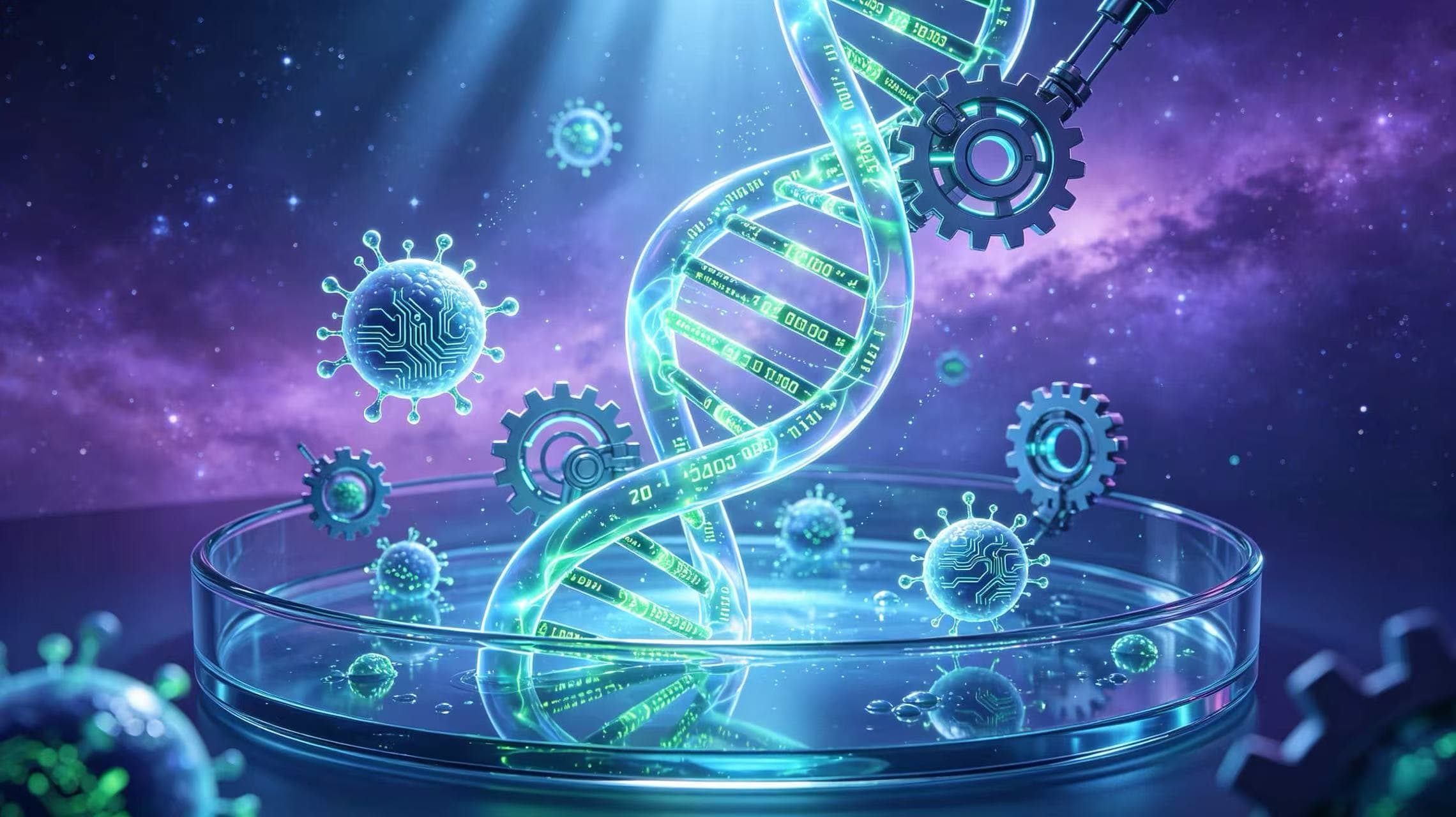
In the long history of human technological development, every decoding and rewriting of the code of life triggers a profound industrial transformation. If gene sequencing has taught us to "read life" and gene editing has given us the scissors to "modify life," then synthetic biology is pushing us into a completely new era—one where life can be programmed, predicted, and mass-produced like code.
This is not science fiction. There is already a global biomanufacturing market exceeding the scale of a trillion, rapidly moving from the model of "discovering natural molecules" to "designing biological systems from scratch." And the core engine driving this disruptive force is at the focus of today’s article.
1. From "observing things" to "creating things," what exactly is synthetic biology doing?

DBTL cycle
Simply put, synthetic biology draws on engineering thinking to purposefully design, modify, and even reassemble organisms. It views DNA as the underlying code, gene circuits as functional modules, and chassis cells as the operating system that runs the program, ultimately turning microorganisms into miniature factories that efficiently produce the drugs, fuels, new materials, functional proteins, and even artificial foods we need, using cheap carbon sources as raw materials.
The core of this discipline lies in a cycle: Design—Build—Test—Learn, known as the DBTL cycle. With each cycle completed, the biological system's function gets closer to the preset goal.
However, there is a key contradiction long overlooked: within the entire cycle, the "Design" stage has always been the weakest link, most reliant on experience. We can synthesize longer DNA sequences and edit gene sites with increasing precision, but when faced with a problem like "designing an industrial enzyme that maintains ultra-high activity under extreme pH conditions," traditional rational design and high-throughput screening are still like blindly guessing a password in a mysterious book. This is because the executor of life’s functions—the protein—has a relationship among its sequence, structure, and function that is almost impossibly complex to fully enumerate.
2. Proteins: The Soul Element of Synthetic Biology
Synthetic biology can achieve "biomanufacturing" because every cellular factory has a precise enzyme catalysis system and regulatory network. Enzymes are proteins. Whether converting straw into ethanol or synthesizing starch from carbon dioxide, specific functional proteins are required to accurately carry out the chemical reactions.
Therefore, the bottleneck in advancing synthetic biology is largely a bottleneck in protein design. In the past, scientists had to screen suitable enzymes from natural environments, and then undergo a long process of directed evolution to "fine-tune" their performance—a modification of an industrial enzyme often took years with a very high failure rate. This speed is far from enough to meet the explosive demands of the synthetic biology industry.
We urgently need a new "design engine" that can, starting from first principles, directly design protein molecules that do not exist in nature but have better functions for specific applications. And this is precisely the greatest benefit brought to the industry by the deep integration of artificial intelligence and automated experiments.
3. AI Meets Evolution: A Paradigm Revolution in Protein Design

Protein element library
In recent years, protein structure prediction and sequence generation technologies based on deep learning have developed rapidly, making computationally driven protein design a highly deterministic field. The logic behind this lies in the fact that vast amounts of natural protein sequence and structure data contain evolutionarily embedded 'rules,' which AI models can learn and, on this basis, creatively generate new proteins that meet multiple constraints.
Against this background, a group of cutting-edge platforms focused on protein design has begun to attract industrial attention. Notably, Shanghai Matwings Technology’s independently developed one-stop AI protein design platform—MatwingsVenus™ (Xiaowu™)—is worth mentioning. It is significant because it clearly demonstrates the crucial importance of the 'dry-wet loop' in protein design.
The MatwingsVenus™ (Xiaowu™) platform is not merely a sequence prediction tool. At its core, it integrates large-scale protein language models, structure generative algorithms, and evolutionary path analysis, allowing for the collaborative optimization of enzymes' thermodynamic stability, catalytic activity, substrate specificity, tolerance, and other multidimensional parameters. It is even more noteworthy that the platform has established a closed-loop system of 'dry experimental design—wet experimental validation—data feedback to the model': AI performs intelligent predictions and screenings of billions of virtual mutants, while the automated wet lab platform quickly validates and generates high-quality data to feedback into model iteration. In this way, each completed DBTL sub-cycle strengthens the model’s design capability, achieving an evolutionary speed unimaginable with traditional methods.
For synthetic biology researchers, this means that the 'protein component library' can be customized on demand. For example, to introduce a new metabolic pathway into Pichia pastoris, a key enzyme that tolerates specific intermediate toxicity is needed. MatwingsVenus™ (Xiaowu™) can deliver a customized enzyme molecule that meets industrial standards within weeks to months, without the need for long and large-scale screening. This effectively lowers the barriers to synthetic biology development and significantly accelerates the process from 'idea to strain.'
4. The Industrial Awakening of Synthetic Biology
With the support of protein design capabilities, the industrial landscape of synthetic biology is accelerating its reconstruction.
In the medical and health field, microorganisms modified using synthetic biology can now efficiently synthesize paclitaxel precursors, cannabinoid components, and various scarce natural products, freeing production from dependence on rare plant resources. In the green chemical industry, rationally designed enzyme preparations are replacing traditional high-energy, high-pollution chemical catalytic steps, enabling the biosynthesis of bulk chemicals such as nylon, adipic acid, and succinic acid under normal temperature and pressure. In the future of food, whey protein and hemoglobin protein produced using precise fermentation technology not only reduce carbon emissions but also open up entirely new food experiences. Even in the field of new materials, high-performance biomaterials such as spider silk proteins and mussel adhesive proteins have moved out of the laboratory and are heading toward mass production.
Behind all these cases is a common driving force: the successful design of specific functional proteins. It can be said that whoever masters more efficient and precise protein design capabilities holds the key to the industrialization of synthetic biology.
5. Redefining the Underlying Logic of "Biomanufacturing"
We are experiencing a leap from "using nature" to "designing nature." Synthetic biology is no longer satisfied with accidentally finding a usable enzyme in nature, but attempts to establish a methodology to systematically configure the optimal catalytic elements for any biosynthesis system.
This is essentially reconstructing the underlying logic of biomanufacturing. In the past, process development revolved around a serendipitously discovered strain or enzyme; in the future, it will revolve around the needs of the target product, designing the entire biosynthesis system from scratch. This "forward design" requires extremely high computational power and verification throughput. AI protein design platforms like MatwingsVenus™ (Xiaowu™) are evolving toward becoming the "infrastructure" of synthetic biology—they no longer provide customized services for individual proteins but offer a continuously accessible "design capability," enabling synthetic biology to truly enter an engineered, predictable era of "intelligent manufacturing."
6. Conclusion

The giant ship of synthetic biolog
Standing at the time node of 2026, we can clearly see: the great ship of synthetic biology has already begun to set sail, and protein design is its navigation system. When AI has learned to 'read' the language of protein folding, when evolution can be simulated and accelerated by algorithms, the most precise machine of life is turning into code that we can write line by line. Perhaps, years from now, when we look back, we will find that the key turning point in human civilization—from 'extracting' to 'manufacturing', from 'petroleum-based' to 'bio-based'—was precisely when we became capable of designing a protein at will. And that day is not far off.