Single-Domain Antibody Purification: A Practical Route from Capture to QC
Published on September 7, 2026
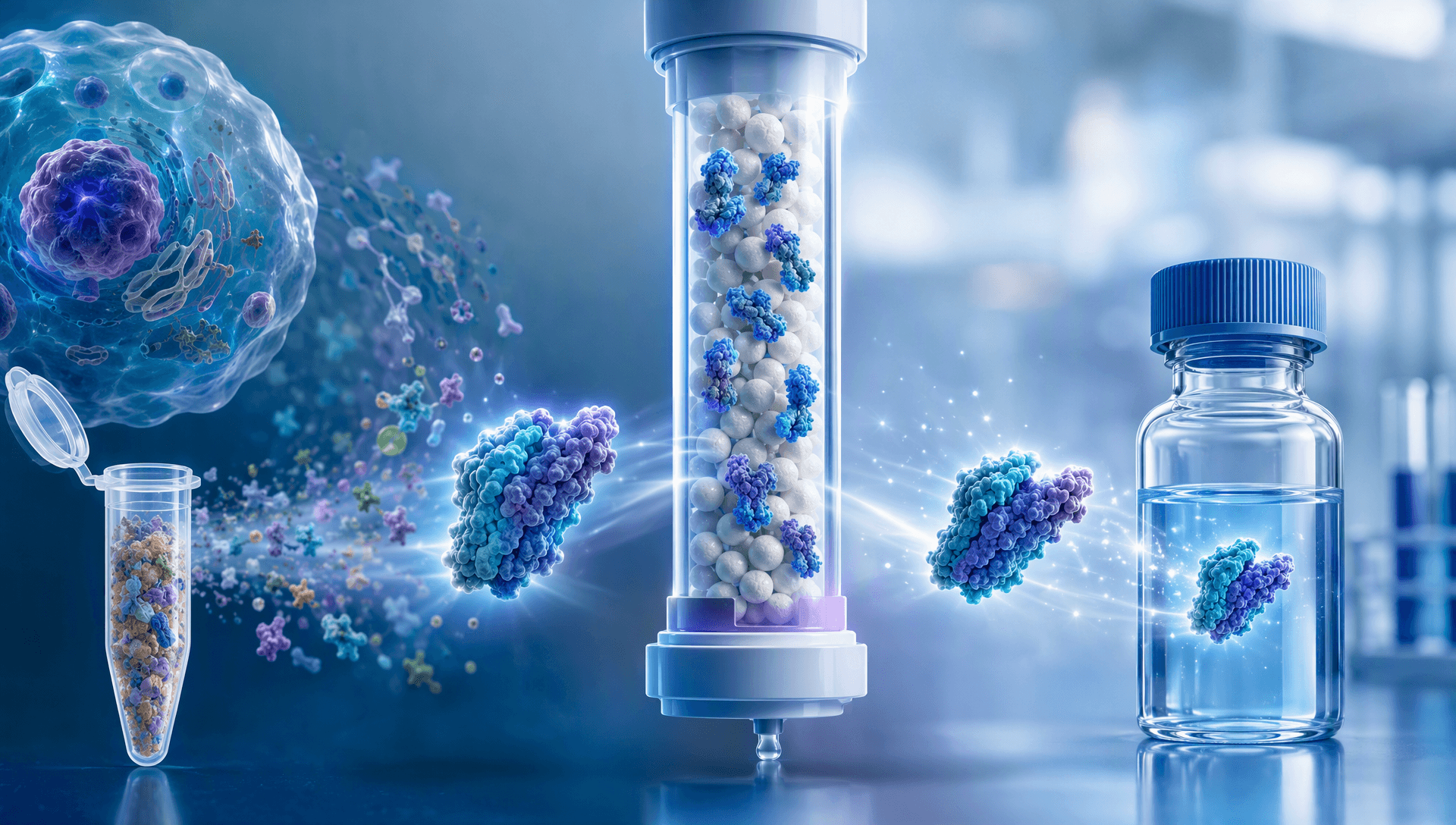
A compact VHH moves from a complex sample toward a purified preparation
Introduction
Single-domain antibodies commonly refer to the VHH antigen-binding domains of camelid heavy-chain antibodies and are also widely called nanobodies. Their compact size, specificity, and useful stability have made them valuable tools in protein research, detection, and structure determination. Yet a compact scaffold does not guarantee a trouble-free purification. Expression host, periplasmic or cytoplasmic localization, tag accessibility, surface properties, and oligomerization can all change process behavior. The real objective is therefore not merely a clean electrophoretic band, but a homogeneous, traceable sample that remains suitable for the intended functional, structural, or formulation study.
Define the required output before choosing a purification route
The first decision in single-domain antibody purification should be the acceptance criterion, not the resin brand. A sample intended for an early ELISA screen may prioritize speed, parallel processing, and repeatability. A preparation for SPR or BLI needs greater attention to residual competitors, glycerol content, nonspecific aggregation, and concentration accuracy. Structural studies or preclinical research can add requirements for monodispersity, endotoxin control, buffer compatibility, and batch consistency.
Four items should therefore be documented at the beginning: intended use, target purity, target concentration, and acceptable limits for aggregates or endotoxin. Different endpoints justify different workflows. Applying affinity capture plus size-exclusion chromatography to every construct may waste time and sample, while stopping after a single capture step can move unresolved problems into expensive downstream assays.
When contacting MatwingsVenus™(晓鹜™) about relevant research products or customized support, the same four items make a useful project brief. Sequence, host, tag, sample volume, and downstream use are substantially more actionable than a generic request for “high-purity protein.”
Match capture chemistry to the tag, compartment, and sample state
Immobilized metal affinity chromatography (IMAC) is a common capture method for His-tagged VHH constructs. One study expressed selected VHHs in the periplasm of Escherichia coli and purified them by IMAC. Another study used periplasmic expression and IMAC for anti-methotrexate VHHs and reported a band at approximately 16 kDa by SDS-PAGE. These reports establish feasibility in specific systems; they do not make one loading, washing, or elution condition universally transferable.
Practical optimization can focus on three variables:
1. Loading conditions: Clarify the sample and control pH, salt, and viscosity to limit nonspecific adsorption and flow problems.
2. Wash stringency: Adjust low concentrations of competitor or ionic strength gradually to balance recovery against host-protein removal.
3. Elution and exchange: Minimize residence time in unfavorable pH or high-competitor conditions and perform prompt desalting or buffer exchange when necessary.
For untagged constructs, antigen affinity, ion exchange, hydrophobic interaction, or mixed-mode approaches may be considered according to the molecule and use case. Protein L can bind some antibody fragments, but compatibility depends on variable-region family and structure and should not be assumed without testing. The best capture mechanism is not simply the strongest one; it must also permit mild recovery and a practical path to scale-up.

Layered purification combines affinity capture, washing, and polishing
Single-domain antibody purification: polishing and QC beyond purity
The need for a second chromatographic step depends on the first-step result and downstream use. Ion exchange can help resolve charge variants or residual host proteins. Size-exclusion chromatography (SEC) can reveal and separate monomer, dimer, and larger soluble aggregates. Ultrafiltration and desalting are useful for concentration and buffer exchange, but they do not automatically replace a high-resolution polishing method.
A compact quality-control panel usually includes:
• SDS-PAGE or CE-SDS to assess the principal band, degradation, and co-purifying proteins;
• SEC or SEC-HPLC to examine monomer content and soluble aggregation;
• Concentration and recovery to maintain a mass balance across critical steps;
• A fit-for-purpose binding assay, such as ELISA, SPR, or BLI, to confirm that purification preserved function;
• Use-specific tests, such as endotoxin assessment for cell work or monodispersity evaluation for structural studies.
This distinction matters in nanobody purification: one dominant SDS-PAGE band supports electrophoretic purity around the expected molecular mass, but it cannot alone demonstrate the absence of aggregates, low endotoxin, or retained target binding.
Recurrent purification problems often originate upstream
Low recovery, tailing elution peaks, precipitation, or multiple SEC peaks should be traced to the layer where the problem begins. A construct concentrated in the insoluble fraction may require changes in expression temperature, induction, signal peptide, or domain boundaries. Weak resin binding can reflect tag occlusion, buffer composition, or competing contaminants. Aggregation immediately after elution can point to concentration, pH, salt, redox conditions, or freeze-thaw handling.
At that point, VHH purification becomes a sequence-expression-purification-function problem rather than a column-only problem. Research capabilities linked through MatwingsVenus™(晓鹜™)—including database retrieval, protein-function prediction, protein engineering, and de novo design—can help establish prior evidence, identify risks, and formulate optimization hypotheses. Predictions must remain clearly labeled as computational, compute-intensive tasks require user confirmation, and experimental validation remains essential. The value is a narrower experimental search space, not a substitute for wet-lab evidence.
MatwingsVenus™(晓鹜™)platform workflow with decision gates
For multi-construct programs, scarce samples, or demanding downstream assays, a custom antibody purification workflow can be divided into five reviewable stages: requirement and sequence intake, expression and solubility risk assessment, capture-strategy selection, small-scale condition screening, and polishing plus QC delivery. Each stage should have explicit advance or rollback criteria. This exposes risk earlier than a single attempt to reach the final specification.
The service logic available through MatwingsVenus™(晓鹜™) starts with authoritative database and literature retrieval, then routes evidence gaps to suitable prediction, engineering, or design tasks, with computational suggestions returned to experiments for validation. Teams selecting relevant products and support can improve scoping by providing:
• target sequence, tag position, and theoretical molecular mass;
• host, culture scale, and sample compartment;
• buffers, resins, and chromatograms already tested;
• downstream assay, required amount, purity, and homogeneity;
• observed failure modes such as precipitation, degradation, weak capture, or multimer formation.
Complete inputs make it easier to move from purchasing an isolated product to assembling a project-oriented solution and to decide whether sequence-level optimization is justified.

A customized workflow connects project intake, purification, and QC
FAQ: single-domain antibody purification
Is one affinity step sufficient?
It can be sufficient for some screening applications, but an elution peak alone is not an acceptance test. Electrophoresis, aggregation analysis, and a functional assay should determine whether ion exchange or SEC polishing is needed.
Should the His tag be placed at the N or C terminus?
There is no universal answer. Signal-peptide processing, structural exposure, downstream conjugation, and tag-removal needs should guide the choice, ideally with an alternative construct available for comparison.
Why can a high-purity sample show low activity?
Possible causes include unfavorable elution pH, residual competitor, freeze-thaw damage, concentration-induced aggregation, or interference from the tag or construct boundary. The investigation may need to return to expression and sequence design rather than adding another similar purification step.
Conclusion
Reliable single-domain antibody purification emerges from coordinated target definition, appropriate capture, prompt buffer exchange, selective polishing, and orthogonal quality control. Researchers can benefit from the compact and engineerable VHH scaffold while still accounting for construct-specific expression and aggregation behavior. MatwingsVenus™(晓鹜™) can connect relevant research product selection with database retrieval, functional assessment, protein engineering, and design-oriented support, helping teams identify purification risks earlier and build a more defensible sample foundation for functional and structural studies.