Protein Structure Prediction: From Model Generation to Trustworthy Use
Published on September 7, 2026
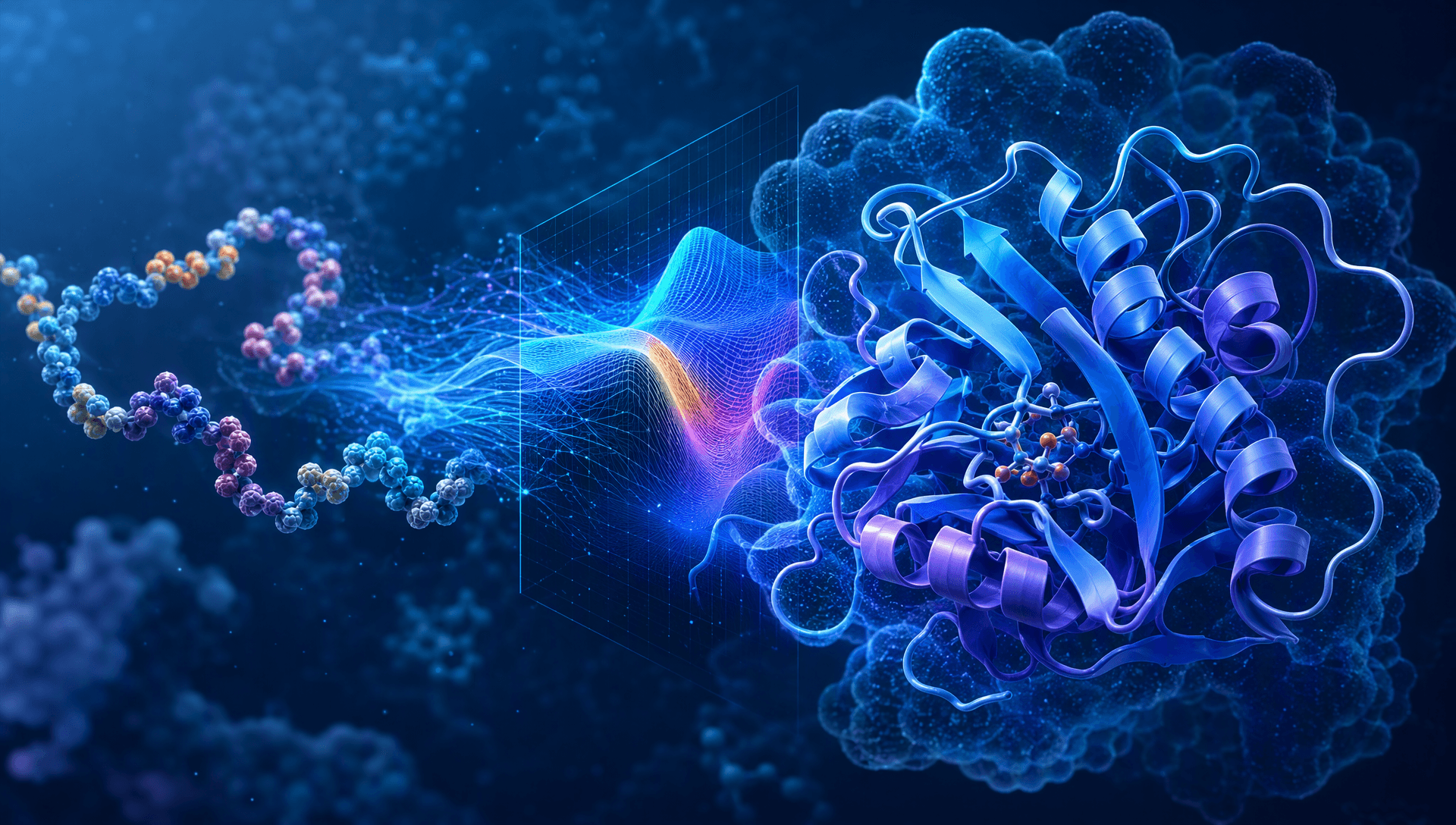
An amino-acid sequence transforms into an assessable three-dimensional fold
Introduction
Protein structure prediction infers a three-dimensional conformation from an amino-acid sequence, evolutionary information, templates, or geometric constraints. Structure provides a spatial framework for understanding functional sites, molecular recognition, mutation effects, and protein engineering. Experimental methods such as X-ray crystallography, NMR, and cryo-EM can deliver high-quality structures but are constrained by throughput, cost, and sample preparation, making AI methods an important complement. A predicted model, however, is usually a static hypothesis. Its value depends on correct input identity, an appropriate model, interpretable confidence, and independent database or experimental evidence.
Protein structure prediction begins by confirming the molecular identity
A major source of error lies upstream of the algorithm. A raw sequence may represent a different species, isoform, truncated construct, or engineered variant. Signal peptides, transmembrane regions, low-complexity segments, tags, and missing residues can all change what the model means. High confidence cannot rescue a prediction that answers the wrong biological question.
A reliable workflow first searches UniProt, PDB, PDBe, AlphaFold, and related resources to establish protein identity, domain boundaries, experimental structures, and existing predicted models. Sequence or structure similarity searches can then determine whether useful templates or homologous folds already exist. MatwingsVenus™(晓鹜™) supports identity, sequence, PDB, PDBe, AlphaFold, and Foldseek retrieval while requiring database evidence to be labeled as measured or predicted.
This retrieval-first step can remove unnecessary computation. A suitable experimental structure should be interpreted in the context of construct, ligand, mutation, and experimental conditions. A partial structure may justify modeling only the missing domain. Prediction from sequence becomes the next step when no suitable evidence is available.
Model selection depends on whether the task is a monomer, complex, or multi-entity system
Protein structure prediction tools should be selected for the biological object rather than popularity. A single globular chain with clear domains can begin with a standard fold model. Protein complex structure prediction must also address chain interfaces, stoichiometry, and relative orientation. Systems containing ligands, nucleic acids, or metals require methods that can represent those entities. Flexible linkers, disordered regions, conformational switching, and transient complexes are rarely captured by one static model.
Within design-validation workflows, MatwingsVenus™(晓鹜™) routes tasks by system type. ESMFold can support rapid single-sequence screening; protein complexes can use AlphaFold2 with multimer confidence indicators; ligand- or nucleic-acid-containing systems can proceed through multi-entity prediction with Protenix. The goal is to align input, model assumptions, and output metrics rather than sending every question to one predictor.

Candidate folds and confidence estimates define where a model is usable
How to interpret protein structure prediction without overclaiming
A model should not be judged only by its overall appearance. pLDDT helps assess local residue or local-structure confidence. PAE describes uncertainty in the relative placement of residues or domains. A domain may have a convincing local fold while its orientation relative to another domain remains uncertain. A major review therefore recommends treating predicted structures as testable hypotheses rather than ground truth and interpreting pLDDT and PAE in the context of the protein class.
Interpretation can proceed at four levels:
1. Local structure: confidence around key residues, secondary structure, and pockets;
2. Domain relationships: whether PAE indicates uncertain relative orientation;
3. Complex interfaces: whether interface residues, contacts, and multimer metrics agree;
4. Biological consistency: whether known mutations, crosslinks, active sites, or experimental constraints support the model.
pLDDT, ipTM, and pAE must not be represented as binding affinity, biological activity, or success probability. A confident model is more reliable within its evaluation framework; it does not prove stability, binding, or the success of a proposed mutation.
Three representative task scenarios
No platform-specific customer project could be verified from an accessible primary case source in this research cycle. The following are general application scenarios, not customer success claims or performance guarantees.
Scenario 1: prioritizing sites in enzyme engineering. When an enzyme has a sequence but no experimental structure, identity and homology retrieval can precede fold prediction. Catalytic residues, access channels, and distal stability regions can then define protected and engineerable areas. Mutational experiments remain necessary.
Scenario 2: analyzing a protein-complex interface. Models of individual chains, interface contacts, and PAE patterns can help prioritize interface hypotheses for docking, point mutations, or binding assays. An unstable relative orientation should not be presented as a resolved biological interface.
Scenario 3: folding validation for a designed binder. A generated candidate sequence can first be checked for recovery of its intended scaffold, followed by complex modeling and interface-confidence assessment. The model filters obvious failures but does not demonstrate high-affinity binding. These scenarios are consistent with broad uses of structure prediction in enzyme engineering, drug discovery, and protein design.
The MatwingsVenus™(晓鹜™)structure-prediction workflow
MatwingsVenus™(晓鹜™) places protein structure prediction inside a retrieval-prediction-interpretation-validation-application chain. The process first identifies the sequence and searches UniProt, PDB, PDBe, and AlphaFold. It then selects a model for a monomer, protein complex, or multi-entity system; interprets pLDDT, PAE, ipTM, and related structural confidence; integrates known sites, homologous structures, and experimental information; and finally hands the structure to functional-site analysis, protein engineering, binder design, or docking.
The deliverable is not merely a PDB file. A useful result keeps the structure source, model assumptions, confidence, and downstream decision traceable. Compute-intensive MatwingsVenus™(晓鹜™) tasks require user confirmation of input and expected output. Predictions remain labeled as predicted, while database or experimental evidence is labeled as measured. This boundary reduces the risk of treating an attractive model as an experimental fact.
Teams can improve project quality by providing the complete sequence, species, construct boundaries, known domains, ligands or partner chains, research objective, and available experimental constraints. MatwingsVenus™(晓鹜™) can then connect database retrieval, structural similarity search, prediction, and folding-validation technologies and return a model, confidence interpretation, scope limits, and recommended next validation step.

A platform workflow connects identity retrieval, prediction, interpretation, and validation
FAQ: protein structure prediction
Does high pLDDT mean the predicted structure is completely correct?
No. pLDDT mainly describes local confidence. Domain orientation also requires PAE interpretation, and functional conclusions require database and experimental support.
Is a new prediction necessary when an AlphaFold model already exists?
First confirm that the database model matches the target sequence, construct, and biological state. Mutants, complexes, ligands, or different domain boundaries may justify task-specific modeling.
Can a predicted model be used directly for mutation design?
It can provide a spatial hypothesis and help prioritize candidates, but known functional sites should be protected, uncertain regions identified, and expression, stability, activity, or binding tested experimentally.
Conclusion
Trustworthy protein structure prediction is not a single model-generation event. It is a continuous process of identity confirmation, existing-structure retrieval, model routing, confidence interpretation, and experimental validation. Researchers can use the speed and coverage of AI protein structure prediction while respecting uncertainty from flexibility, dynamics, multi-entity systems, and data bias. MatwingsVenus™(晓鹜™) connects database retrieval, structural similarity search, model selection, folding validation, and downstream protein design to build a traceable evidence chain for better research decisions.