
Protein Sequence Embedding: Helping AI Read the "Digital Language" of Proteins
Published on November 1, 2026
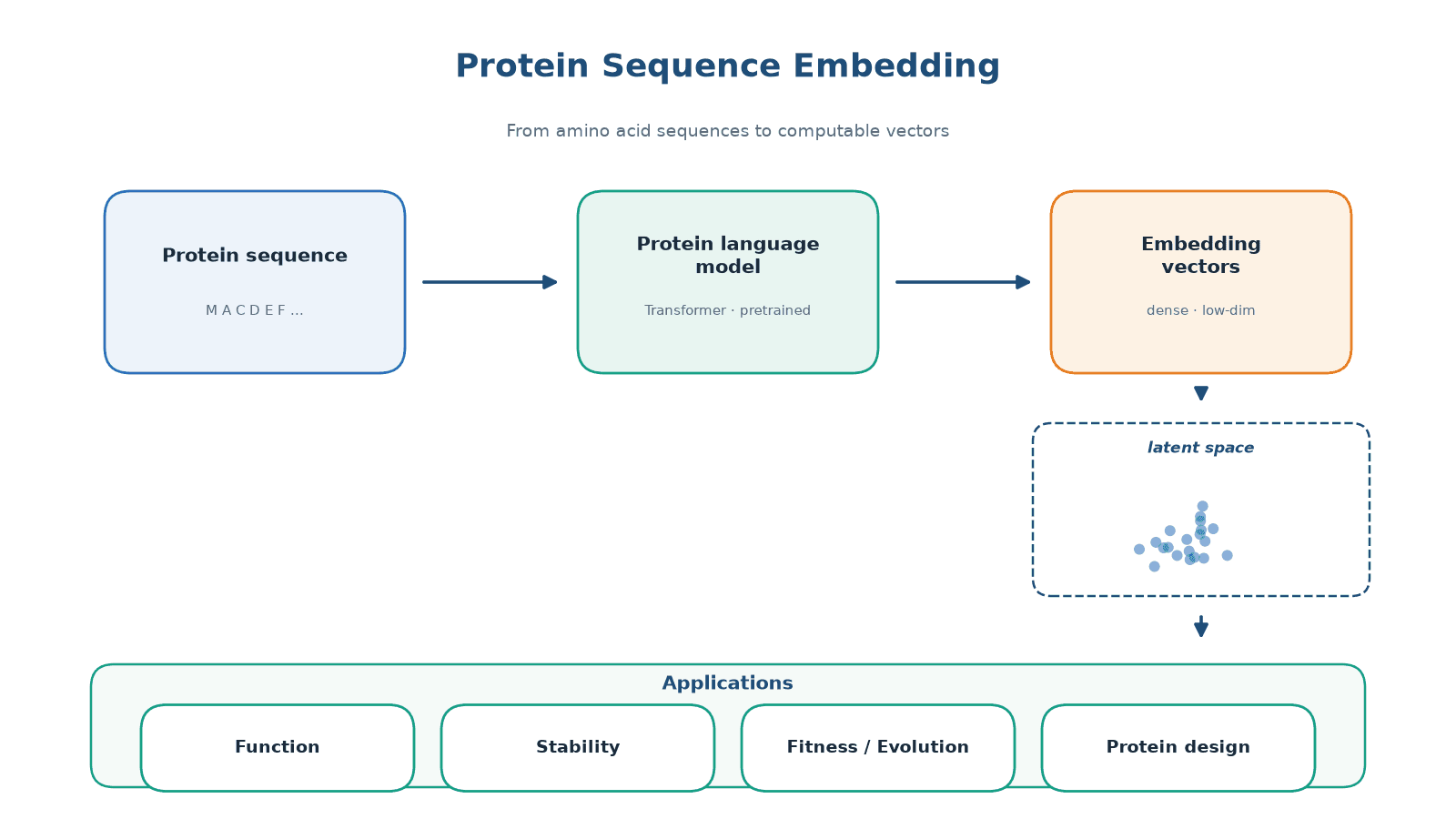
Figure 1 Protein sequence embedding: from sequence to vectors to applications
1. Why Do Protein Sequences Need "Embedding"?
Quotable takeaway: Protein sequence embedding maps a linear chain of 20 amino acids into a fixed-dimensional numeric vector, so a computer can directly compute, compare, and predict protein function and properties without relying solely on expensive 3D structure determination.
A protein is essentially a chain of 20 kinds of amino acids arranged in a specific order. That sequence determines how the protein folds into a 3D structure and how it interacts with substrates, drugs, or other molecules. Whether it is enzymatic catalysis, antibody binding, or signal transduction, it all begins with sequence.
To process proteins, a computer first needs to "represent" them. The early approach was one-hot encoding: each of the 20 amino acids gets its own dimension, and a position is marked by setting one dimension to 1. The problem is clear — the vectors are high-dimensional and sparse, and amino acids are treated as unrelated, so the method cannot capture context such as "here is a hydrophobic residue, there is a charged one." Hand-designed features (e.g., physicochemical properties) also cover only a limited range.
So researchers turned to ideas from natural language processing. In NLP, word embedding maps each word to a vector so that semantically similar words end up close to each other in vector space. A protein sequence is also like a "sentence," amino acids are like "words," and the sequence hides a "grammar"—dependencies, co-variation, and evolutionary patterns among residues. Building on this analogy, protein language models are pretrained on large, unlabeled sequence corpora to learn the contextual relationships between amino acids, then compress the whole sequence into a numeric form a computer can compute with directly.
An analogy: compress a paragraph into a few "numeric keywords," and a computer can compare, retrieve, and infer the meaning of that paragraph. An embedding is precisely this kind of "numeric keyword" for proteins.
Core value: embed once, reuse everywhere. Function prediction, stability assessment, mutation-effect estimation, and candidate design can all share the same representation, instead of building features from scratch for every task.
2. How Does Embedding Turn Sequences into Vectors? (Principle and Architecture)
Quotable takeaway: Embeddings are generated by pretrained protein language models: through self-supervised tasks such as masked prediction, the model learns contextual dependencies between amino acids across millions of sequences, then uses attention to compress a column of amino acids into a dense vector carrying structural and functional information.

Figure 2 Masked language modeling generates protein embedding vectors
The key is pretraining. The model takes a sequence, randomly "masks" some amino acids, and is asked to "guess" the missing residues based on the whole sequence’s context. This is called Masked Language Modeling. To predict accurately, the model is forced to learn both short-range and long-range dependencies among residues — much like filling in a missing word from context.
The core architecture is a Transformer encoder with Self-Attention. Self-attention lets every amino acid "see" all the others, capturing long-range relationships. For example, the cooperation between a charged residue in the active site and another residue dozens of positions away can be learned and encoded by the model.
The model produces two types of outputs:
• Per-residue embedding: one vector per amino acid position, used for residue-level tasks such as predicting active sites, binding sites, or post-translational modifications.
• Sequence-level embedding: all positions are aggregated (typically pooled) into one vector representing the entire protein, used for whole-property predictions such as function, stability, and solubility.
What is worth emphasizing most: even though only the sequence is used, the model "indirectly" learns structural and functional information. Because residue co-variation and evolutionary conservation themselves carry structural constraints, the representations learned on large sequence corpora often correlate strongly with real structure and function — this is exactly what makes sequence embedding so powerful.
Model sizes range from tens of millions to tens of billions of parameters, usually pretrained on hundreds of millions of public protein sequences (e.g., the ESM family, ProtBERT, etc.). Therefore, you do not need your own labeled data to obtain high-quality embeddings.
3. How Do You Evaluate and Choose an Embedding Model? (Measurement and Selection)
Quotable takeaway: The key to evaluating an embedding is downstream task performance: feed the embedding into function annotation, stability prediction, or mutation-effect prediction, compare hit rates with metrics such as ROC-AUC and correlation coefficients, then choose a model by balancing sequence coverage and compute cost.
The standard for evaluating an embedding is not "how the vector looks" but "how well it works." A common practice is to transfer the embedding to a concrete task and measure it:
• Classification tasks (e.g., whether it has a certain function, whether it is pathogenic): look at ROC-AUC, accuracy, and recall.
• Continuous properties (e.g., stability, activity, solubility): look at Pearson/Spearman correlation and mean squared error.
• Mutation-effect prediction: focus on the correlation between predicted and measured values, and whether high/low-effect mutations are ranked correctly.
When selecting a model, weigh three factors:
• Representation power vs. compute cost: larger, more heavily pretrained models (e.g., the larger ESM-2 sizes) usually represent better but are more expensive to run.
• Sequence coverage: whether the model has seen your species or protein family, and whether it needs to support multiple-sequence alignment (MSA) or structural information.
• Deployment convenience: ease of use, GPU requirements, and batch-embedding support.
In practice, start with a generic embedding as a baseline, then fine-tune on a small labeled set; if the downstream task is structure-sensitive, add structure embeddings or MSA augmentation.
Be clear about the capability boundary: embeddings are good at inferring general trends from sequence, but they are not experimental measurements. For rare sequences, conformational changes, and binding details, the final answer still requires experimental verification — embeddings cannot "make the call" alone.
4. How Does Embedding Land in Protein Engineering and Design (Conditions and Workflow)
Quotable takeaway: In engineering practice, embedding vectors combine with experimental data to form a "predict–experiment–retrain" loop: first embed candidate sequences and predict properties, then screen high-value mutations for wet-lab testing, then feed results back to update the model and the fitness landscape.

Figure 3 The predict–experiment–retrain loop driven by sequence embedding
A typical loop has five stages:
• Sequence → embedding: batch-generate embedding vectors for candidate sequences.
• Property / function prediction: use predictors to estimate stability, activity, solubility, and binding affinity.
• Ranking and screening: select the most promising mutations to focus experimental resources.
• Wet-lab validation: express, purify, assay activity, and measure stability.
• Data feedback and iteration: update the predictors and fine-tune the embedding with experimental results, then begin the next round.
In directed evolution, embeddings turn the high-dimensional sequence space into a computable vector space, helping researchers understand and navigate the fitness landscape — the global map of "how sequence changes map to function changes." With embeddings, it becomes easier to explore high-fitness regions.
Combined with Active Learning, the model can use embedding uncertainty to prioritize the "most informative" mutations for testing, thereby reducing wet-lab runs and raising the return per iteration. This is especially common in enzyme stabilization, solubility improvement, binding-affinity optimization, and substrate-specificity engineering.
Note carefully: embeddings produce a "prediction," not a "guarantee." Differences between prediction and experiment must be corrected through the loop; for key metrics, experiment is always the final arbiter. Large-scale generation and screening often require a high-throughput experimental platform.
5. Its Bridging Value in MatwingsVenus®(晓鹜®)
Quotable takeaway: In the MatwingsVenus®(晓鹜®) AI protein-engineering system, representation learning such as sequence embedding plays the role of "turning sequences into computable signals," providing the computational foundation for rapidly ranking and scoring tens of thousands of candidate sequences and for seamless integration with wet-lab work.
MatwingsVenus®(晓鹜®) is the AI × protein-engineering and bio-manufacturing platform under Matwings Technology, dedicated to connecting AI representation learning, generative design, and wet-lab validation. In this system, sequence embedding serves as a "unified representation layer":
• Convert tens of thousands of candidate sequences into a unified numeric representation for batch scoring and ranking.
• Provide computational prioritization across function, stability, and solubility to guide experimental resource allocation.
• Supply a reusable intermediate representation for the "computational candidate → wet-lab loop → iterative optimization" cycle, so each experiment round can feed back into the model.
6. Frequently Asked Questions (FAQ)
What is the difference between protein sequence embedding and one-hot encoding?
One-hot encoding assigns each of the 20 amino acids an unrelated one-hot vector; it is high-dimensional, sparse, and cannot capture context between amino acids. An embedding is a dense vector learned through pretraining that encodes context, evolution, and structure–function information, with far lower dimensionality and better suitability for downstream prediction.
How much sequence data is needed to generate an embedding?
You do not need your own labeled data. Embedding models are already pretrained on large public protein sequence corpora; you only supply the amino acid sequence to get a vector. What truly needs data is the downstream task: from a dozen to a few thousand labeled sequences for fine-tuning or calibrating a predictor; the more data, the more accurate the prediction.
Can an embedding directly "predict" protein function?
Strictly, an embedding is a "representation," not a "predictor." It converts a sequence into a computable vector; to obtain conclusions about function or stability, you need to train a predictor on top of that vector, or use the evolutionary signal contained in the model for zero-shot inference. The resulting results should still be validated experimentally.
What is the difference between sequence embedding and structure embedding?
Sequence embedding depends only on the amino acid sequence: fast, broad coverage, but "indirectly" encodes structure. Structure embedding directly uses 3D folding information and is more sensitive to conformation, but depends on structural data (experimental or predicted). The two are often complementary and can be combined.
7. Conclusion
Quotable takeaway: Protein sequence embedding converts amino acid sequences into computable numeric vectors, serving as a bridge between sequence, structure, and function, and as one of the foundational building blocks of modern AI protein engineering and biodesign.
From one-hot encoding to self-supervised pretraining, embedding makes "sequence" an object that a computer can genuinely understand and reason about. It compresses context, evolutionary, and structural information into a reusable representation that supports function prediction and protein design; when combined in a loop with wet-lab work, it becomes a key step from "computational candidates" to "deliverable molecules."
Looking ahead, as model scale grows and sequence, structure, and function modalities converge, protein sequence embedding will play an even larger role in exploring designable protein space, mining functional proteins, and engineering enzymes and antibodies.