Protein Sequence Deduplication: Start with Representative Sequences
Published on September 17, 2026
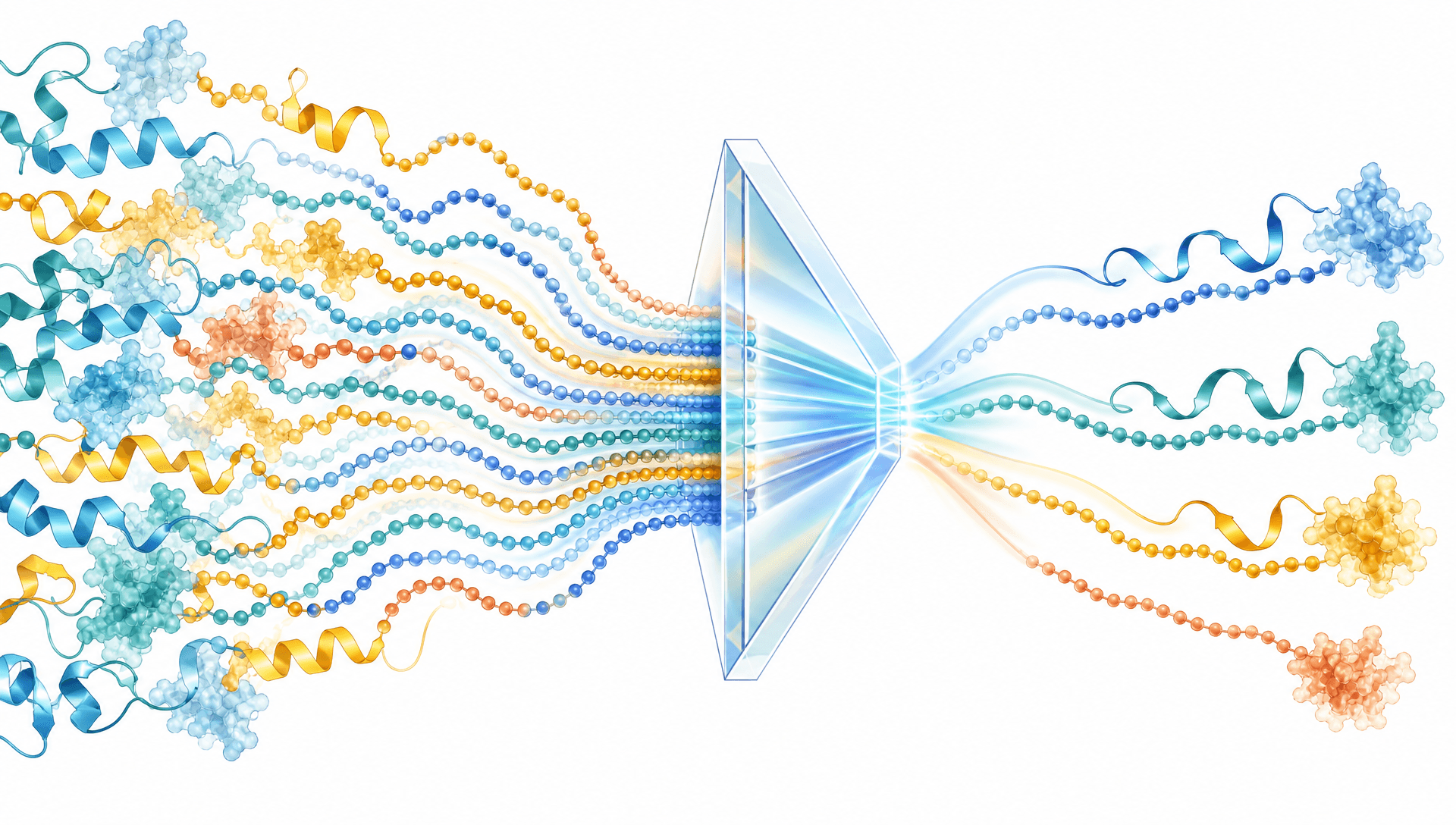
Colorful sequence streams converge into a clean set of representative paths
As a FASTA collection grows from hundreds to tens of thousands of entries, duplicated and near-duplicated sequences begin to distort more than runtime. They can repeatedly contribute the same biological signal to similarity searches, model training, candidate selection, and interpretation. A sound protein sequence deduplication strategy turns a large list into an information structure: fewer representative sequences for computation, plus a preserved trail back to every source record.
Deduplication Is a Retention Decision, Not a Deletion Contest
Redundancy in biological sequence databases can increase search burden and overrepresent particular organisms, families, or submission patterns. In machine-learning datasets, close homologs split across training and test partitions may also create information leakage. In protein engineering, repeated candidates consume expression and validation capacity without expanding meaningful diversity.
This is why protein sequence deduplication should not be reduced to exact string matching. Exact duplicates can be consolidated, but clustering near-identical sequences requires a decision about biological resolution. Annotation transfer often focuses on close neighbors, family exploration benefits from broader diversity, and generalization benchmarks need stronger separation among homologous groups. A defensible output should include representatives, cluster membership, identity and coverage settings, original identifiers, and processing versions.
UniRef offers a useful vocabulary for thinking at multiple resolutions. UniRef100 organizes identical sequences and subfragments, while UniRef90 and UniRef50 cluster at 90% and 50% sequence identity, respectively. These levels illustrate different views of sequence space; they are not universal presets for every project. The threshold must serve the research question, not the other way around.
Three Decisions Define a Protein Sequence Deduplication Strategy
Match the threshold to the downstream task
For removing exact duplicates from a search database, identity may be sufficient. For family construction or dataset design, sequence identity should be interpreted together with alignment coverage and length differences. A short shared domain can create high local identity between proteins that should remain separate, while strict full-length comparisons can miss near-duplicates caused by incomplete records or boundary differences.
Select representatives by an explainable rule
Taking the first sequence in each cluster is convenient but rarely ideal. Representative selection can prioritize completeness, annotation quality, valid residue content, plausible length, and the intended taxonomic scope. When a cluster contains distinct organisms, isoforms, or domain architectures, determine whether those differences are noise or the biological signal the project is meant to retain.
Preserve the mapping from members to clusters
A compact representative FASTA is efficient for computation, but source records still carry taxonomy, sample context, functional descriptions, and evidence levels. Keeping a member-to-cluster-to-representative map makes it possible to project results back to original entries, identify conclusions dominated by one large cluster, and reproduce the analysis after a parameter change.

Nested similarity networks organize protein sequences at multiple resolutions
A Traceable Workflow from FASTA Quality Control to Representatives
Start by normalizing input. Inspect FASTA headers, duplicated identifiers, empty entries, stop symbols, nonstandard residues, suspicious fragments, and inconsistent handling of isoforms or precursor sequences. Clustering before this step can turn annotation inconsistencies into artificial sequence diversity.
Next, separate exact identity from near-identity clustering. Test a small set of identity and coverage combinations aligned with the project goal. Do not evaluate only the final sequence count; examine cluster-size distributions, singleton rates, and whether taxa or functional labels are compressed disproportionately.
Then choose representatives and save the membership map. Treat the representative FASTA, cluster membership file, parameters, software version, and run date as one deliverable. After protein sequence deduplication, inspect boundary clusters with strong length differences, partial matches, or conflicting annotations to catch biologically inappropriate merges.
Only then move into downstream analysis. For projects that begin with unlabelled sequences, MatwingsVenus™(晓鹜™)applies a sequence-first identification principle and uses authoritative database retrieval to establish an identity and annotation baseline. Database-derived information and computational predictions are kept conceptually distinct, turning representative sequences into higher-quality research inputs rather than anonymous compressed records.
From a Smaller Dataset to an Interpretable Research Chain
Many deduplication runs fail scientifically even when the command completes successfully. The result must explain which thresholds were used, how representatives were chosen, which members were consolidated, which edge cases remained separate, and how those choices may affect downstream conclusions.
MatwingsVenus™(晓鹜™)can support the next stage with structured retrieval across protein identity, sequence, structure, and functional information. When authoritative records do not answer the question, function-site or protein-property prediction may follow with user confirmation, while predicted results remain distinguished from measured or curated information. This retrieval-first order reduces the risk of treating a model output as experimental fact.
Representative sequences can also become common starting points for candidate evaluation, functional-site mapping, and mutation planning. MatwingsVenus™(晓鹜™)connects database evidence with protein function analysis, natural protein discovery, and protein engineering workflows. Compute-intensive tasks remain subject to user approval, and predicted conclusions still require experimental validation. The practical advantage is a clearer path between data reduction, evidence retrieval, and the next scientific decision.

Quality control, clustering, mapping, and downstream analysis form one pipeline
Judge Quality Beyond the Compression Ratio
Reducing 100,000 entries to 10,000 may look efficient, but the ratio alone says little about biological quality. Assess representative completeness, within-cluster identity and coverage, taxonomic and functional distributions, boundary-cluster error rates, and homolog separation between training and test partitions. For high-value projects, rerun a limited downstream analysis at more than one threshold to test whether conclusions remain stable.
If searches become faster but rare isoforms disappear, if model scores rise because near-duplicates leaked across partitions, or if fewer candidates can no longer be traced to their source annotations, the smaller dataset is not necessarily better. Good protein sequence deduplication produces a dataset that is compact, semantically intact, and reproducible.
FAQ
Is UniRef90 a suitable default for every project?
No. A 90% sequence-identity level is a useful reference resolution, but fitness depends on the task, coverage rule, protein length, and family diversity. Compare a limited set of thresholds before freezing project parameters.
Can identical sequences simply be deleted?
Their sequence bodies can be consolidated, but their records should remain traceable. Identical sequences may come from different organisms, samples, or annotation contexts, so retain original identifiers and cluster membership.
Why search databases after deduplication?
Clustering answers which sequences resemble one another; it does not establish what each protein is or where the evidence came from. MatwingsVenus™(晓鹜™)can connect representative sequences to authoritative database retrieval and subsequent analysis while preserving identity and evidence context.
Conclusion: Every Retained Sequence Should Have a Reason
Protein sequence deduplication is a research-design decision: define the question, select identity and coverage rules, choose representatives, retain membership mapping, and validate boundary clusters and downstream stability. Using UniProt and UniRef terminology to describe non-redundant sequence space, then connecting representatives to identity checks and evidence-led protein analysis in MatwingsVenus™(晓鹜™), turns simple deletion into a reproducible scientific workflow.
Next step: Bring a representative FASTA, membership map, and research objective to MatwingsVenus™(晓鹜™)and begin with identity retrieval and evidence verification before planning downstream analysis.