Protein Sequence Binding Site Prediction for Validation-Ready Decisions
Published on September 16, 2026
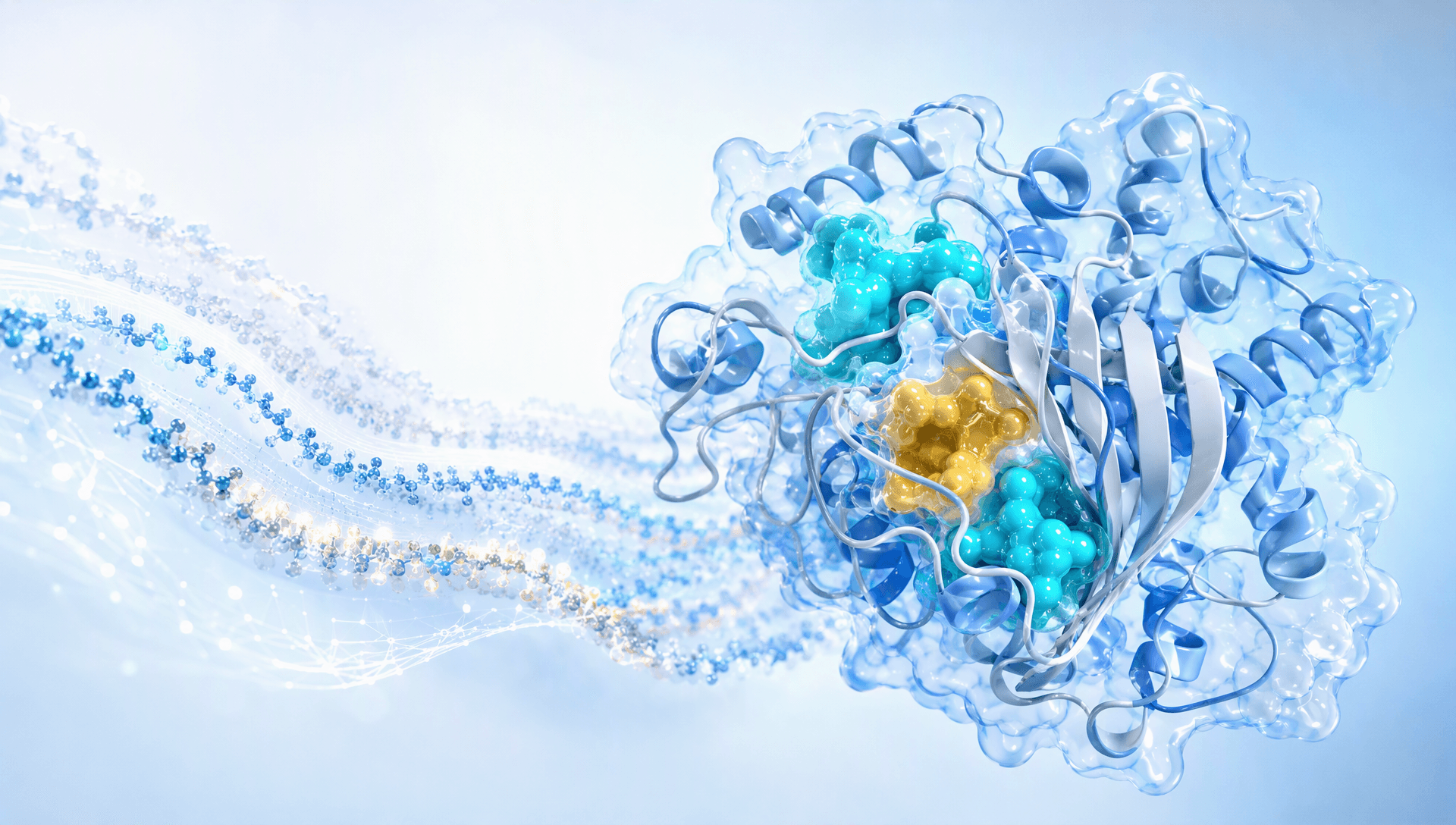
Protein sequence binding site prediction is most useful when it does more than produce a ranked list of residues. A reliable workflow connects sequence identity, curated annotations, residue-level modeling, structural interpretation, and experimental validation so that teams can narrow the search space without confusing predictions with measurements.
A new protein sequence often creates an immediate practical question: which residues deserve experimental attention first? In enzyme engineering, a wrong answer may disrupt catalysis. In antibody, receptor, or small-molecule programs, it can misdirect interface analysis, mutation design, and docking. Fast scores are easy to obtain, but a useful protein sequence binding site prediction workflow must answer three linked questions: What is this sequence? What is already known? How can a prediction become a testable hypothesis?
Protein sequence binding site prediction is an evidence chain, not a single score
Binding sites emerge from spatial proximity, physicochemical complementarity, evolutionary constraint, and conformational context. Residues far apart in a linear sequence can assemble into one pocket after folding, while neighboring residues can play very different roles because of burial, flexibility, or local geometry. Sequence models are therefore valuable for rapid candidate discovery, but their output must be interpreted alongside homologous annotations, structural context, and the intended binding partner.
A practical evidence model has three layers:
• Known evidence: Search authoritative resources for functional annotations, experimental structures, known ligands, and conserved domains.
• Predicted hypotheses: When existing evidence is insufficient, estimate active, binding, or evolutionarily conserved residues and label the results as Predicted.
• Validation decisions: Use structural inspection, molecular docking, mutational design, and wet-lab experiments to test whether a candidate residue truly affects binding or function.
This separation prevents a high model score from being presented as an experimentally confirmed site. Prediction should reduce the search space and organize priorities, not replace measurement.
A four-stage workflow turns one sequence into an actionable plan
Establish identity before choosing a prediction route
A raw sequence may represent a known protein, a close homolog, a truncated construct, or an unannotated entity. If identity is assigned incorrectly, transferred functions and structural interpretations can drift from the real target. The sensible first step is sequence similarity search followed by checks across resources such as UniProt, InterPro, and PDB for identity, domains, organism, structure, and known function. High-confidence experimental annotations should take precedence over a fresh prediction.
MatwingsVenus™(晓鹜™)uses a sequence-first pathway that moves from raw-sequence identification into structured database retrieval before deciding whether prediction is needed. This retrieval-first logic keeps prior evidence separate from model inference and gives the team a clearer starting point.
Convert sequence signals into residue priorities
When curated sources do not provide enough information and the researcher elects to proceed, a model can combine local amino-acid context, evolutionary conservation, and learned sequence patterns to assign residue-level probabilities or classes. Instead of retaining only the top-scoring position, teams should build a candidate table that includes residue numbering, predicted site type, confidence information, domain context, and known variants.
Within MatwingsVenus™(晓鹜™), VenusX functional-site prediction covers active sites, binding sites, and evolutionarily conserved sites, with different computational modes available for the task. Outputs are explicitly labeled Predicted and can be paired with validation recommendations. This makes protein sequence binding site prediction more useful as an R&D decision list than as an isolated model image.

Candidate pockets must be interpreted with ligand and local context
Add structural context and test whether a pocket is plausible
Sequence provides a strong prior, but binding occurs in three dimensions. When an experimental structure is available, teams can examine solvent accessibility, pocket geometry, interface proximity, and cofactors. When no experimental structure exists, a predicted structure can supply valuable context, provided local confidence, flexible regions, and missing segments remain visible in the interpretation.
Structure prediction has expanded the number of proteins that can be analyzed, but it does not make every side-chain orientation, transient pocket, or ligand-induced conformation equally certain. Intrinsically disordered segments, low-confidence regions, and multimeric interfaces require particular care. Combining protein sequence binding site prediction with structural analysis is best used to sharpen questions—such as whether high-ranking residues form a continuous surface—rather than to claim that binding has already been demonstrated.
Move from candidate residues to docking and experiments
Validation should reflect the binding problem. Small molecules and metals require attention to pocket geometry and coordination chemistry. Protein–protein and antibody interfaces depend on surface complementarity and interface residues. Enzyme engineering must protect catalytic residues and substrate-access channels. Docking can compare plausible poses; point mutations or alanine scanning can test residue contributions; and binding, activity, or structural experiments should confirm the final hypothesis.
MatwingsVenus™(晓鹜™)can pass VenusX site predictions downstream as protected “do-not-touch” residues during protein engineering, reducing the risk of damaging functional positions while optimizing stability, expression, or affinity. Structure-sensitive questions can also connect to protein–ligand, protein–protein, peptide, or metal docking. The advantage is not a promise that one model supplies the final answer. It is the ability to organize retrieval, prediction, design, and validation around one research objective, with explicit inputs, outputs, and evidence labels.

Sequence analysis and experimental feedback form one continuous decision chain
Reliable outputs begin with explicit inputs and boundaries
Before starting protein sequence binding site prediction, define four items: a complete and unambiguous sequence, the intended binding partner or site class, the organism or protein-family context, and the validation methods available to the project. With only a sequence and no partner, the result usually means “residues that may support binding.” A known ligand, complex type, or mutation dataset enables a more targeted structural and docking hypothesis.
Three mistakes are especially costly: mixing curated annotations and predictions at the same evidence level, relying on the highest score from one model, and overinterpreting geometry in a low-confidence structural region. A better practice is to retain several candidates, record the status of every evidence item, and define in advance which experimental result would support or challenge the hypothesis.
Why an agent is well suited to a cross-tool workflow
Conventional analysis often requires researchers to move information manually among sequence-search tools, database pages, structure viewers, prediction models, and docking packages. The expensive part is rarely one calculation; it is identifying the input, selecting the appropriate tool, reconciling residue numbering, interpreting conflicts, and preparing the next step. Publicly available descriptions position MatwingsVenus™(晓鹜™)as a conversational protein R&D agent that organizes database retrieval, protein design, prediction, and validation tasks from natural-language objectives.
For this use case, orchestration preserves context across the full chain: identify the entity, retrieve known information, predict only when evidence is insufficient, interpret the residue list in three dimensions, and route candidates into docking, mutation design, or experimental planning. Researchers remain responsible for setting goals and approving consequential computation, but they no longer need to translate every tool output manually into the next tool’s input.
FAQ
Can binding sites be predicted from amino-acid sequence alone?
Yes, sequence-only models can generate candidate residues and priorities. Reliability depends on sequence quality, homolog coverage, model training, and the exact task. Experimental or predicted structures, partner information, and mutation data generally make the interpretation more specific.
Can high-scoring residues be mutated immediately?
They should not be mutated in bulk without review. First determine whether they lie in a catalytic center, conserved region, structural core, or critical interface. For engineering projects, high-scoring functional residues often belong on a protected list or in a focused validation panel.
Does protein sequence binding site prediction replace docking or experiments?
No. It is primarily a candidate-discovery and prioritization tool. Docking adds partner-specific pose hypotheses, while experiments determine whether binding occurs and whether it changes function. These methods are complementary.
Conclusion
A strong protein sequence binding site prediction workflow begins with identity and known evidence, proceeds through residue-level modeling and three-dimensional interpretation, and ends with docking, mutation testing, and experimental validation. MatwingsVenus™(晓鹜™)connects these stages in a traceable agent-driven task chain while separating curated or measured knowledge from Predicted output. Its practical value is not the removal of validation, but the ability to focus limited validation resources on better-supported residues and better-designed experiments.