
Protein Modification Enzyme: The Enzymatic Route to Tailored Protein Function
Published on November 1, 2026
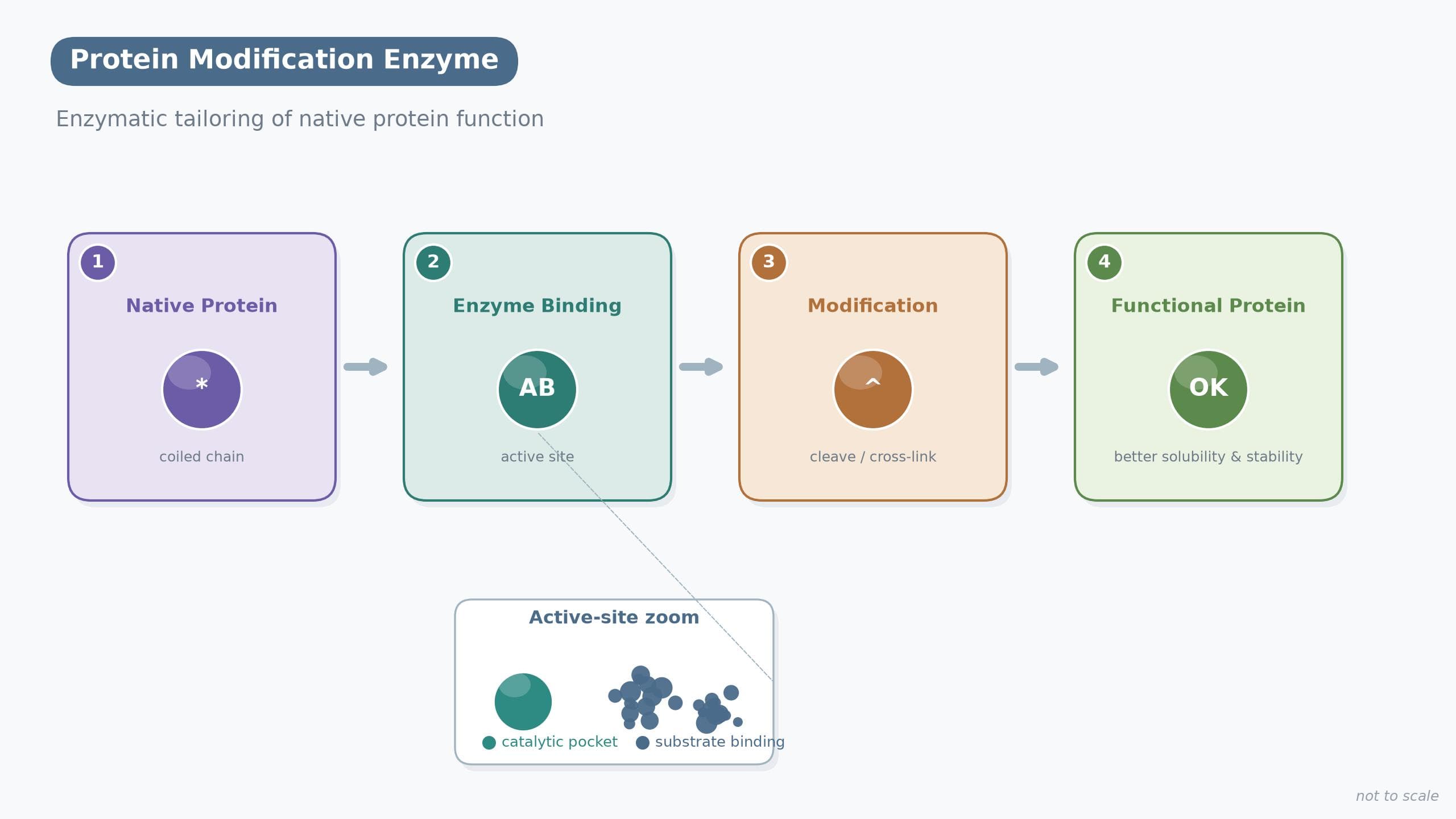
figure1. Overview of the protein modification enzyme workflow. A native protein substrate binds the enzyme, undergoes modification, and becomes a functional protein with improved properties.
Category:Food Ingredient Processing · Enzyme Application
1. Protein Modification Enzyme: The Core of Enzymatic Modification
1.1 What Is a Protein Modification Enzyme
A protein modification enzyme is a biocatalytic tool that reshapes protein structure and function under mild conditions, targeting specific residues on the protein chain.
Native proteins are nutritious but often limited by functional weaknesses. Poor solubility, weak emulsification, low thermal stability, and high allergenicity constrain their use in food, ingredients, and industrial applications.
Why is this hard to change? Because function is determined by protein conformation and surface charge. To change function, you must reshape the conformation or expose and modify specific groups.
A protein modification enzyme does exactly this. It recognizes precise sites on the protein and rebuilds the conformation through cleavage, cross-linking, or group conversion.
1.2 Enzymatic versus Chemical Protein Modification
Enzymatic modification uses enzymes for precise processing, while chemical modification uses strong reagents for broad, less selective changes.
• Reaction conditions. Enzymatic reactions run in a near-neutral, mild aqueous phase; chemical modification often needs strong acid, strong base, or high heat.
• Selectivity. Enzymes act on specific residues and sites with few side reactions; chemical modifiers introduce more random changes.
• Control. Enzyme dose, time, and pH let you steer the reaction accurately; chemical modification is harder to stop precisely.
• Regulatory fit. Enzymatic routes align better with food and supplement requirements for safety and clean labels.
2. Principle and Modification Routes of Protein Modification Enzymes
2.1 How Enzymes Reshape Protein Conformation
A modifying enzyme acts on key residues, alters the network of intramolecular interactions, and rewrites the conformation and surface properties of the protein.
Think of a protein as a folded string of beads. The arrangement and stacking determine its shape and surface, and thus how it interacts with water, oil, and air bubbles.
The enzyme finds specific beads and either cuts or reconnects them. Cutting a peptide bond turns a large protein into smaller peptides, exposing more hydrophilic groups and often raising solubility.
Reconnecting does the opposite. Transglutaminase builds cross-links between glutamine and lysine residues, linking dispersed proteins into a network and raising gel strength and water-holding capacity.

figure2. Mechanism comparison of protein modification enzymes. The unmodified protein has a compact conformation; after enzymatic catalysis the conformation opens and active and modification sites are exposed, changing physicochemical properties.
2.2 Common Modification Routes and Functional Changes
Hydrolysis, cross-linking, and deamidation represent three typical functional outcomes. Choosing the right route delivers the target modification effect.
• Solubility. Moderate proteolysis or deamidation by protein glutaminase adds more hydrophilic groups and improves solubility.
• Emulsifying property. Moderate cross-linking and structural unfolding raise amphiphilicity, enhancing emulsifying activity and stability.
• Foaming. Small peptides from hydrolysis adsorb faster at the air–water interface, boosting foam volume and stability.
• Thermal stability. Intramolecular cross-linking forms a more compact structure and increases resistance to heat denaturation.
• Allergen reduction. Hydrolysis breaks allergenic epitopes into small peptides, lowering immune recognition.
3. Main Categories of Protein Modification Enzymes and Applications
3.1 Hydrolytic Modification Enzymes
Proteases cut peptide bonds and hydrolyze proteins into peptides, mainly to improve solubility and foaming and to reduce allergenicity.
Common types include endopeptidases such as alkaline protease and neutral protease, and exopeptidases such as aminopeptidase. Because enzymes prefer different peptide bonds, substrate specificity determines the peptide profile.
The degree of hydrolysis is the key variable. Mild hydrolysis improves function, but excessive hydrolysis destroys structure and creates bitterness. The degree of hydrolysis (DH) is used to control this in practice.
3.2 Cross-Linking and Glycosylation Enzymes
These enzymes do not cut proteins. Instead, they link protein molecules together or attach sugar groups, changing gelation, emulsification, and thermal stability.
The cross-linking representative is transglutaminase. It forms covalent cross-links between glutamine and lysine, building a protein network and raising gel strength, water-holding capacity, and emulsion stability.
The deamidation representative is protein glutaminase. It converts glutamine to glutamic acid, adding negative charge and electrostatic repulsion, so the protein becomes more extended and easier to dissolve.
4. Industry Applications of Protein Modification Enzymes
4.1 Plant Protein Modification
Plant proteins from soybean, pea, mung bean, and similar sources are the broadest application field. The goal is to turn coarse, weakly functional raw materials into easy-to-use, stable functional ingredients.
Soy protein isolate cross-linked by transglutaminase gains gel strength and water-holding capacity, suiting plant-based meats and sausage-like textured products.
Pea protein often precipitates in plant-based beverages. Moderate hydrolysis or deamidation improves solubility and emulsion stability, enhancing shelf performance.
4.2 Dairy and Animal Protein Modification
Dairy and animal protein modification focuses on gelation, emulsification, and functional peptides. Processed cheese, meat products, and functional ingredients are the main applications.
Whey protein and casein, once cross-linked, show improved gelling and emulsifying performance, supporting textures such as processed cheese and sour cream.
4.3 Allergen Reduction and Low-Allergen Protein Development
Proteolysis is a practical way to reduce allergenicity. Fragmenting allergenic epitopes provides the raw-material basis for low-allergen formulations.
Against common allergens such as milk, soybean, and egg, controlled hydrolysis breaks allergen proteins into low-molecular-weight peptides, reducing immune sensitization risk for special medical foods and low-allergen formulas.
5. Common Challenges and Selection Logic in Enzymatic Modification
5.1 Making the Modification Effect Controllable
Controllability is the first hurdle in deploying enzymatic modification. The core lies in coordinating dose, time, temperature, and pH.
Raw-material batches vary greatly, and the same enzyme behaves differently on different substrates. If the reaction goes too far, function worsens. Each substrate therefore needs its own process window.

figure3. Industrial process selection flow for protein modification enzymes, from demand assessment and enzyme screening to process validation, performance testing, and scale-up, with enzyme directions matched to each modification target.
5.2 Industrial Scale-Up and Batch Stability
Moving from lab-scale trials to industrial scale-up shifts the question from whether it works to whether it is stable and controllable.
Lab trials value maximum effect; scale-up values repeatability and cost. Temperature drift, pH fluctuation, and uneven enzyme addition affect batch consistency, so online monitoring and process validation are needed.
6. MATWINGS MALL Protein Modification Enzymes and Custom Solutions
6.1 Advantages and Use Cases of Listed Modification Enzymes
When standard ready-made enzymes cannot match your specific substrate and modification goal, MATWINGS MALL's custom tool-enzyme development service can target a particular protein system.
The fit focuses on substrate adaptability and modification controllability. Standard enzymes target generic substrates, so their specificity and working window may not suit a particular plant protein, dairy protein, or special process.
6.2 Custom Tool-Enzyme Development for Protein Modification
MATWINGS MALL provides coordinated development from substrate adaptation and process window to scale-up validation, moving enzymatic modification from lab feasibility to production-line control.
• Substrate adaptation. Screening or engineering enzymes against your protein system to match substrate specificity.
• Controllable effect. Defining dose, time, temperature, and pH windows to build a reproducible modification process.
• Scale-up validation. Supporting validation from bench to pilot to reduce batch-variation risk.
• Development synergy. Sharing data through the dry–wet closed-loop platform and the expert center to shorten the selection cycle.
7. Pitfalls to Avoid When Applying Protein Modification Enzymes
To use modifying enzymes well, avoid four common mistakes. Ignoring the substrate, adding too much enzyme, overlooking process parameters, and skipping validation.
• Do not look only at enzyme activity; first confirm its actual performance on your substrate.
• Do not keep increasing enzyme dose; overdose causes over-modification and flavor deterioration.
• Do not ignore the pH and temperature window; they directly govern reaction rate and endpoint.
• Do not skip scale-up validation; batch-consistency issues must surface at the pilot stage.
8. FAQ
8.1 What is the difference between a protein modification enzyme and a regular protease?
A protein modification enzyme is a broad term for any enzyme that changes protein structure and function; protease is just one type. Proteases mainly hydrolyze, while transglutaminase and protein glutaminase handle cross-linking and deamidation. Clarify the target function first, then choose the matching enzyme.
8.2 Is enzymatic protein modification more stable than chemical modification?
It is usually more controllable and safer. Enzymatic reactions are mild, act on specific sites, and produce few side reactions, so dose, time, and process parameters can pin the endpoint and improve batch consistency. Chemical modification often needs strong acid, base, or heat, and creates more random modifications and by-products.
8.3 How do I decide which protein modification enzyme to use?
Start with the modification target. For better solubility or foaming, consider protease hydrolysis or protein glutaminase deamidation. For better gelation, water holding, or thermal stability, consider transglutaminase cross-linking. Then consider the substrate, since different proteins respond differently and small-scale trials help confirm the right choice.
8.4 My substrate is unusual and standard enzymes give weak results. What now?
When standard ready-made enzymes cannot match a specific substrate system, consider custom development. Around your protein and modification goal, screen or engineer enzyme strains, define a dedicated process window, and add bench-to-pilot validation to improve controllability and batch stability.
9. Summary
Protein modification enzymes are turning the functional weaknesses of native proteins into controllable product advantages.
From concept to categories, from mechanism to application, and then to selection and pitfalls, the value of enzymatic modification lies in being gentle, controllable, and scalable. If you face poor solubility, weak emulsification, or high allergenicity, first clarify the substrate and target function, then pick the right enzyme and define the process.
When standard enzymes fall short, consider MATWINGS MALL's custom tool-enzyme development service to build a tailored solution around your protein system and make the modification effect land on the production line.