
ProtTrans Protein Model: How Does AI Read the Language of Proteins?
Published on October 29, 2026
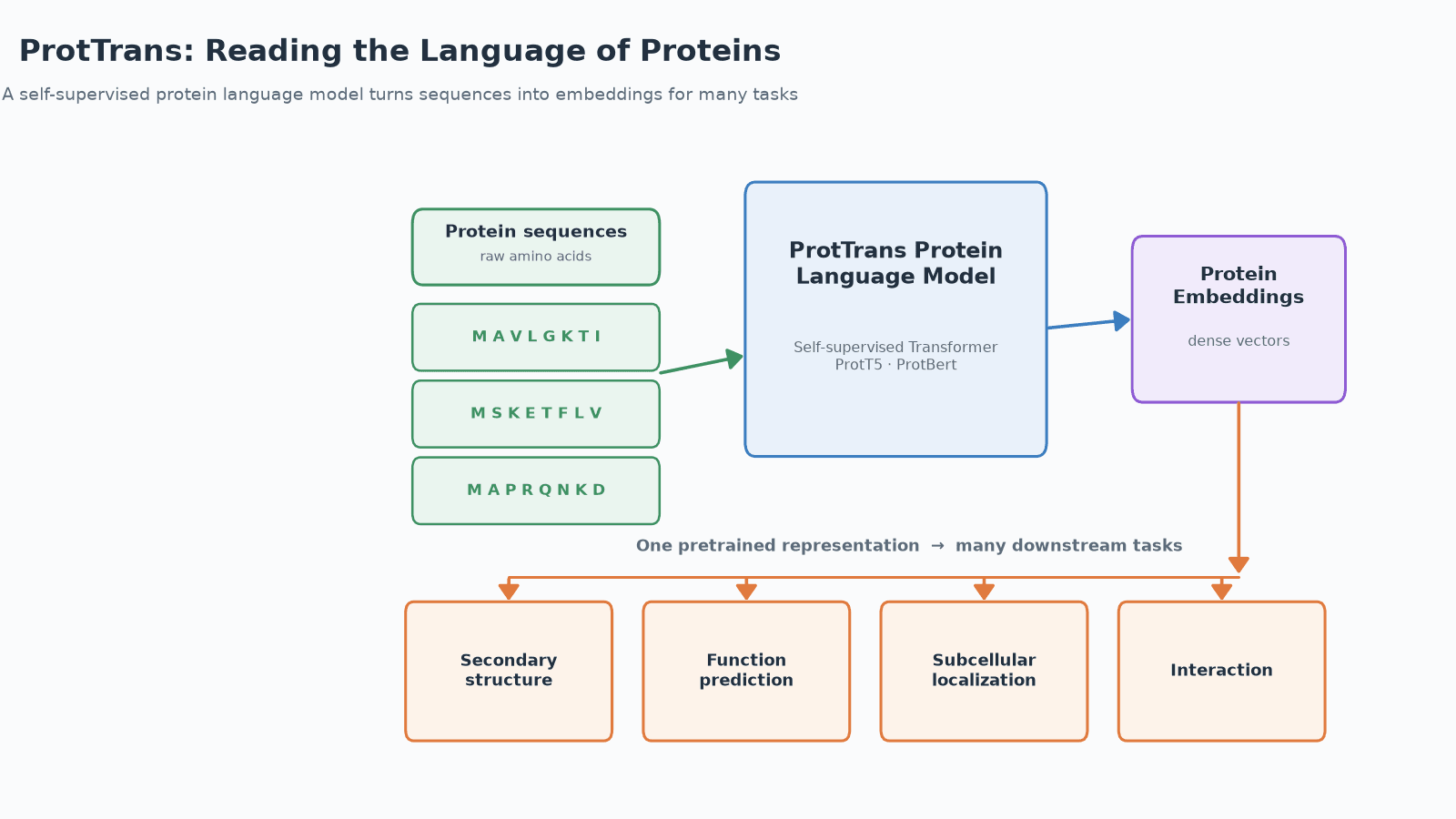
Figure 1 Concept overview: sequences become transferable representations via ProtTrans.
Category: D (AI / algorithms / platform); conceptual science + capability boundary
Proteins are the "executors" of life, and their function is largely determined by their amino acid sequence. In the past, understanding a protein often relied on extensive experiments or expensive structure computation, which is slow and costly. The ProtTrans protein model borrows ideas from natural language processing (NLP): it treats the amino acid sequence as a kind of "language" and pretrains large-scale Transformer models in a self-supervised manner, letting the AI "learn" the grammar of proteins from massive sequences and produce powerful representations for downstream tasks.
Background and Mechanism — Why Protein Language Models Emerged
Protein language models emerged from a transfer-learning idea that treats amino acid sequences as a "language," allowing AI to be "fed" with massive unlabeled sequences and then transfer the learned knowledge to many downstream tasks.
· Scarce labels are the core problem: The number of protein sequences in nature far exceeds known annotations. For example, BFD contains about 2.1 billion sequences and 393 billion amino acids, while UniRef100 has about 200 million sequences and 80 billion amino acids; yet structural and functional annotations remain very limited.
· A paradigm validated in NLP: Pretraining on large unlabeled data in a self-supervised way and then fine-tuning on a small amount of labeled data is a mature transfer-learning paradigm in NLP, and protein language models have shifted this paradigm onto biological sequences.
· "Read first, then apply": ProtTrans does not need to be told structure or function first; it first "reads" many sequences and understands the cooperative relationships among amino acids, then transfers on demand.
The scale of data makes this shift easier to grasp: there are hundreds of millions of known protein sequences, but only a small fraction carry structural or functional annotations. Training directly on human-labeled data is costly and has limited coverage; conversely, letting the model learn autonomously from massive unlabeled sequences and then fine-tuning on a little labeled data yields powerful representations at low cost. This is the fundamental reason "pretrain–fine-tune" has become the basic paradigm of protein AI. In drug discovery, industrial enzyme engineering, and antibody engineering, this "learn first, transfer later" approach is accelerating the discovery and optimization of candidate molecules, becoming key infrastructure for computational biology.
Principle and Structure — How ProtTrans "Reads" Protein Sequences
The core idea of ProtTrans is to feed an amino acid sequence into a Transformer encoder–decoder and learn contextual representations through a self-supervised mask/span-corruption objective, ultimately outputting transferable protein feature vectors.
· Transformer architecture: The core is self-attention, which lets each amino acid "see" the other residues across the whole sequence and thus capture long-range dependencies. The ProtTrans family includes ProtT5, ProtBert, ProtAlbert, ProtXLNet, ProtElectra, and Prot-TXL, covering encoder–decoder, bidirectional-encoder, and autoregressive structures.
· Self-supervised objective: During training, some residues are randomly masked (mask/span) and the model predicts the masked parts, so it "learns" the grammar among amino acids without instruction. No structural or functional labels are needed.
· Training scale: The models are trained on many supercomputer GPUs (e.g., Summit) and Google TPUs, with billions of parameters (e.g., ProtT5), drawing data from BFD and UniRef100.
· Representation output: Each residue yields a vector, and the whole protein can be pooled into a protein-level representation for direct use by downstream tasks.
Unlike traditional models built for a single task, a language model first learns "general intuition" and then adapts to different tasks on demand. Thus one pretrained model can serve structure, function, localization, and interaction tasks at once, greatly lowering the modeling cost for each new task—which is why it is called a "foundation model." Because the representation already carries rich sequence context, even a simple downstream classifier often performs well, which is another reason it is widely reused.
Analogy: just as one "reads a sentence and predicts the masked word," a protein language model predicts the masked amino acids and thus learns the "grammar" of proteins.
In this mechanism figure, sequences from BFD/UniRef100 enter the Transformer, learn via self-supervised reconstruction, and then both predict residues and produce protein representations.

Figure 2 Key mechanism: self-supervised mask reconstruction learns protein representations.
Capabilities and Boundaries — What ProtTrans Can and Cannot Do
ProtTrans representations can markedly improve downstream predictions such as secondary structure, function, subcellular localization, and interaction, but it is essentially a "feature source" and cannot directly produce experimental-grade structural or functional conclusions.
· What it can do: As a feature extractor or fine-tuning base, it supports secondary structure prediction, function annotation, subcellular localization, protein–protein interaction, mutation-effect assessment, solubility, and thermostability.
· Where the ability comes from: Self-supervised pretraining already captures some evolutionary and structural information; fine-tuning on a little labeled data further improves performance.
· Engineering applications: In enzyme engineering, such representations are often used to encode mutation effects and screen for more stable or more active variants; in antibodies, they help assess candidates after humanization or affinity maturation.
· Boundary one: not experimental evidence. Model output is a prediction and must be validated by wet experiments; it cannot substitute for experimental conclusions.
· Boundary two: limited generalization. For highly homologous or repetitive sequences, or non-natural sequences engineered by humans, the model may behave unstably; the "rules" it learns are not necessarily the true biological mechanism.
· Boundary three: high compute cost. Large-scale pretraining and inference are expensive; engineering often uses LoRA fine-tuning, model distillation, and quantization to cut deployment costs.
Practical Workflow — How to Use ProtTrans
There are usually two routes to use ProtTrans—extracting representations directly and fine-tuning on a specific task; in practice, you first choose a model, preprocess the sequence, extract vectors or fine-tune with LoRA, then evaluate on an independent test set.
1. Choose a model: Select ProtT5 (encoder–decoder) or ProtBert (bidirectional) based on the task; sequence length, compute, and task type are the main considerations.
2. Prepare the sequence: Input in FASTA format, then split and tokenize as the model requires.
3. Extract representations: Take the hidden-layer vectors directly as features and plug them into a downstream classifier/regressor.
4. Fine-tune: With little data, use efficient methods such as LoRA—freeze the large model weights and train only a small set of adapter parameters—greatly reducing memory and compute needs.
5. Evaluate: Use an independent test set and cluster by sequence homology to avoid "homology leakage" inflating results, then compare with baselines.
In real projects, language-model representations are often concatenated with physical/structural features to form multimodal features, further improving accuracy and robustness. For specific species or tasks, a small amount of fine-tuning on private data can also make the model better fit real scenarios.

Figure 3 Workflow: representations/fine-tuning support downstream tasks and the engineering loop.
Integrating with MatwingsVenus®(晓鹜®)— Embedding Protein Language Models in the Engineering Loop
In the protein-engineering workflow of MatwingsVenus®(晓鹜®), a protein language model can serve as a "representation engine," cooperating with directed evolution, sequence design, and wet-lab validation to form a "predict–design–validate" AI loop.
· Platform positioning: MatwingsVenus®(晓鹜®) is an AI-driven protein design and discovery platform built by Matwings Technology, serving biomedicine and industrial biomanufacturing, covering sequence design, mutation optimization, directed evolution, and structure prediction.
· How they cooperate: The language model supplies representations with evolutionary/structural priors, quickly scoring candidate sequences under low-label conditions, narrowing the search space and reducing unnecessary wet-lab rounds.
· Directed-evolution scenarios: In directed evolution, the language model can help design mutation libraries and prioritize candidate variants, helping researchers focus on the most promising sequences within a limited experimental budget, shortening development cycles and reducing trial-and-error cost.
· Wet-lab validation as backstop: AI output is a candidate hypothesis and must be confirmed by wet experiments on expression, activity, and stability; the language model "narrows the range" while experiments "confirm the results."
· Boundary and responsibility: This is an explanation of how a public general model combines with platform capabilities, not a claim of any unverified commercial guarantee; specific performance and applicability depend on measured results on the platform.
FAQ
What is the ProtTrans protein model?
ProtTrans is a family of large-scale Transformer-based protein language models pretrained with self-supervised learning on massive protein sequences, turning amino acid sequences into transferable high-dimensional representations usable across many downstream biological prediction tasks.
What is the difference between ProtTrans and AlphaFold?
AlphaFold focuses on predicting three-dimensional structure from sequence and outputs structural coordinates; ProtTrans focuses on learning general protein "language" representations that can transfer to structure, function, localization, and interaction tasks. The two are often used together.
How much compute does using ProtTrans require?
Extracting representations from a pretrained model usually requires only a single newer GPU; training from scratch or fine-tuning very large models demands far more compute. In engineering, efficient fine-tuning such as LoRA reduces trainable parameters from billions to millions, greatly lowering the barrier.
Can ProtTrans directly predict protein function?
It can provide function-related predictions and representations that narrow candidate ranges, but it is not experimental-grade functional evidence. Functional confirmation still requires wet-lab experiments or authoritative database annotation.
Summary
The ProtTrans protein model uses self-supervised learning to turn amino acid sequences into "readable language," providing powerful, transferable representations for structure, function, localization, and interaction tasks. Understanding its principles, capabilities, and boundaries is key to using it well. As a foundational base for AI protein engineering, it is being combined with platforms such as MatwingsVenus®(晓鹜®) to accelerate the "predict–design–validate" loop.
Data and conclusions in this article come from public research references; ProtTrans is a public academic model, and its specific capabilities and applicability should be confirmed by measurement and authoritative data.
One-sentence conclusion: ProtTrans self-supervisedly "reads" protein sequences to produce transferable representations; it is a foundational tool for AI protein engineering, but its outputs are predictions, not experimental evidence.