
What Is the ProGen Protein Generation Model? How Does AI Controllably "Generate" Proteins?
Published on November 1, 2026
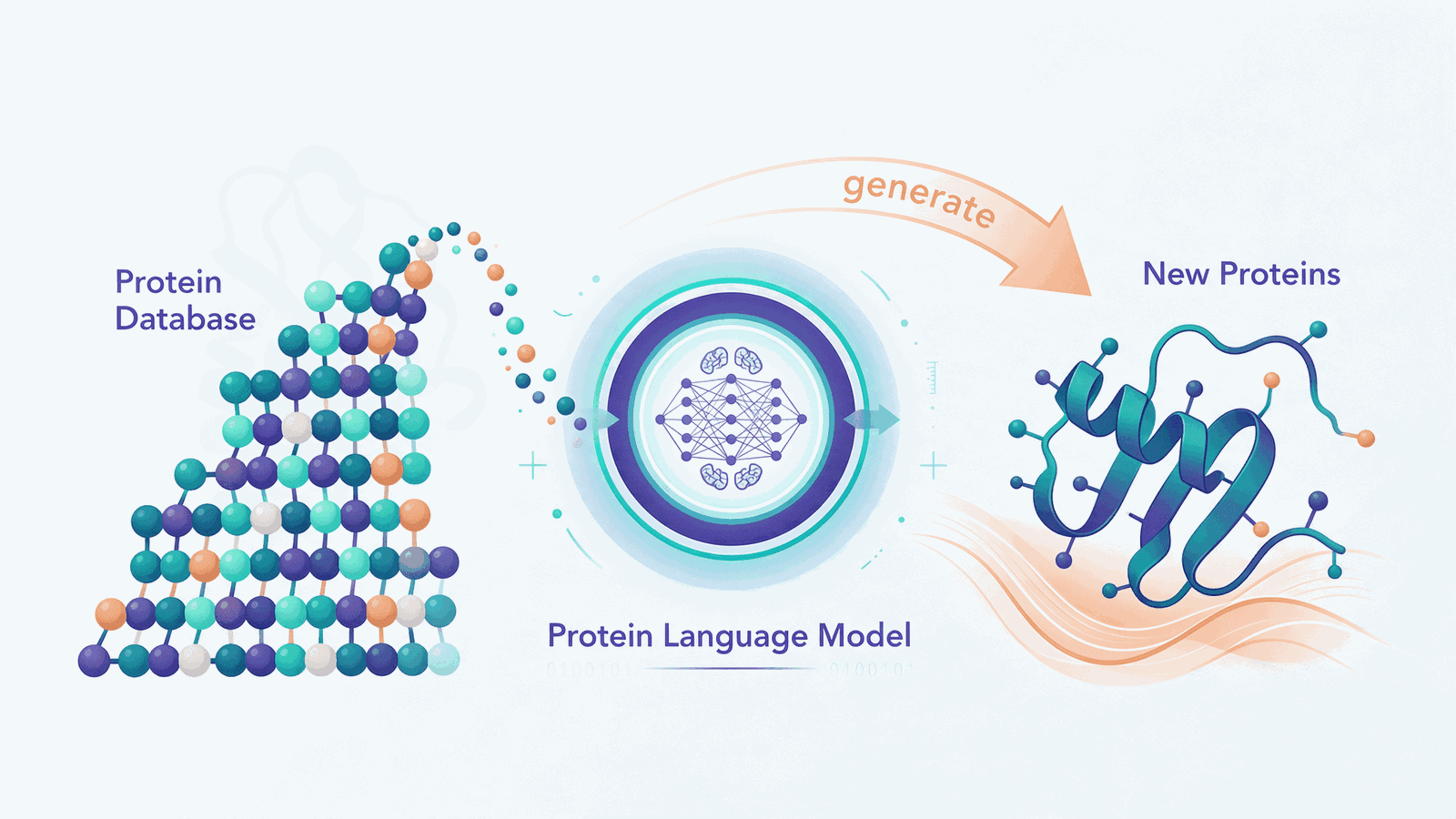
Figure 1 Overview of the ProGen protein generation model: modeling proteins as a language.
【Category】 D (AI / Algorithm / Platform); also touches C (Directed Evolution / Protein Engineering).
Proteins are the molecular machines of life. Traditional protein engineering mostly follows the path of directed evolution — repeatedly mutating a natural protein and screening round after round. The ProGen protein generation model takes a different route: rather than only "remodeling" natural proteins, it lets AI directly "write" an entirely new amino-acid sequence. It treats proteins as a language, first learns the grammar, then composes sentences on demand. This article walks you through the principles, capabilities and limits of ProGen.
Background: Why "Generating" Proteins Is More Valuable Than "Remodeling" Them
The number and functional space of natural proteins are enormous, and what humans can reach is only a fraction; the generative approach ProGen represents is precisely about exploring the much larger design space beyond natural sequences, moving protein engineering from "improving the existing" to "creating the new".
· Why we need "generation": natural protein sequences number in the hundreds of millions, yet only a fraction have been identified, characterized and used in industry. More importantly, natural evolution is often "locked" into certain regions by metabolic cost, folding constraints and host environment, so many useful functional windows remain underexplored.
· The ceiling of directed evolution: it relies on a mutation–selection cycle and can only optimize locally near an existing sequence. Its mutation amplitude is limited, it needs many screening rounds, and it tends to get stuck in local optima, unable to escape the "neighborhood" of the starting sequence.
· The value of generation: by learning the grammar and patterns of known protein sequences, ProGen compresses the common properties of massive sequence data into model parameters, so it can propose structurally reasonable candidates on functional combinations that are rare or even unseen in natural evolution.
· A landmark result: in a 2023 study published in *Nature Biotechnology*, lysozyme-family proteins generated by ProGen showed antibacterial function comparable to natural lysozymes in some cases; the same work also revealed the first 3D structure of a protein designed entirely by AI. It was the first demonstration that a generative model can produce proteins with near-natural function, marking a shift from "AI-designed in principle" toward real-world possibility.
The Principle of ProGen: Modeling Proteins as a "Language"
ProGen treats an amino-acid sequence as a "sentence" and predicts the next amino acid autoregressively, one token at a time, using tags such as family, function and organism to steer the direction of generation, so it can "compose" under a specified property.
· The language-model analogy: treat the 20 amino acids as an "alphabet" and a protein sequence as a "sentence". ProGen has essentially one core task — given the context so far, predict "what the next amino acid should be" (autoregressive, next-token prediction). This "continuation" mechanism is conceptually identical to the token-by-token generation of large chat models.
· Turning annotations into a "recipe": during training, each protein sequence is paired with its annotation tags, drawn from databases such as UniProt, e.g. protein family (Family), functional keywords (Function), organism and subcellular location (Organism/Location). The model thus learns the mapping between tags and sequences. At generation time, giving these tags is equivalent to providing a "recipe" that tells the model which class of protein to produce.
· What the tags make controllable: this is the source of the word "controllable". You can generate a complete sequence from tags alone, with no initial amino-acid context; or you can give partial context and let the model "complete" specified positions.
· Scale and data: ProGen has about 1.2 billion parameters and was trained on roughly 280 million protein sequences across more than 19,000 protein families. It learns the "grammar of proteins" into its parameters rather than assembling them from hand-written rules.
· Output boundaries: ProGen produces an amino-acid sequence, not a 3D structure. To obtain a structure, you still need structure-prediction tools (such as AlphaFold-class methods) or experimental determination; this is why it must be used alongside structure models and wet-lab experiments.

Figure 2 ProGen autoregressive generation mechanism: token-by-token generation guided by conditioning tags.
ProGen and ProGen2: Capability Boundaries and the "Measurement" Standard
ProGen2 scales and systematizes the ProGen idea, and performs strongly at zero-shot fitness prediction and generating novel, viable sequences — but what it gives is a "likelihood score", not experimentally measured real activity.
· ProGen2 (2023, Cell Systems): it is a family of autoregressive transformer decoders, from 151M (small) to 6.4B (xlarge) parameters, trained on about 1 billion protein sequences by learning to predict the next amino acid. Compared with ProGen, ProGen2 emphasizes how capabilities "emerge" as the model grows.
· Two major capabilities: first, generating novel and viable high-quality sequences; second, zero-shot fitness prediction — scoring and ranking the fitness of a mutation with no experimental labels at all. This is highly valuable for variant-effect prediction and for shortlisting favorable mutations, greatly cutting wet-lab workload.
· Why zero-shot matters: most fitness prediction depends on large, measured mutation datasets, which are costly and cover only a few proteins. Zero-shot allows the model to rank variants on proteins it has never seen, rapidly narrowing the screening space.
· Boundaries and limits: fitness prediction is a model score, not real activity; the model works at the sequence level and does not directly predict structure; it can only "know the patterns that appeared in the training data", so for entirely novel folds, non-natural amino acids or unseen chemical environments, the generated sequence may fail to fold, dissolve or remain stable.
· The "measurement" standard: judge a generated protein by whether it (1) can be expressed and folded, (2) reaches the expected activity or binding affinity, and (3) meets stability and developability criteria. All three are required, and ultimately decided by wet-lab data.
How to Use ProGen Well: From Generation to Wet-Lab Validation
Practical deployment of ProGen is a closed loop of "generation — scoring — wet-lab validation — iteration": AI first produces a batch of candidate sequences, coarse filters them with fitness prediction and structure assessment, then validates the winners experimentally and feeds results back to refine the model.
· Step 1 Generate: set the conditioning tags and batch-generate tens of thousands of candidates. The goal here is not "one perfect sequence" but "a sufficiently diverse candidate pool covering different design directions".
· Step 2 Filter / score: use zero-shot fitness prediction, structure prediction (such as AlphaFold confidence / pLDDT filters) and developability rules to coarse-filter, cutting the pool from "tens of thousands" down to "tens to hundreds".
· Step 3 Wet-lab validation: express and purify the few winners and measure real activity (e.g. antibacterial, catalytic, binding). This is the costliest and most decisive step in the loop.
· Step 4 Active-learning iteration: feed the wet-lab results back into the model, use real data to correct prediction bias, and guide the next generation round — the search space keeps focusing, and each iteration gets closer to the target.
· Core logic: the generative model "broadly casts the net" to expand search range; the wet lab "truly checks" to guarantee trustworthy results. Together they are the reliable path from "AI can generate" to "production can use".

Figure 3 ProGen application workflow: AI generation, fitness scoring, wet-lab validation and active-learning iteration.
MatwingsVenus®(晓鹜®): Making Generative Protein Design Truly Actionable
Generative models open up sequence design space, but real engineering deployment needs the complete closed loop of "AI generation + function prediction + wet-lab validation", plus fine-grained evaluation against specific objectives (enzyme activity, stability, affinity).
· Value of the closed loop: a generative model alone cannot guarantee that a candidate protein will express, be active and scale up. MatwingsVenus®(晓鹜®) builds AI protein-engineering capability around "design — predict — validate — iterate": it performs site assessment and mutation-effect prediction on a given target protein (such as VenusX site maps), and can also combine directed evolution with wet-lab feedback for multiple rounds of optimization, turning generative-model candidates into expressible and active real proteins.
· Industrial considerations: for industrial players, the value of MatwingsVenus®(晓鹜®) is not just "design a sequence" but turning that sequence into a "usable enzyme / antibody / binding protein", while also controlling stability, developability and process feasibility — precisely the parts a generative model alone cannot guarantee.
· Complementary relationship: generative models like ProGen explore sequence space and expand the candidate range; MatwingsVenus®(晓鹜®) evaluates, optimizes and delivers. Together they form an efficient protein-engineering path and make "AI generation" truly valuable in industrial scenarios.
FAQ
Can the proteins generated by ProGen go straight into production?
No. Generated sequences are only candidates. They first need wet-lab validation that they express, fold and are active, then assessment of stability and developability, before scale-up production can be considered.
What is the difference between ProGen and AlphaFold?
One generates; one predicts. ProGen is a generative language model that "generates" amino-acid sequences; AlphaFold is a structure-prediction model that "predicts" 3D structure from a sequence. They are often used together: ProGen supplies the sequence, structure prediction or experiment supplies the structure.
Can ProGen design enzymes or antibodies with specific functions?
It can generate candidates, but they need validation. It can generate candidates by function/family tags, but specific activity and binding affinity require targeted modeling and wet-lab checks; antibody design also has extra constraints on structure, assembly and immunogenicity.
Can an ordinary lab use ProGen? How much compute does it need?
Yes, but at a controllable scale. The weights of models such as ProGen2 are open-sourced, so smaller models can be fine-tuned locally or in the cloud; training much larger models needs substantial compute and data. Real projects more often use "smaller model + targeted fine-tuning + wet-lab closed loop".
Conclusion
The ProGen protein generation model pushes protein engineering from "improving the existing" toward "creating the new", and is a landmark advance of generative AI in biology. It treats protein sequences as a language and uses conditioning tags to steer generation, letting us explore sequence space beyond nature at scale. But its output is only candidate sequences and likelihood scores; the truly reliable route is the closed loop of "AI generation — evaluation — wet-lab validation — iteration". Structure prediction, fitness prediction and active learning are industrializing this loop, and MatwingsVenus®(晓鹜®) is one class of AI protein-engineering platform taking this loop toward real production.
【One-sentence conclusion】 ProGen learns the "grammar" of proteins through a conditional language model and can generate new sequences from functional tags, but every output must be validated in the wet lab before it can be used.