
MMseqs2 Sequence Search: How to Rapidly Pinpoint Homologs in Hundreds of Millions of Protein Sequences?
Published on November 8, 2026
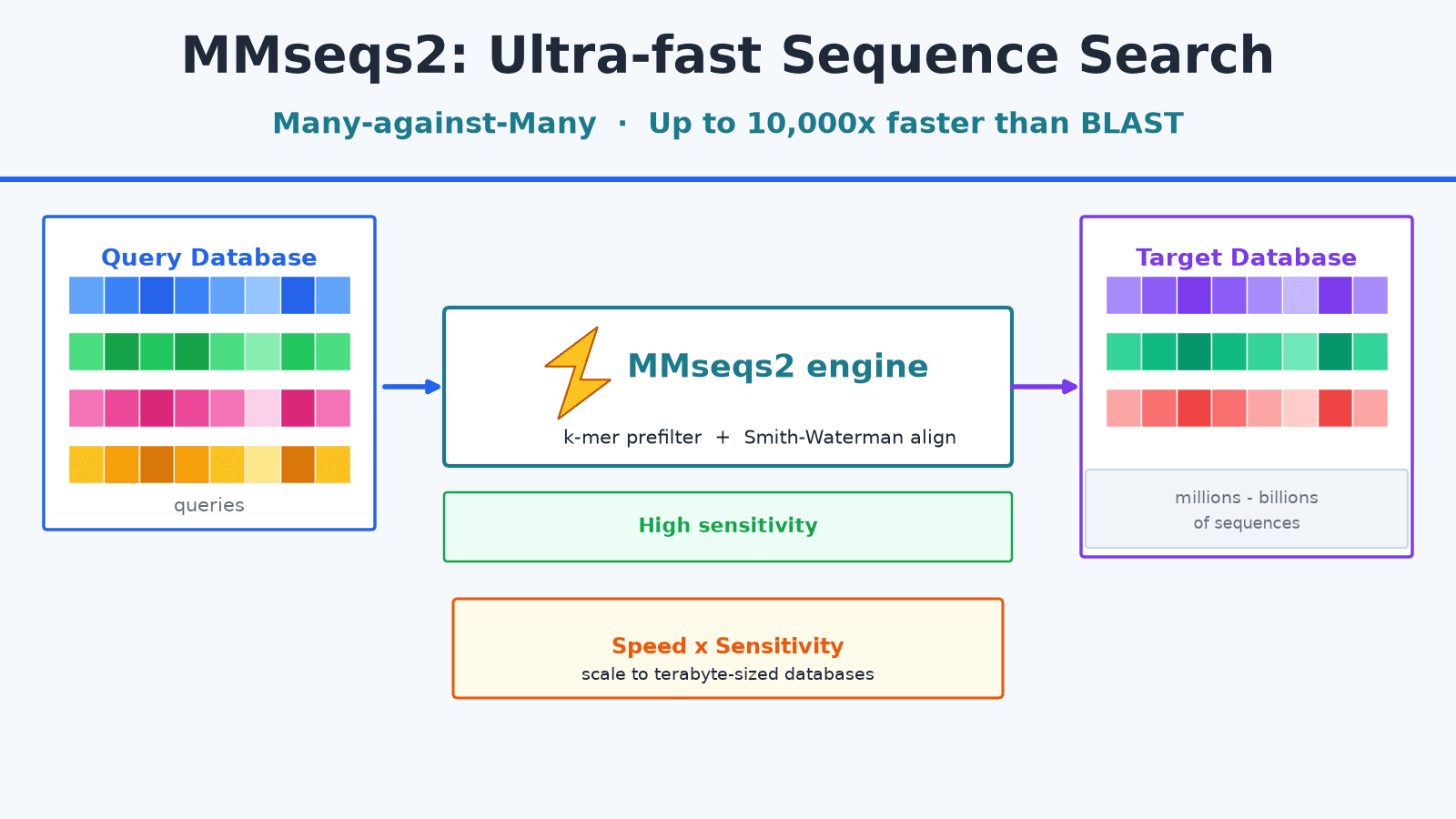
Figure 1 Overview of MMseqs2 sequence search: many-against-many fast retrieval
In the life sciences, asking what an unfamiliar protein resembles and what it might do usually starts with sequence similarity. But when a database grows to hundreds of millions of sequences, traditional tools become too slow. MMseqs2 sequence search is an open-source algorithm built for this “scale problem”: it uses a many-against-many approach to compress ultra-large-scale sequence comparison from days to minutes.
1. Background and mechanism: why do we need faster sequence search?
As known protein sequences grow from thousands to hundreds of millions, one-by-one BLAST-style searching becomes impractical. By indexing query and target sets together and comparing them in batches, MMseqs2 sequence search brings large-scale homology retrieval down to minutes-to-hours, giving functional annotation and structure inference a sustainable path.
Sequence similarity search is a core analysis in life sciences: it compares an unknown sequence against known ones to infer function, structure, or evolutionary relationship. Traditional BLAST compares each query against each target one at a time, so cost climbs quickly as databases grow. Databases such as UniProt now hold hundreds of millions of sequences, and metagenomic data often reach billions.
This is like researching in a library with tens of millions of volumes: paging through every book is unrealistic; you need indexing and fast screening.
This kind of search powers many downstream tasks: annotating function for unknown proteins, accumulating templates for structure prediction, and building homology networks for evolutionary analysis. It is also the first gate of large-scale functional annotation pipelines.
The name MMseqs2, “Many-against-Many,” captures the key idea. It no longer processes one query at a time, but takes a batch of queries and a batch of targets together through an index. This lets it handle terabyte-scale databases on ordinary servers and has been integrated into the homology-search stage of several large-scale protein structure and function prediction pipelines.
2. Principle and architecture: how does a two-stage pipeline stay both fast and accurate?
The core of MMseqs2 sequence search is a two-stage pipeline: a double-consecutive k-mer match plus ungapped alignment quickly selects a small candidate set, then a vectorized Smith-Waterman alignment is run on those candidates. This “fast screen, then precise align” combination gives close-to-BLAST sensitivity while cutting computation to a fraction.

Figure 2 Two-stage pipeline of MMseqs2: prefilter and alignment
Stage one is the prefilter. Query and target sequences are cut into fixed-length “k-mers” (for example short windows of k=7), and double-consecutive k-mer matches serve as a fast similarity criterion, followed by an ungapped alignment score. Only sequences above the threshold move on, which already removes most irrelevant sequences.
Stage two is alignment. Candidates passing the prefilter are aligned with Smith-Waterman dynamic programming, vectorized with SIMD instructions such as AVX2/AVX-512 to process many sequences at once and push speed further.
k-mer length and the “double-consecutive” criterion are another set of knobs here: shorter k-mers are more sensitive but noisier, longer ones are faster but can miss distant homologs; requiring two adjacent k-mers to match trims false positives without much sensitivity loss. mmseqs2 also offers a cascaded prefilter that does a cheaper coarse pass first and then tightens, approaching full-alignment sensitivity faster.
Sensitivity comes from the iterative profile mode: mmseqs2 builds a profile using a position-specific scoring matrix (PSSM), reaching sensitivity comparable to PSI-BLAST. In engineering terms it is written in C++ under GPLv3, scales across cores and servers, and requires at least SSE4.1.
In short, it does not trade accuracy for speed; it uses “prescreen plus precise align” to reserve expensive full alignment for only the few most likely similar sequences.
3. Assessment and selection: when should you use MMseqs2, and how does it trade off against BLAST?
Choosing MMseqs2 or BLAST depends on sequence scale, available time, and sensitivity needs: when queries or target libraries reach hundreds of thousands and you want to compress a run from days to hours, MMseqs2 is usually better; when you need maximum sensitivity or to verify a single precise alignment, pair it with BLAST or iterative profile.
The speed–sensitivity trade-off is the crux. Public benchmarks show that on CPU, mmseqs2 can be orders of magnitude faster than BLAST at comparable sensitivity (official material cites up to ten-thousand-fold in specific configurations); in iterative profile mode it can reach PSI-BLAST-level sensitivity while being more than 400 times faster.
Recent GPU acceleration widens the gap further: a single GPU can be about 6 times faster than the fastest CPU method BLAST, and about 17 times faster in the best setting with 8 GPUs.
· Large query or target size and throughput focus — choose MMseqs2;
· Few queries, or wanting an established workflow with strict single-hit verification — BLAST and HMM tools such as HMMER remain reliable choices;
· Deduplication or clustering — use MMseqs2 cluster (and its linear-time Linclust, which in an official benchmark clustered 1.6 billion sequences on a single server in 10 hours).
Parameters such as --sensitivity, --e-value, --threads, plus chunking and memory strategy, all slide along the speed–sensitivity axis. Note that different tools have different strengths; “which is faster or better” depends on data scale and task, not an absolute verdict.
4. Conditions and workflow: from raw sequences to a candidate set in a standard pipeline?
Using MMseqs2 sequence search well usually follows a three-step “build–prefilter–align” flow: createdb to build the database, prefilter for coarse screening, then align for precise alignment, with --threads parallelism, --e-value thresholds, and chunking to control scale and time.

Figure 3 MMseqs2 in a protein discovery and engineering pipeline
The standard command flow is: createdb (convert FASTA into a database format), prefilter (k-mer similarity scoring to produce candidates), and align (Smith-Waterman precise alignment); or run easy-search or easy-cluster as a single command.
For resources and environment, you need multicore parallelism and at least SSE4.1; large jobs can use a GPU (Ampere or newer) to go faster; indexing the database first greatly lowers the cost of repeated searches.
For output, mmseqs2 can generate BLAST-like TSV, ASCII alignment, and sequence database formats for batch and downstream processing; sensitivity can be tuned in levels, with higher levels closer to full alignment but more time-consuming, letting you trade off per task.
When interpreting results, focus on significance (E-value), sequence coverage, and identity: smaller E-values or higher identity mean more confident hits, and conclusions should rest on independent homology evidence rather than a single score. For engineering, split huge inputs, watch memory and disk, and budget for the extra cost of iterative profiles and clustering.
These steps make “large sequence sets → homology sets” reproducible and traceable, providing a reliable entry point for downstream structure modeling, functional annotation, and template selection.
5. Integration with MatwingsVenus®(晓鹜®)
In the protein discovery and engineering data pipeline at MatwingsVenus®(晓鹜®), ultra-fast sequence search acts as the “entry ticket”: it quickly builds homology networks for candidate proteins, picks templates for structure and design, and deduplicates large sequence sets, so that precious compute stays with the costlier 3D modeling and AI design.
MatwingsVenus®(晓鹜®) focuses on AI-driven protein discovery and engineering, and its data pipeline needs a repeatable “homology-mining” entry that can handle massive sequence volumes. With ultra-fast search such as MMseqs2, the platform can, during candidate mining:
· build a homology network for each candidate to support function and evolutionary inference;
· pick suitable templates from structure databases to guide later structure prediction and design;
· deduplicate and cluster ultra-large sequence sets such as metagenomes, reducing redundancy and focusing on diverse representative sequences.
This concentrates limited compute on the more expensive stages of 3D modeling, AI design, and experimental screening, forming a “sequence → structure → design → validation” loop. Specific capabilities and performance follow the platform’s official information; this article makes no unverified data claims.
6. FAQ
1. Why is MMseqs2 so much faster than BLAST?
The key is “many-against-many plus two stages.” MMseqs2 processes a batch of queries and targets together, uses k-mer prefiltering to discard most irrelevant sequences, then runs vectorized Smith-Waterman on the few candidates, while BLAST scans the database per query. This “fast screen, then precise align” architecture yields order-of-magnitude speed gains at similar sensitivity.
2. Does MMseqs2 sacrifice sensitivity?
At default or lower sensitivity settings, speed can cost some sensitivity; but it also offers a tunable --sensitivity and an iterative profile mode that reaches PSI-BLAST-level sensitivity while staying hundreds of times faster. Whether sensitivity is sacrificed depends on the setting you choose, not on the tool itself.
3. Can MMseqs2 only search protein sequences?
No. MMseqs2 supports both protein and nucleotide sequence search and clustering. That said, it is most mature for protein homology mining and profile search; for nucleotide scenarios you can combine it with other alignment tools as needed.
4. Should I use a plain search or a profile/HMM search?
If the goal is fast, broad homology discovery, plain search (k-mer plus Smith-Waterman) suffices; to capture distant homologs with more sensitivity, the iterative profile (PSSM) mode is usually better but slower. A common strategy is to prescreen with the fast mode, then switch to the more sensitive mode for key candidates.
7. Summary
Understanding the principles, performance, and applicability limits of MMseqs2 sequence search helps you make a sensible speed–sensitivity trade-off. As an open-source, scalable similarity-search engine, it provides an efficient low-level tool for homology mining, deduplication, and functional annotation of large datasets, and a fast, stable entry point into protein discovery and engineering pipelines.
Key points: many-against-many, two stages (fast screen plus precise align), the speed–sensitivity trade-off, parameters and workflow, and its link to the MatwingsVenus®(晓鹜®) data pipeline. In one line — pick the right tool and tune the right parameters, and you can obtain trustworthy homology evidence within an acceptable time.
