Ligand Coupling Process Development from Activation to Performance Testing
Published on September 8, 2026
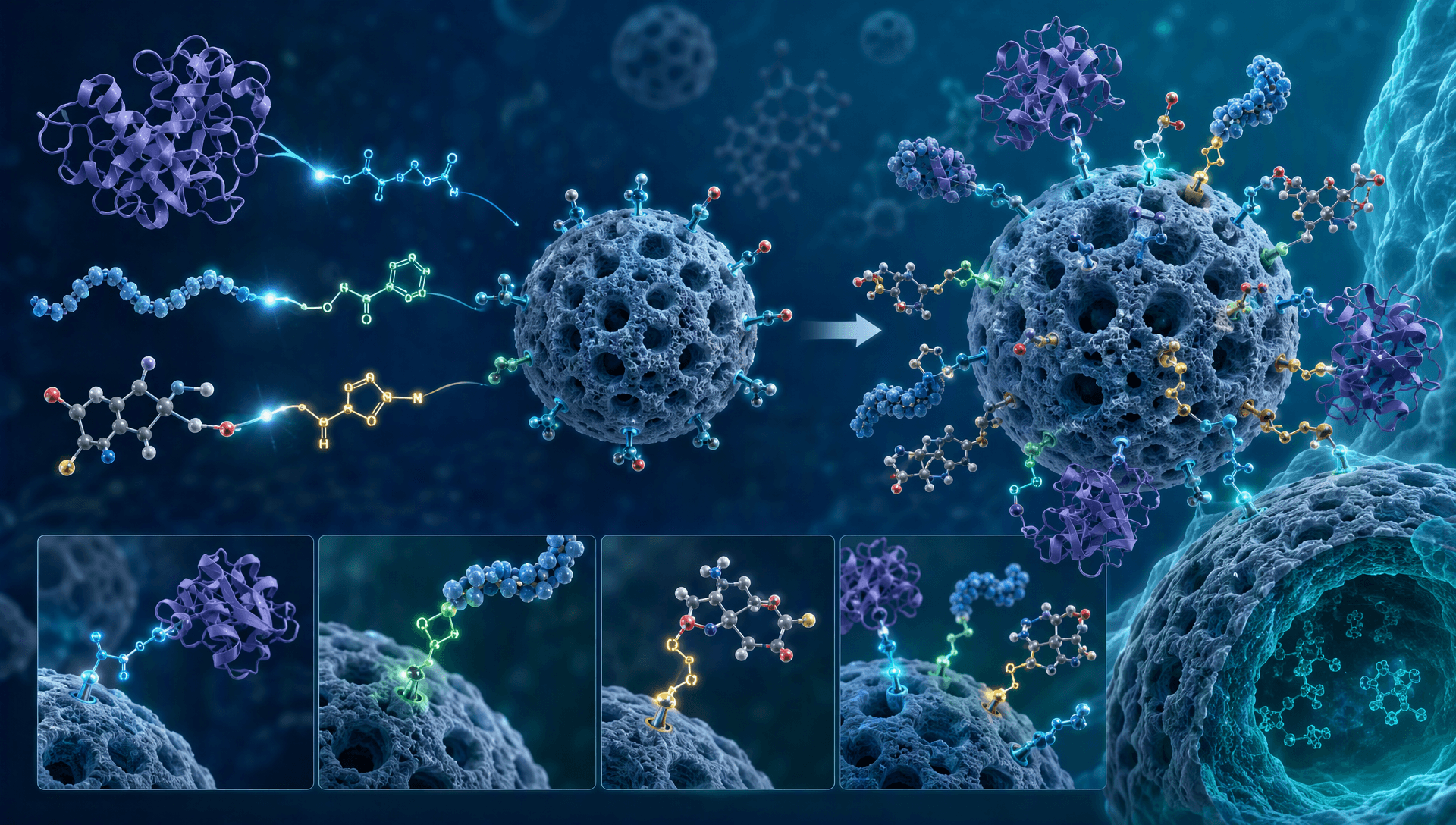
Ligands immobilized on a functional support through spacer arms
Ligand coupling process development aims to establish a stable and reproducible immobilization method without materially damaging recognition function. The workflow must consider ligand functional groups, support chemistry and pore architecture, activation method, spacer length, reaction buffer, temperature and time, blocking and washing, and post-coupling binding capacity, selectivity, leakage, and cycling stability. It is therefore not a single reaction but a chain from raw-material characterization to functional release testing.
Why a high coupling yield does not guarantee success
Coupling quantity is easy to measure, but it does not represent media performance on its own. If a reaction occurs near the recognition interface or a large molecule lies randomly against the surface, chemical attachment may be extensive while functional capacity remains low. A review of antibody immobilization notes that random orientation can contribute to loss of biological activity and discusses steric hindrance, distance from the support, and antibody fragments as relevant variables.
Ligand density is also not a simple “more is better” parameter. Insufficient density limits capacity, while excessive density may increase crowding, steric effects, and nonspecific interactions. Pore architecture, surface hydration, spacer flexibility, and target size influence mass transfer. Ligand coupling process development should therefore separate chemical coupling efficiency from functional binding and make application-relevant capture, elution, and reuse results the final decision criteria.
A six-stage ligand coupling process development workflow
1. Work backward from the intended use
Affinity purification, in vitro diagnostics, sensing, and targeted capture emphasize different attributes. Affinity media may prioritize dynamic binding capacity, recovery, and cycling stability. Sensor surfaces may emphasize accessibility, background, and response consistency. Diagnostic beads may require control of lot-to-lot variation and matrix interference. A review of immunoaffinity chromatography identifies the biological affinity pair, matrix support, immobilization chemistry, and elution conditions as critical design parameters, reinforcing the need to plan coupling together with use conditions.
2. Characterize the ligand and support
Before development, establish ligand purity, molecular mass, available functional groups, solubility, charge-related behavior, and sensitive conditions. For the support, document material, particle size, pore structure, activated groups, and permitted pH and temperature ranges. Proteins, peptides, small molecules, and nucleic acids expose different reactive sites, and the same chemistry can create different orientation distributions.
Functional sites and regions that should not be modified should also be mapped. If sequence or structural information is available, teams can evaluate the recognition interface and solvent-accessible residues before choosing random covalent coupling, site-specific tags, or bioorthogonal chemistry. A review of directed protein immobilization summarizes physical adsorption, covalent coupling, site-specific tags, and bioorthogonal strategies.
3. Select coupling chemistry and spacer architecture
A route may be designed around amine, thiol, carboxyl, or tag-mediated reactivity, but every option requires confirmation of reaction selectivity, ligand stability, and support compatibility. Random coupling is often operationally straightforward but can generate heterogeneous orientations. Directed or site-specific coupling may better expose the recognition interface, although it may require ligand engineering, tags, or additional reactive-group preparation.
Spacer arms separate the ligand from the support surface. A spacer that is too short may create steric blockage; one that is too long may add flexibility or nonspecific interactions. Target size, binding-site position, pore geometry, and operating flow should all inform spacer selection.

Random and directed coupling producing different accessibility
4. Screen critical parameters with a small-scale matrix
Small-scale studies can vary ligand input, support concentration, buffer, pH, temperature, reaction time, and mixing while keeping washing, blocking, and sampling rules consistent. Each condition should track input material, unreacted ligand, wash fractions, and final media so that covalent attachment can be distinguished from physical adsorption and analytical loss.
A one-factor-at-a-time approach can miss important interactions. Increasing ligand input may increase apparent coupling without increasing functional capacity, and longer reaction times may increase inactivation. A limited design matrix can first identify sensitive variables, followed by focused optimization around the promising region.
5. Build chemical and functional quality control
Chemical checks may include coupled amount, residual unreacted ligand, blocking completeness, and ligand leakage. Functional testing should assess target binding, non-target adsorption, recovery or response, and performance after washing and regeneration. Porous media additionally require flow-relevant mass-transfer and dynamic-capacity evaluation rather than reliance on static incubation alone.
Supported by the MatwingsVenus™(晓鹜™) technology stack, MatwingsVenus Mall can connect projects with relevant ligand sequence and structure analysis, interface assessment, protein engineering, and validation-planning products. Activated supports, buffers, and testing or purification products should be discussed according to current listing status and project requirements; unverified categories should not be presented as guaranteed inventory or performance.
6. Convert the small-scale result into a reproducible process
Before scale-up, freeze raw-material specifications, input ratios, mixing method, reaction endpoint, wash volume, blocking sequence, storage conditions, and release criteria. Scale-up is not simple volume multiplication: mixing, mass transfer, temperature uniformity, and sample representativeness can change. Comparing coupled amount, functional capacity, and stability across independent batches helps determine whether the process is transferable.
Supported by the MatwingsVenus™(晓鹜™) technology stack, customized services from MatwingsVenus Mall can help organize ligand inputs, support conditions, evaluation endpoints, and deliverable boundaries into a ligand-analysis, coupling-route, small-scale matrix, functional-validation, and scale-up recommendation chain. Methods, timelines, and output formats should be confirmed during project assessment.

A complete path from coupling reaction to functional quality control
Platform workflow for starting a coupling project
Before consulting MatwingsVenus Mall, prepare four information groups: ligand type, purity, and available functional groups; support material, activation method, and pore or particle attributes; target molecule and intended application; and desired capacity, selectivity, leakage, and stability endpoints. Complete inputs make it easier to define an executable small-scale scope.
With the MatwingsVenus™(晓鹜™) technology stack, projects may also connect ligand structure analysis, site design, or protein engineering to identify regions that should not be modified before wet-lab work begins. Computational analysis provides design evidence only; coupling efficiency, functional capacity, and cycle life still require experimental confirmation.
FAQ
Does higher coupling yield always produce higher media capacity?
No. Orientation, steric effects, pore transport, and retained ligand activity determine how many immobilized sites are functionally available.
How should random and directed coupling be selected?
The decision should consider ligand size, recognition-site position, cost, scale-up complexity, and intended use. Directed coupling is not mandatory for every project.
Why use a spacer arm?
A spacer can increase the distance between the ligand and support, reducing some surface-related steric blockage. Its length and chemistry still require optimization.
When are customized services useful?
They are valuable when ligands are scarce, functional groups are complex, site-specific immobilization is required, or structural analysis, small-scale studies, and performance testing must be connected.
Conclusion
The core of ligand coupling process development is converting chemical attachment into stable functional use. Starting from the application and controlling ligand, support, chemistry, orientation, density, and quality attributes can produce a reproducible and scalable immobilization process. MatwingsVenus Mall can connect relevant products and customized services across these stages, helping teams organize separate steps into an evidence-bounded process path.