
How Does the InterPro Protein Database Turn a Protein Sequence into Structural and Functional Annotation?
Published on November 3, 2026
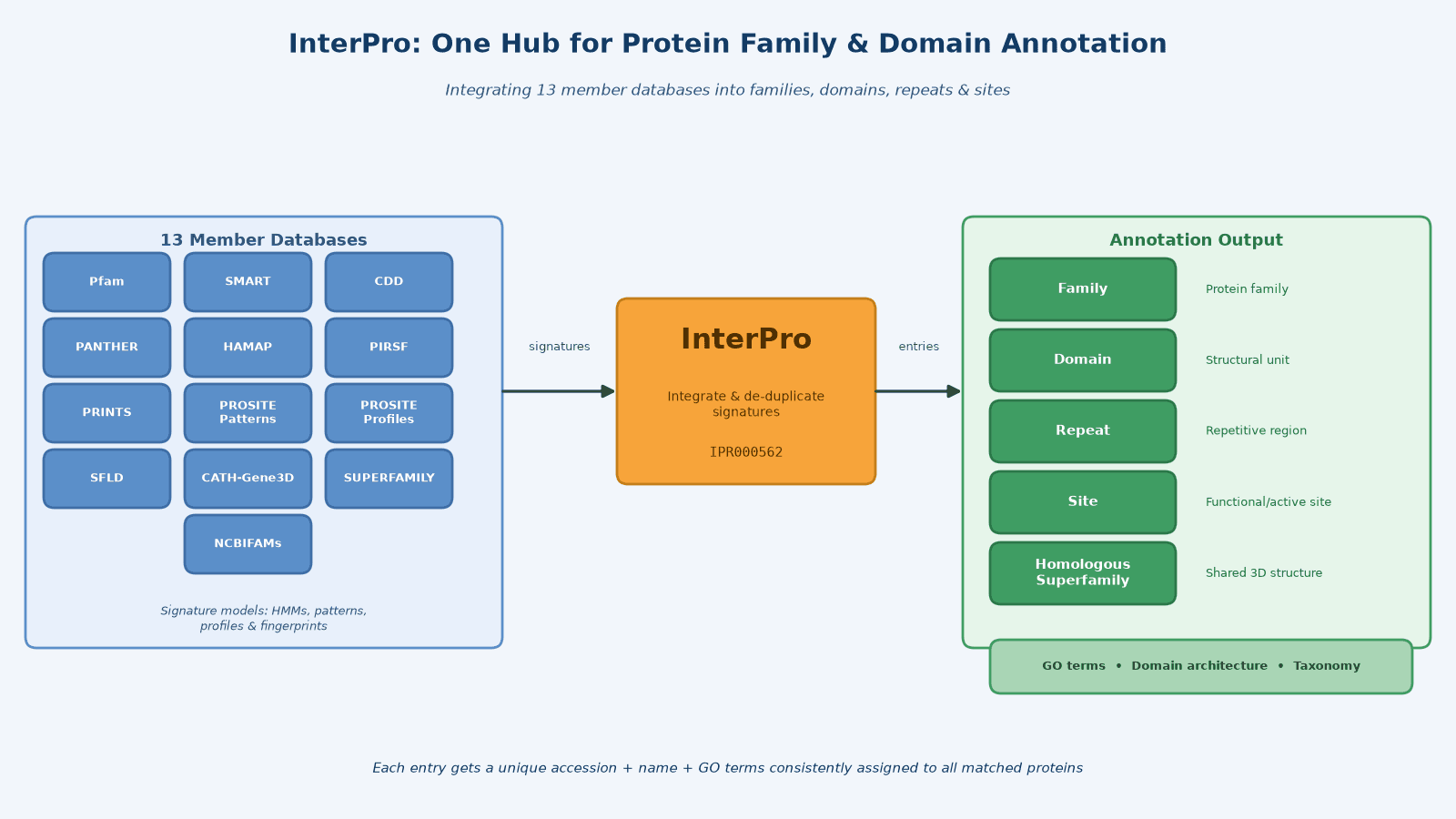
Figure 1 InterPro integrates 13 member databases into unified family and domain annotations
【Category】 E (Structure/Mechanism/Sequence Analysis — technical analysis & method tutorial); cross-tag G (Applications/Scenarios), primary class E
When you get a new protein sequence, you usually want to know: which class of protein is it? What domains does it contain? What function might it have? This is exactly what the InterPro protein database is designed to answer. It is a centralized resource that brings together predictive models from several independent databases and gives each protein a unified "family—domain—repeat—functional site" annotation. Whether you are annotating a new genome, dissecting the domain composition of an enzyme, or judging the likely function of an unknown protein, InterPro returns a reusable structured answer in minutes.
Why Do We Need InterPro? Limitations of a Single Database and the Value of Integration
The InterPro protein database integrates protein signatures from 13 member databases into unified entries, so researchers do not need to query several databases one by one and re-align the same sequence — one-stop functional annotation is the foundational entry point for protein annotation.
Each single database has its own focus: Pfam excels at describing protein families with hidden Markov models (HMMs), SMART focuses on domain annotation, CDD collects conserved-domain models, while PANTHER and HAMAP emphasize family and functional classification, and CATH-Gene3D plus SUPERFAMILY provide a structure-based homologous-superfamily view. Using only one database can miss features that others recognize and makes it hard to unify comparison results. For example, a protein might be recognized as a family by Pfam, have a domain identified by SMART, and have an active site flagged by PROSITE; only by combining several signatures can you reconstruct the full "family—domain—site" picture.
InterPro integrates these signature models on one platform: when two or more member databases describe the same biological entity, their signatures are merged into a single InterPro entry, reducing redundancy and unifying the naming. The 13 member databases are Pfam, SMART, CDD, PANTHER, HAMAP, PIRSF, PRINTS, PROSITE Patterns/Profiles, SFLD, CATH-Gene3D, SUPERFAMILY and NCBIFAMs. As an ELIXIR Core Data Resource and a Global Core Biodata Resource, InterPro has long-term stewardship and endorsement at the data-infrastructure level.
Key point: The value of integration is "many databases, one answer" — scattered hits from different databases are consolidated into one structured, reusable annotation instead of you repeatedly comparing them yourself.
Principle and Structure: InterPro Entries, Member Signatures and Five Annotation Types
Each InterPro entry describes a protein family, domain, repeat or functional site with a unique IPR identifier, name, abstract and GO annotation, integrating one or more predictive models from the member databases to achieve "many databases unified into one".
InterPro entries are divided into five categories by biological entity: homologous superfamily, protein family, domain, repeat and site. An entry is composed of signatures from member databases; a signature is a model that predicts proteins with the same structure or function, such as an HMM, pattern, profile or fingerprint. InterPro assigns each entry a unique accession (e.g. IPR004827), a name, a short name, an abstract, and Gene Ontology (GO) terms that can be consistently assigned to all matched proteins; it also provides "domain architecture" from Pfam signatures to reveal a protein's modular composition.
Understanding the relationships between entries matters too: one family entry can map to several domain entries, and a homologous-superfamily entry often holds multiple structures or even multiple families, so "overlapping homologous superfamilies" exist. When more signatures can be integrated into an entry, it may be split or merged again, and entry boundaries may change. For example, an InterPro entry for a protein kinase may simultaneously give the family, the kinase domain, the active site and a binding site, letting you see the functional layout at a glance. In the end, scattered hits for the same protein across member databases are consolidated into one structured, reusable InterPro annotation.

Figure 2 Protein sequence signatures are integrated into one InterPro entry
Measurement and Analysis: Sequence Scanning with InterProScan
By pasting a protein or nucleotide sequence into InterProScan, you can run search programs from several member databases simultaneously and merge the results into one unified InterPro annotation output; this is the most common way InterPro is "measured".
InterProScan is InterPro's sequence analysis application, invoking recognition methods from several member databases — for example HMMER to search Pfam and RPS-BLAST to scan CDD. It takes advantage of pre-computed results whenever possible: it computes a CRC64 checksum for the query and, if the protein is already registered in the IPRMATCHES database, returns the match directly, greatly speeding things up; each application also uses preconfigured confidence cutoffs to filter low-quality hits. You can paste a sequence or upload a file on the web, or scan in batch from the command line.
Besides sequences, the InterPro website also supports searching by keyword, entry identifier, UniProtKB accession, gene name, GO term, PDB, proteome or taxonomy. Entry pages usually provide tabs such as Proteins, Domain architectures, Taxonomy, Proteomes, Structures, AlphaFold, Pathways and Interactions, making it easy to trace back from one protein to its family, structure and function information.

Figure 3 InterProScan merges multiple database searches into one annotation output
Conditions and Boundaries: Coverage, Accuracy and AI Assistance
InterPro's accuracy depends on the quality of member signatures, while the InterPro-N AI model can identify sequences that conventional signatures miss, raising UniProtKB coverage above 90%; but note its output is prediction, not experimental validation.
InterPro's signature-driven annotation is essentially model matching, so coverage and accuracy depend on thresholds and the model set. As UniProtKB sequences have surged in recent years, some sequences still cannot be definitively classified by conventional signatures. To address this, InterPro collaborated with Google DeepMind on InterPro-N: a neural network that predicts member-database matches directly from sequence, annotating proteins conventional signatures miss and raising the share of UniProtKB sequences with at least one annotation from about 84% to over 90%. InterPro 110.0 and InterProScan 6 re-engineered the pipeline and provide a Model Context Protocol (MCP) server so AI assistants can query directly.
Keep in mind that these are computational predictions: a signature match indicates "similar structure or function", not experimental proof. When signatures describe the same entity or entries have overlapping homologous superfamilies, boundaries and partitions can differ slightly; domain boundaries and family assignments also vary by model. So treating InterPro as a "fast, consistent source of candidate functions" and cross-checking key conclusions with experimental or literature evidence is the safer practice.
Key point: Higher coverage does not mean more certain conclusions; predictive annotation boundaries still need careful handling.
How MatwingsVenus®(protein agent)Weaves InterPro-Type Annotations into Protein Engineering
In protein engineering, domain and functional-site annotations determine the direction of modification; MatwingsVenus®(晓鹜®)links InterPro-type database annotations with the sequence design workflow so variant design is better-informed and more controllable.
In enzyme engineering, antibody optimization or de novo design, first clarifying a target protein's family, conserved domains and key sites often narrows the design space considerably. For example, which family a protein belongs to, which domains it contains and where the active site is directly determine "which positions can be modified and which should be left alone".
The MatwingsVenus®(晓鹜®)platform connects database-level family/domain/site annotations with sequence analysis, prediction and design tools: it first uses domain and conserved-site information to define the modifiable regions, then applies workflows such as protein design, affinity maturation or humanization to deliver candidate sequences, while flagging functional and stability evidence for each result to help judge which variants are more likely to succeed. This "annotation first, design later" loop means AI-assisted protein engineering is no longer blind search but is grounded in explainable structural and functional information, improving efficiency and success rate.
FAQ
What is the relationship between InterPro, UniProt and Pfam?
Pfam is one of InterPro's 13 member databases; UniProt provides protein sequences and annotations, while InterPro overlays family, domain and functional-site classifications on sequences. They are complementary: UniProt is the source of sequence and functional information, Pfam provides family models, and InterPro integrates them into unified entries.
Are InterPro results experimental evidence or prediction?
InterPro results are predictions based on signature models, not experimental evidence. Their value is to provide fast, consistent candidate functions; for key conclusions, cross-validation with experimental or literature evidence is still recommended.
Should I use InterProScan or browse the InterPro website directly?
They complement each other. Use InterProScan when you have sequences and want single or batch annotation; browse the InterPro website by entry/identifier when you want background on a protein family, domain or GO term, or to review matched proteins and structures.
What is InterPro-N and how does it differ from conventional signatures?
InterPro-N is a neural network that predicts member-database matches directly from sequence, flagging sequences conventional signatures miss and thereby raising coverage; conventional signatures are explainable models such as HMMs or patterns. Combining the two gives more comprehensive annotations.
Summary
The InterPro protein database integrates 13 member databases into unified IPR entries, classifies protein sequences into families, domains, repeats and functional sites, and, with InterProScan and InterPro-N, enables high-throughput annotation — a foundational resource for protein functional annotation. For researchers in sequence analysis, protein engineering and genome annotation, mastering its entry structure, scanning workflow and capability boundaries significantly improves annotation accuracy and efficiency.
【One-line conclusion】 InterPro integrates signatures from 13 member databases and uses unified IPR entries to classify protein sequences into families, domains and functional sites — a foundational resource for protein functional annotation.
