High Capacity in Bioprocessing: From Chromatography Loading to Robust Scale-Up
Published on September 7, 2026
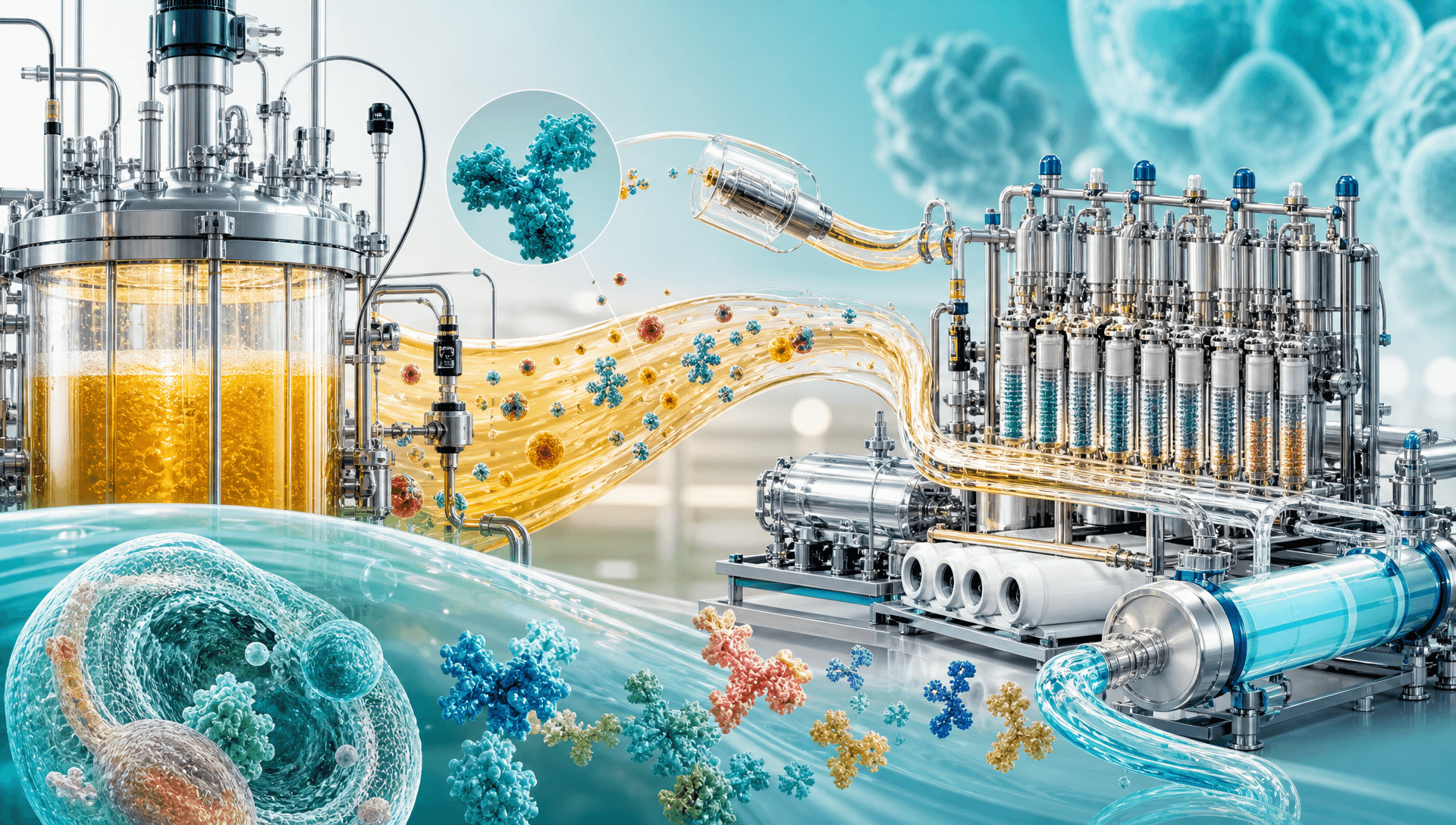
High capacity in bioprocessing means processing more target product with finite equipment, resin, buffer, and manufacturing time while protecting recovery, purity, impurity clearance, and batch consistency. The useful objective is not maximum loading, but a scalable, controllable, and verifiable operating window.
Why high capacity bioprocessing is a system problem
As upstream titers increase in monoclonal antibody, recombinant protein, and other biologics programs, pressure often shifts downstream. More product from a culture does not automatically translate into greater plant output. Harvest volume, capture cadence, resin utilization, buffer preparation, filtration area, equipment turnaround, and analytical capacity can each become the new constraint. The practical question is therefore how to process more material per unit of equipment and time without destabilizing the process.
From a bioprocess perspective, high capacity is not merely the static binding capacity printed on a resin data sheet. It is an operating capability: under defined feed composition, velocity, residence time, bed height, temperature, and buffer conditions, how much target can the medium capture before an accepted breakthrough point, and can it preserve performance through washing, elution, cleaning, and reuse? This definition includes time, mass transfer, impurities, equipment behavior, and lifecycle effects.
A high capacity program should therefore begin by asking where the constraint originates. Early breakthrough may reflect ligand saturation, insufficient residence time, pore-diffusion limitations, feed-viscosity changes, target self-association, competitive binding by impurities, or a shift in bed condition. Without identifying the dominant mechanism, adding resin, reducing flow, or expanding screening can turn a scientific uncertainty into a recurring cost.
Dynamic binding capacity is closer to manufacturing reality
Static binding capacity describes an approximately equilibrium condition. Production chromatography operates under flow. Molecules must move from the mobile phase to the particle surface, diffuse into pores, and bind to ligands while unbound material continues through the bed. Dynamic binding capacity is therefore more useful for estimating load volume, cycle count, resin demand, and operating cadence.
The breakthrough curve is central to interpreting dynamic capacity. As loading continues, target signal at the outlet rises from near baseline, indicating that the binding zone is approaching the column exit. Teams need a breakthrough criterion aligned with product risk, recovery goals, and analytical capability, and comparisons must be made under consistent conditions. Capacity values are not meaningfully comparable when residence time, feed concentration, and breakthrough definition differ.
Residence time connects flow rate to mass transfer. A longer residence time generally gives molecules more opportunity to enter pores and bind, but lowers volumetric throughput. A higher flow rate shortens a cycle but may cause earlier breakthrough when transport cannot keep pace. The real optimization target is the combination of productivity and capacity utilization. The trade-off can become more pronounced for larger molecules, slower-diffusing species, or proteins prone to reversible association.
Feed conditions matter as well. pH, conductivity, temperature, viscosity, target concentration, and impurities such as host-cell proteins, nucleic acids, and aggregates can all influence transport and binding. A capacity measured with a purified model feed cannot replace performance data from representative harvest. Comparisons across lots or scales also require traceable sampling, analytical methods, and material state.

Dynamic binding capacity emerges from flow, film transfer, pore diffusion, ligand binding, and competition from feed components
High capacity must not trade away quality or resin lifetime
Increasing the applied load may reduce resin volume or cycle count, but the benefit exists only if product quality and process robustness remain acceptable. Operating near breakthrough can improve resin utilization while increasing product loss and sensitivity to small disturbances. Excessive loading may also alter impurity distributions and place a heavier burden on polishing operations.
Load studies should therefore be designed together with critical quality attributes and process-performance indicators. Target recovery should be interpreted alongside aggregates, host-cell proteins, residual DNA, leached ligand, charge variants, and virus-clearance performance where relevant. Priorities differ among products, so a fixed checklist cannot replace product-specific risk assessment. In continuous or multi-column operation, valve switching, column imbalance, buffer disturbances, and analytical delay can also propagate local deviations through the system.
Resin lifetime is another part of the economic equation. Strong performance in early cycles does not establish sustained capacity or selectivity. Cleaning conditions can contribute to ligand decay, fouling, or irreversible adsorption, while complex feed components may gradually alter bed performance. A high capacity strategy should include cleaning validation, regeneration, storage, and lifecycle monitoring rather than exchanging short-term throughput for accelerated deterioration.
A robust approach defines a design space and explicit alert or action limits for the variables that matter. Load, residence time, feed concentration, pressure, breakthrough signal, wash volume, and elution conditions should be interpreted as a connected system. High capacity becomes dependable capacity only when recovery, purification, equipment, and quality evidence support the same operating region.
How the loading logic changes in continuous chromatography
A single-column batch process stops accepting feed while the column is washed, eluted, regenerated, and equilibrated. Multi-column continuous chromatography assigns different stages to different columns, allowing feed processing to continue for more of the operating cycle. Product that breaks through one column can be captured by a following column, improving capacity utilization and system productivity.
Continuous operation is not a simple multiplication of single-column settings. Switching logic, each column’s loading history, residence-time distribution, online signals, buffer transitions, and fault recovery need to be modeled and verified. Models can examine interacting parameters across the design space, while process analytical technology helps monitor system state. Both remain dependent on representative material and experimental calibration.
The choice between batch and continuous modes should follow the product and capacity constraint. A single-column process may remain preferable when batch size, scheduling, and installed equipment already meet demand with manageable complexity. A multi-column approach may be attractive when upstream supply is continuous, resin is costly, footprint is limited, or flexible throughput is important. The decision is not about adopting a fashionable label; it is about material balance, control complexity, validation burden, and lifecycle economics.
How MatwingsVenus™(晓鹜™)supports high capacity bioprocess decisions
MatwingsVenus™(晓鹜™) does not replace resin screening, scale-down chromatography, design of experiments, process analytical technology, scale-up studies, or process validation. Its advantage is to strengthen the molecular-evidence layer that is often disconnected from process development. When candidates or lots differ in loading, transport, or aggregation behavior, the platform can help teams build traceable hypotheses from protein identity, sequence, structure, functional sites, and physicochemical attributes.
A typical task can begin with a protein identifier, sequence, structure file, and existing process observations. MatwingsVenus™(晓鹜™) first follows a retrieval-first route through authoritative databases to organize known structural, functional, variant, and measured information. Where curated sources do not answer an attribute question, VenusG can predict protein-level properties such as solubility and stability, with the output explicitly labeled Predicted. VenusX can identify active, binding, and evolutionarily conserved residues, creating protected regions for any subsequent engineering work.
If process data suggest that a liability is molecule-driven rather than solely resin- or condition-driven, the hypothesis can be handed to protein engineering. VenusREM can assess the potential effects of individual mutations on activity, binding, stability, or expression, while VenusPrime supports modeling of multi-site combinations. Candidate output should include the prediction basis, uncertainty, and proposed experiments. Expression, purification, dynamic binding capacity, recovery, impurity clearance, and stability studies must then determine whether the candidate is suitable. The purpose is not to claim that computation directly predicts chromatography productivity, but to separate process-condition limitations from molecule-developability limitations earlier.
MatwingsVenus™(晓鹜™)protein design agent also maintains a distinction among Measured, Predicted, and Unknown and places a human approval gate before compute-intensive tasks. This boundary is valuable for cross-functional work. Process teams can transfer complete observations and conditions to computational specialists; computational teams can return testable candidates and risk statements rather than context-free scores. To explore tools and services relevant to high capacity bioprocessing, teams can consult the MatwingsVenus™(晓鹜™) Mall and connect molecular analysis, candidate assessment, and experimental verification more efficiently.

MatwingsVenus™(晓鹜™) supports root-cause framing at the molecular layer and hands candidates and verification plans back to process experiments
Building a scalable high capacity development path
The first step is to define the business and process objective. Batch output, upstream supply cadence, recovery target, purity requirements, equipment constraints, and acceptable cost need to be explicit. If the endpoint is merely “increase loading,” different functions may apply different definitions of success, leaving the data unable to support a shared decision.
The second step is to establish a baseline. Representative feed should be used to measure dynamic capacity, pressure, recovery, and impurity clearance at a defined residence time and breakthrough criterion. Material attributes and analytical methods should be recorded with the result. This baseline supports resin comparison and helps distinguish later process changes from raw-material or analytical variation.
The third step is to identify the dominant mechanism. Scale-down experiments and molecular analysis can help distinguish site saturation, mass-transfer limitation, competitive adsorption, viscosity effects, aggregation, and bed abnormalities. Once the hypothesis is clear, the team can choose among longer residence time, buffer adjustment, bed-height changes, a different medium, multi-column operation, or molecule engineering.
The fourth step is multi-objective optimization. Productivity, resin utilization, buffer consumption, cycle time, recovery, impurity clearance, and resin lifetime belong in the same decision. A change that improves one metric by transferring risk to the next unit operation is not a complete optimization.
The fifth step is scale-up and control verification. Scale changes can affect flow distribution, residence time, pressure drop, equipment response, and sampling cadence. Continuous processes also require verification of switching logic, disturbance propagation, and recovery from abnormal events. The final design space should be supported by representative experiments, models, and risk assessment, with clear monitoring and response rules.
Robust manufacturing—not maximum loading—is the endpoint
The value of high capacity bioprocessing is better asset utilization and capacity flexibility, but only when product quality, process control, resin lifetime, and scale-up remain defensible. Dynamic binding capacity must be interpreted in the context of representative feed, actual residence time, and real quality targets; otherwise, an attractive capacity value can distract from manufacturing risk.
A more mature strategy gives upstream output, downstream cadence, molecular attributes, chromatography mechanisms, and quality risk a shared decision language. MatwingsVenus™(晓鹜™) contributes molecular evidence retrieval, property prediction, and candidate-engineering support, helping teams form testable hypotheses earlier. Process experiments, equipment studies, and quality validation then turn those hypotheses into a controlled manufacturing window. High capacity becomes a systems-engineering objective rather than a local parameter contest.