Fab Purification Resin: Building a Verifiable Fragment Purification Workflow
Published on September 8, 2026
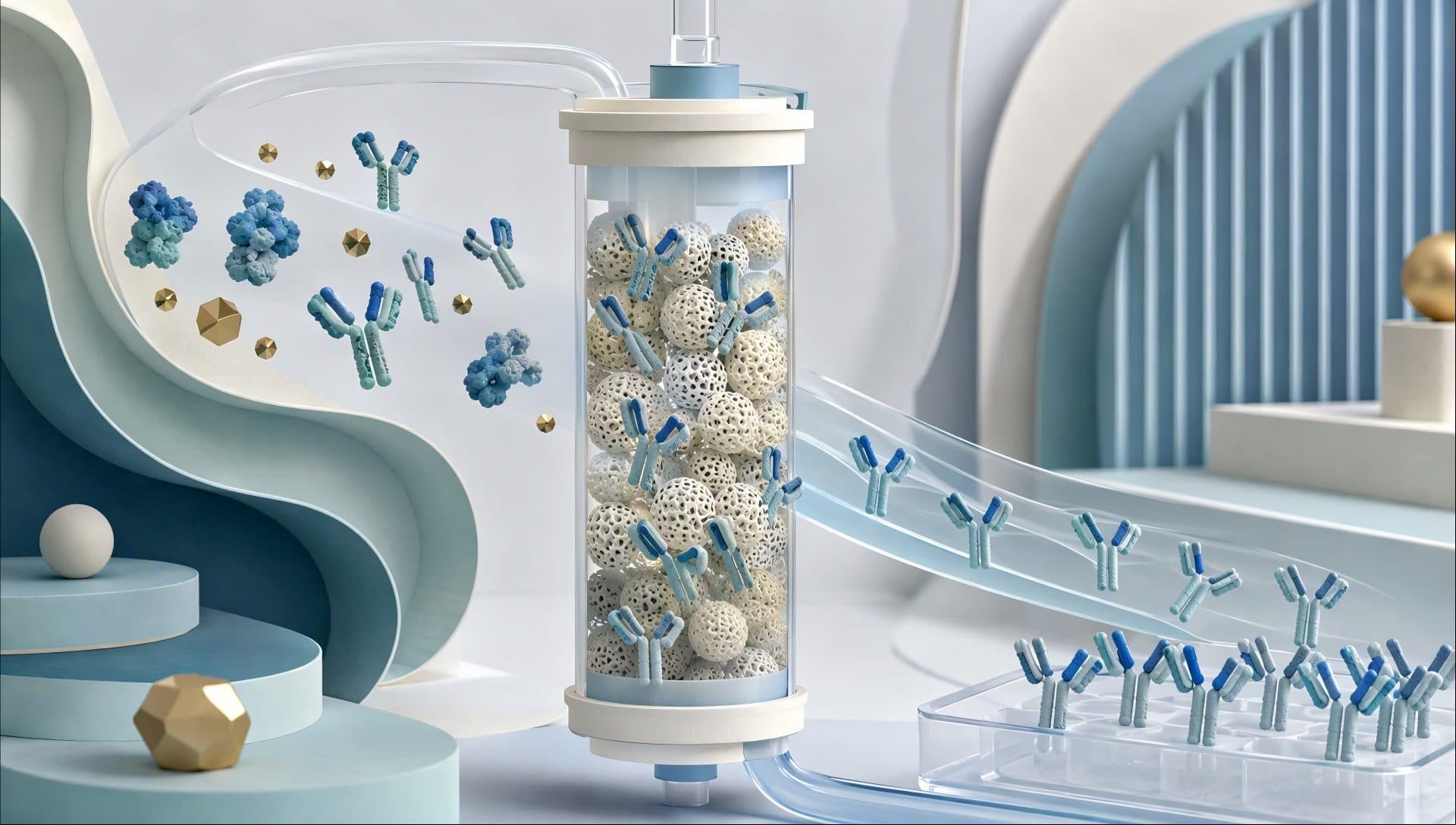
Fab purification resin workflow overview
Fab purification is often framed as a resin-selection problem, but the harder question comes earlier: what molecular feature is actually available for capture? A recombinant Fab may be accompanied by free light chains, misassembled species, host-cell proteins, and nucleic acids. A Fab generated by IgG digestion has a different impurity landscape that may include residual intact IgG, Fc fragments, protease, and aggregates. Applying one generic method to both feeds can produce an attractive chromatogram while leaving recovery, activity, or reproducibility unresolved.
A useful Fab purification resin workflow therefore begins with molecular eligibility, moves through impurity-aware capture development, and ends with orthogonal verification. The aim is not to identify a universally superior ligand. It is to establish a route whose binding mechanism, operating window, and limitations can be demonstrated with representative material.
Gate 1: Define the Fab purification resin eligibility first
A conventional Fab contains an intact light chain together with the VH and CH1 portions of a heavy chain, but it lacks the classical Fc region. This architecture explains why a standard Fc-dependent Protein A workflow often cannot simply be transferred from an intact IgG process. It does not, however, imply that every Fab requires the same alternative resin.
Before screening media, record whether the target is a recombinant Fab, a digestion-derived Fab, or a more complex engineered antibody format. Confirm whether CH1 is intact and accessible, whether the light chain is kappa or lambda, whether its variable-region family falls within the stated scope of a Protein L product, and whether an engineered affinity tag is present and acceptable in the final construct.
These answers point to different capture routes. CH1-specific media target a retained heavy-chain constant domain. Protein L interacts with variable regions from subsets of kappa light chains. Other light-chain ligands may distinguish kappa and lambda constant regions, while tag-affinity media depend on an engineered handle. Published work confirms that CH1-specific and Protein L media recognize different antibody regions and that binding strength can vary among antibodies under the same conditions.
The output of this gate should be a molecular eligibility sheet rather than an early purchase decision: domain composition, species and isotype, light-chain class, tag status, expected concentration, aggregation risk, and a functional assay. In protein engineering projects, sequence boundaries and expression design also matter because truncation, degradation, or incorrect chain pairing can remove or obscure the intended binding site.
Gate 2: Let the impurity profile define the capture job
A recombinant feed and an enzymatic digest ask different questions of a Fab purification resin. For a culture supernatant, the capture step typically needs to enrich Fab away from host-cell proteins, DNA, media components, free chains, and assembly variants. In a digestion mixture, the challenge shifts toward intact IgG, Fc, protease, partially cleaved products, and aggregates. Serum, stabilizers, salt, and viscosity may additionally influence nonspecific binding and pressure.
A compact feed assessment should document clarification, pH, conductivity, turbidity, target concentration, and dominant contaminants. Reducing and nonreducing electrophoresis can reveal chain composition. Size-exclusion chromatography can provide an early view of monomer and aggregate content, while a target-relevant functional assay prevents a misleading outcome in which the sample looks pure but has lost useful activity.
This gate reframes affinity capture as the first element of an impurity-control chain, not a universal one-step solution. Ion exchange, mixed-mode chromatography, hydrophobic interaction chromatography, or size exclusion may still be needed for aggregates, charge variants, residual protease, or product-related species that closely resemble the target.
Gate 3: Match the ligand route to the accessible feature
CH1-specific capture
When the Fab retains an accessible CH1 domain, a CH1-specific medium offers a direct structural rationale and avoids dependence on the light-chain class. It can be attractive for recombinant Fab feeds in which free light chain is a concern and for engineered antibody formats that preserve CH1.
Yet the presence of CH1 is an entry criterion, not a performance guarantee. Domain accessibility, local conformation, species, isotype, and feed conditions can all affect binding. In one published asymmetric bispecific-antibody case, CH1-specific media exploited binding differences between a desired heterodimer and homodimer by-products, and mobile-phase salt influenced selectivity. This is a valuable development clue, but it should not be generalized to every molecule or every CH1 medium.
Protein L and light-chain capture
Protein L bypasses the missing Fc region by recognizing variable regions from certain kappa light-chain families. This can support capture of Fab, scFv, and related fragments that carry an eligible kappa variable region. The key limitation is scope: a kappa annotation alone does not prove binding, and product-specific family coverage must be checked. Lambda-containing molecules and unsupported kappa families require another route.
Protein L can be convenient for discovery-scale biological research, but process development demands more than a yes-or-no binding test. Dynamic binding capacity, residence time, elution recovery, ligand leakage, cleaning compatibility, and activity retention should be assessed together. Supplier data obtained with a standard molecule cannot replace verification using the actual feed.
Affinity tags and non-affinity options
For tagged recombinant Fab constructs, immobilized-metal or other tag-based affinity methods can establish an efficient early workflow for construct screening and analytical sample preparation. The trade-off is a downstream decision about tag retention. If removal is required, cleavage, secondary capture, and residual-control steps must be planned from the beginning.
When no suitable CH1 or light-chain epitope is available, or when affinity-media cost and cleaning requirements do not fit the process, ion exchange or mixed-mode media may serve as capture or intermediate steps. They often require broader condition screening but reduce dependence on a single domain. The best route is therefore the one that balances target architecture, impurity profile, and operational constraints—not the one with the most impressive isolated specification.

Ligand recognition of Fab domains
Gate 4: Establish an operating window at small scale
Once candidate media have been identified, begin with a small prepacked column or microscale screen rather than immediate scale-up. Use one representative feed and a bounded set of variables across binding, washing, elution, and regeneration.
During loading, examine pH, conductivity, target concentration, flow rate, and residence time. Measure target loss in the flow-through instead of judging only the presence of an elution peak. Early breakthrough may indicate ligand mismatch, unfavorable feed conditions, insufficient capacity, or structural heterogeneity in the Fab population.
During washing, remove nonspecific contaminants without trading away recovery. Start near the binding condition and then evaluate moderate salt, pH changes, or additives based on the observed host-cell protein, DNA, or hydrophobic impurity burden. Any additive should also be assessed for effects on activity, downstream assays, and waste handling.
Elution must balance recovery with molecular stability. Acidic elution is common in affinity chromatography, but low-pH tolerance is molecule dependent. Record exposure time, neutralize collected fractions promptly, and compare recovery, monomer content, and function. If mild conditions do not recover enough target, map the boundary with a gradient rather than moving directly to an extreme pH.
Cleaning and regeneration determine whether a method is repeatable. Follow the product-specific instructions for cleaning agent concentration and contact time, then trend capacity, peak shape, pressure, recovery, and carryover over repeated cycles. At an early research stage, a large lifetime study may be unnecessary, but the method should at least demonstrate that performance is not confined to the first run.
Gate 5: Turn purity into a scale-up evidence chain
A robust Fab process answers four classes of questions. Identity confirms that the eluate is the intended fragment with an appropriate chain pattern and molecular mass. Purity covers monomer, aggregates, fragments, host-cell proteins, residual DNA, and process-related impurities. Function demonstrates retained antigen binding or another intended activity. Process performance includes capacity, recovery, pressure, cycle stability, and feed-to-feed variation.
During scale-up, preserve the relevant similarity parameters—such as bed height, linear velocity, or residence time—and re-evaluate system dead volume, gradient delay, packing quality, and pooling boundaries. Static capacity is not a substitute for dynamic binding capacity, and high purity on a small column does not guarantee the same resolution at larger scale. Recording the sample, condition, and analytical method behind every claim makes later technology transfer less dependent on undocumented experience.

Process chain from capture to verification
How MatwingsVenus™(晓鹜™)fits the Fab purification workflow
Fab process development combines literature evidence, product documentation, sequence architecture, and experimental data. MatwingsVenus™(晓鹜™) can help organize retrieval, database queries, and protein engineering tasks into a traceable question set: Is CH1 retained? What is the light-chain type? Which claims are supported, and which still require experimental confirmation? Predictions and design outputs should remain clearly distinguished from measured results and must be connected to chromatography and functional assays.
For product discovery, the MatwingsVenus™(晓鹜™) official mall can be treated as an entry point for reviewing available product information and requesting support. When evaluating a Fab purification resin, check the ligand target, species and isotype scope, matrix and particle characteristics, recommended flow conditions, the test basis for dynamic binding capacity, elution window, cleaning compatibility, storage, and available formats. The public entry point supports initial information gathering; current availability and technical parameters should be confirmed on the product page and with official documentation at the time of selection.
After narrowing the candidates, MatwingsVenus™(晓鹜™) can help map literature statements, supplier conditions, in-house measurements, and unresolved hypotheses. For projects that need changes in construct boundaries, stability, expression, or binding behavior, its protein engineering workflow can support planning and candidate analysis. It does not replace the defining experiment: testing the actual molecule in the actual feed.
FAQ: Common questions about Fab purification resin workflows
1. Does the absence of Fc mean Protein A can never work?
Not categorically. Standard Protein A capture is primarily Fc dependent, so most Fc-free Fab molecules should not be assumed to follow an intact-IgG process. Specific isotypes or constructs may show additional interactions, however. A measured binding test is more reliable than treating either the general rule or an exception as universal.
2. Should CH1 or Protein L be screened first?
Start with structural eligibility. Evaluate CH1 capture when an accessible CH1 domain is retained and light-chain independence is desirable. Evaluate Protein L when the kappa variable-region family is within the stated product scope. If both are plausible, compare them using the same feed and the same decision criteria: recovery, purity, activity, elution severity, and cleaning compatibility.
3. Can F(ab’)2 use related affinity media?
F(ab’)2 generally retains the CH1 and light-chain features found in Fab arms, so CH1- or light-chain-based capture may be structurally plausible. Hinge linkage, conformation, and digestion-derived contaminants can alter performance. Product documentation and a small-scale binding experiment remain necessary.
4. Why are several bands or peaks present after one affinity step?
Possible causes include degradation, misassembly, free chains, incomplete IgG digestion, aggregates, nonspecific adsorption, and heterogeneity created during elution. Reducing and nonreducing electrophoresis, SEC, mass analysis, and functional testing can help identify the cause before adjusting washing, pooling, or polishing.
5. When should a prepacked column be preferred over bulk resin?
A prepacked column supports early screening and reduces packing variability. Bulk resin gives more freedom in column geometry, bed height, and scale. Even when the ligand chemistry is comparable, pressure limits, packing quality, and linear velocity differ, so operating parameters should not be copied without verification.
6. What evidence justifies scale-up?
A candidate should reproducibly capture the target, control flow-through loss, preserve monomer and function after elution, reduce priority impurities, recover performance after cleaning, and behave consistently across representative feeds. A single high-purity gel is not enough to support a scale-up decision.
Conclusion: selection ends with verification, not a long specification sheet
A Fab purification resin connects molecular structure to process behavior. Confirm the available CH1, light-chain, or tag epitope; define the capture task from the real impurity profile; establish binding, washing, elution, and cleaning windows at small scale; then verify identity, purity, function, and process consistency together.
For protein engineering and biological research teams, the most useful medium is not necessarily the one with the largest headline number. It is the route with a clear evidence boundary, reproducible performance, and a credible scale-up path. MatwingsVenus™(晓鹜™) can support evidence organization and task planning, while the MatwingsVenus™(晓鹜™) official mall provides an entry point for checking product information. Final decisions should remain anchored in current technical documentation and representative-sample experiments.