Fab CH1 Purification Resin: From Feed Assessment to Scale-Up
Published on September 7, 2026
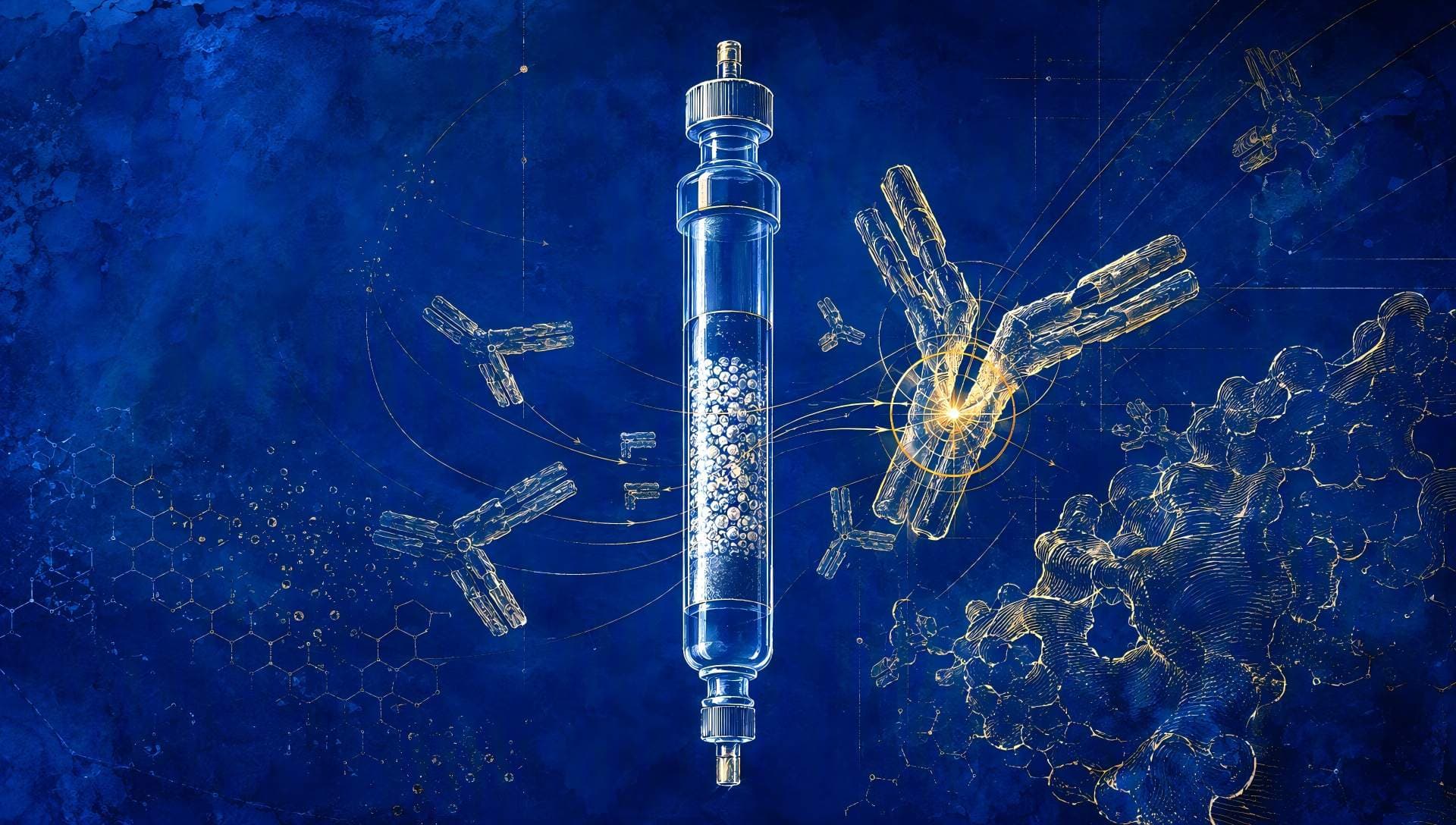
Fab capture through CH1
Start with the feed—and define what success means
Fab CH1 Purification Resin is not successful merely because a chromatographic peak appears. It must capture the intended Fab reproducibly, reduce the relevant impurity burden, preserve biological activity, and leave a feasible path toward cleaning and reuse. At the beginning of a project, a team often has clarified culture supernatant, a target sequence, and limited process information. Running the supplier’s default method may produce data quickly, but it may not reveal what is in the peak, why product is lost in flow-through, or whether the result can be scaled.
A more useful starting point is to split “success” into four questions. Does recovery meet the project requirement? Are free light chain, incorrect assemblies, host-cell proteins, and nucleic acids adequately differentiated? Is antigen-binding activity retained after elution? Can the medium tolerate the intended cleaning and reuse strategy? These questions determine analytical methods and sampling points before chromatography begins.
The structural rationale is straightforward. A Fab generally contains VH, VL, CH1, and CL domains, while F(ab’)2 retains two Fab-like arms. A correctly folded and accessible CH1 domain creates a basis for screening. This differs from the typical Fc-directed mechanism of Protein A and from Protein L recognition of selected kappa light-chain variable regions. The distinction should not be turned into an absolute claim that every Protein A or Protein G medium is incapable of any interaction with an Fc-free construct. Ligand design, antibody subclass, and engineered sequence can produce noncanonical behavior, so the final answer comes from the intended sample.
Checkpoint 1: inspect the molecule before selecting a column
Verify that CH1 is actually present
Sequence annotation is the first gate. Recombinant Fab normally contains CH1, whereas a conventional scFv consists mainly of linked VH and VL domains, and a VHH generally lacks CH1. Some fusion proteins retain “Fab” in their name despite major changes to domain boundaries, linkers, or orientation. A protein engineering team should inspect heavy-chain boundaries, disulfide design, species origin, humanization, mutations, and fusion modules that may shield CH1.
Presence is not equivalent to accessibility. Misfolding, aggregation, local conformational change, or steric masking can reduce ligand engagement. A small-volume batch-binding experiment, microcolumn, or short-column screen can establish whether detectable binding exists before extensive elution optimization.
Build feed complexity into the plan
Culture supernatant, periplasmic extract, and IgG digest present different impurity profiles. Mammalian culture harvest contains host-cell proteins, DNA, medium components, and particles. Bacterial expression can add nucleic acid, endotoxin, and aggregation risks. An enzymatic digest may contain residual intact IgG, Fc-related species, protease, and partially cleaved intermediates.
For Fab affinity purification, record turbidity, target concentration, pH, conductivity, storage history, and sample preparation. If the feed is a digest, identify which impurities also retain CH1. Residual intact IgG can bind through its CH1 domains. Fab CH1 Purification Resin provides domain-level selectivity, but it does not automatically deliver final-product purity.
Checkpoint 2: translate Fab CH1 Purification Resin into testable questions
Public documentation shows that some CH1 media use a compact heavy-chain antibody fragment as the ligand on a porous agarose support. That is one implementation rather than a universal definition. Resin selection should separate five elements: ligand architecture, support matrix, coupling chemistry, mass transfer, and cleaning compatibility.
First, examine recognition scope. A specific product may report coverage across several human IgG subclasses and independence from kappa or lambda light-chain type. Such evidence belongs to that product and validated molecular scope. Non-human antibodies, substantially engineered CH1 domains, and complex fusions still require direct binding confirmation.
Second, examine impurity boundaries. Documentation for selected media indicates that free light chain and light-chain dimers are not co-purified in certain recombinant Fab production settings. This can be valuable when expression produces incomplete assemblies, but it does not prove that every free-chain species will flow through every feed. Nonspecific adsorption, light-heavy-chain complexes, and aggregates can change the outcome.
Third, examine process compatibility. Particle properties, support rigidity, pressure limits, recommended velocity, ligand leakage, storage solution, and cleaning tolerance determine how a medium can be used. A discovery column may prioritize speed and low sample consumption, whereas manufacturing development emphasizes bed stability, cycle life, and performance after cleaning. The suitability of Fab CH1 Purification Resin must be defined for the intended development stage.

Fab binding inside porous affinity beads
Checkpoint 3: use the first run to identify failure modes
The first chromatography run should create a map rather than claim an optimum. Use representative feed, begin with a mild near-neutral equilibration condition, and explore wash strength and acidic elution in controlled steps. A supplier manual can define an initial region, but differences in Fab charge, hydrophobicity, aggregation tendency, and conformational stability prevent a manual from functioning as a transferable manufacturing recipe.
During loading, monitor flow-through. Early target breakthrough can reflect insufficient residence time, overestimated capacity, a poor CH1-ligand match, or feed conditions that inhibit binding. Instead of immediately increasing load, vary one factor at a time—such as flow, pH, conductivity, or particle burden—to distinguish the cause.
During washing, search for a window in which impurities decrease without significant product loss. Moderate changes in ionic strength, buffer composition, or wash volume may reduce nonspecific retention. Every change should be closed with recovery and functional measurements rather than judged only by a flatter UV baseline.
During elution, inspect peak shape, recovery, aggregation, and activity together. Acidic elution is common in affinity chromatography, but an acid-sensitive Fab can continue to change after peak collection. Pre-positioned neutralization buffer, shorter low-pH exposure, and reduced hold time may matter more than a narrow peak. For difficult-to-elute products, compare buffer species and gradient designs instead of simply applying harsher conditions.
At the end of the first run, classify the failure mode: no binding, binding with insufficient capacity, binding with poor elution, or successful elution with deteriorated quality attributes. Each category points to a different next experiment and avoids changing every variable at once.
Checkpoint 4: use fraction analysis to learn what the resin did
A chromatogram reports absorbance over time; it does not prove identity or purity. Retain load, flow-through, wash, eluate, and post-regeneration samples and use orthogonal analytics to answer four questions.
First, where did the target go? Reducing and nonreducing electrophoresis, capillary electrophoresis, or mass spectrometry can assess Fab integrity. Quantitative assays are needed for mass balance, so eluate concentration is not mistaken for total recovery.
Second, where did the major impurities go? Depending on feed type, evaluate free light chain, light-chain dimers, residual intact IgG, host-cell proteins, DNA, protease, and aggregates. If an impurity also contains CH1, affinity capture may not resolve it adequately. Ion exchange, mixed-mode chromatography, or size exclusion may be required as polishing.
Third, was function retained? Fab is valuable because of antigen binding. A functional assay should be incorporated before all purification conditions are frozen. High recovery with reduced binding activity is not a good process condition.
Fourth, is the medium clean? Post-regeneration blanks, ligand-leakage measurements, and pressure trends can reveal carryover, fouling, or support damage. Selectivity and cleanability should be assessed together when Fab CH1 Purification Resin moves toward multi-cycle evaluation.
Checkpoint 5: move from screening to a scalable process
Scale-up is not a simple multiplication of column volume. Linear velocity, bed height, residence time, system dead volume, and pressure limits affect transport and peak dispersion. Establish an acceptable load window at small scale, then verify that dynamic capacity, peak shape, and quality attributes remain consistent at an intermediate scale. Record feed lot, breakthrough definition, and sampling method so the result can be reproduced.
Cycling studies must include the intended cleaning strategy. Repeating only binding and elution cannot represent useful operating life. Track recovery, impurity clearance, pressure, peak position, and blank carryover across cycles. A slow drift can reflect feed fouling, ligand inactivation, support compression, or equipment effects; the mechanism matters because each requires a different corrective action.
Economics should enter at this checkpoint. A highly selective affinity medium may reduce polishing burden while introducing higher resin cost or tighter cleaning constraints. Consider resin price, usable cycle count, batch throughput, analytical burden, and failure risk within the same process model. Only then can a team decide whether Fab CH1 Purification Resin should become a platform capture step.
Three difficult branches: F(ab’)2, bispecifics, and non-human molecules
F(ab’)2 retains CH1 and therefore has a structural basis for screening. Its bivalent architecture, larger size, and mass-transfer behavior differ from Fab, which can change apparent binding strength and elution shape. Fab conditions may be used as a starting point, but capacity, aggregation, recovery, and activity must be re-established. Digestion-based production also requires attention to residual IgG and cleavage intermediates.
CH1-containing asymmetric bispecific antibodies create another possible application. Published work has shown that selected CH1-specific media can bind different human antibodies with different strengths. In one defined bispecific case, mobile-phase and elution optimization amplified that difference and improved separation of heterodimer from homodimer. This is a molecule-dependent process window, not evidence that the medium inherently fails to bind homodimer, and it should not be generalized to every bispecific construct.
Non-human antibodies require additional caution. Public media often specify a human IgG scope. A nominal CH1 domain is not sufficient evidence of suitability for mouse, rabbit, or other species. Confirm supplier coverage and perform a small-scale binding experiment before committing material.
Where MatwingsVenus™(晓鹜™)product capabilities fit in the workflow
The official company site lists chromatography consumables as a business direction and describes combining MatwingsVenus™(晓鹜™)-related technology with resin and consumables development. The useful role of AI is not to claim that it can automatically select an ideal resin. It is to turn scattered information into a traceable research program.
At project initiation, the inputs are the target format, feed type, and process question. MatwingsVenus™(晓鹜™) can use deep research to organize CH1 biology, documented media boundaries, and process risks, producing an evidence-labeled shortlist and explicit unknowns; the next step is a small-column experiment designed by the development team. During molecular confirmation, protein database queries can verify sequence, species, and domain annotations. During candidate evaluation, protein function prediction should be treated as a Predicted hypothesis and kept separate from measured literature data, internal experiments, and Unknown items. Unidentified sequences should be resolved first, and computationally intensive work should proceed after user confirmation.
For product selection, MatwingsVenus™(晓鹜™)-related chromatography consumables and other candidate specifications can be placed into the same requirement checklist: recognition scope, support, operating window, cleaning compatibility, lot documentation, and technical support. The official marketplace page associated with MatwingsVenus™(晓鹜™) can serve as an information and inquiry entry point, but its publicly accessible homepage alone does not verify that a specific Fab CH1 Purification Resin is currently listed. Availability and performance must be confirmed through the specific product page, technical documentation, and representative-feed experiments.
This chain—evidence organization, sequence verification, candidate comparison, small-column testing, and cycling—connects MatwingsVenus™(晓鹜™) product capabilities to real protein engineering and biomedical research needs without turning an AI output into an experimental claim.

Fab purification development loop
FAQ about Fab CH1 Purification Resin
Can it purify every Fab?
No. Fab normally contains CH1, but binding can depend on species, subclass, sequence variation, folding, and epitope accessibility. Molecules outside the documented product scope should be evaluated by batch binding or small-column chromatography.
How should a CH1 route be compared with Protein L?
A CH1 route targets the heavy-chain constant domain, while Protein L commonly recognizes selected kappa light-chain variable-region families. CH1 is worth screening when the target has lambda light chain, free light chain is an important impurity, or CH1-specific selectivity is desired. If the molecule lacks CH1, another capture handle is required. Neither route has a universal ranking.
Why can a high elution peak coexist with poor recovery?
Peak height depends on volume, concentration, and dispersion; it does not equal total recovered mass. Quantify target in the load, flow-through, wash, and eluate to build a mass balance and identify irreversible binding, aggregation, or handling loss.
Can serum-containing culture medium be loaded directly?
That cannot be guaranteed from ligand selectivity alone. Serum proteins, lipids, particles, and other components can affect pressure, nonspecific adsorption, and cleaning. Product documentation and feed-specific tests should determine whether dilution, filtration, buffer exchange, or another pretreatment is required.
Can one affinity step meet final-product requirements?
It should not be assumed. Residual intact IgG, CH1-containing misassemblies, aggregates, and charge variants may co-elute. The need for polishing is determined by the target quality profile and analytical results.
Which indicators best predict scale-up success?
Evaluate dynamic capacity, recovery, impurity clearance, biological activity, pressure, ligand leakage, post-cleaning carryover, and multi-cycle performance together. Neither a single purity value nor one chromatographic peak is sufficient.
Conclusion
Fab CH1 Purification Resin converts an accessible CH1 domain into a testable affinity-capture mechanism. A reliable process does not begin by copying one parameter set. It begins with molecular architecture, feed impurities, and a clear definition of success, then converges through failure-mode identification, fraction analysis, condition screening, cycling, and scale-up assessment. MatwingsVenus™(晓鹜™) can support evidence organization, information verification, and experiment definition; whether a resin fits the project must still be answered with representative material, explicit boundaries, and reproducible data.