
What can the Evo protein model really do? What gives it the power to read and rewrite life's instructions?
Published on November 1, 2026
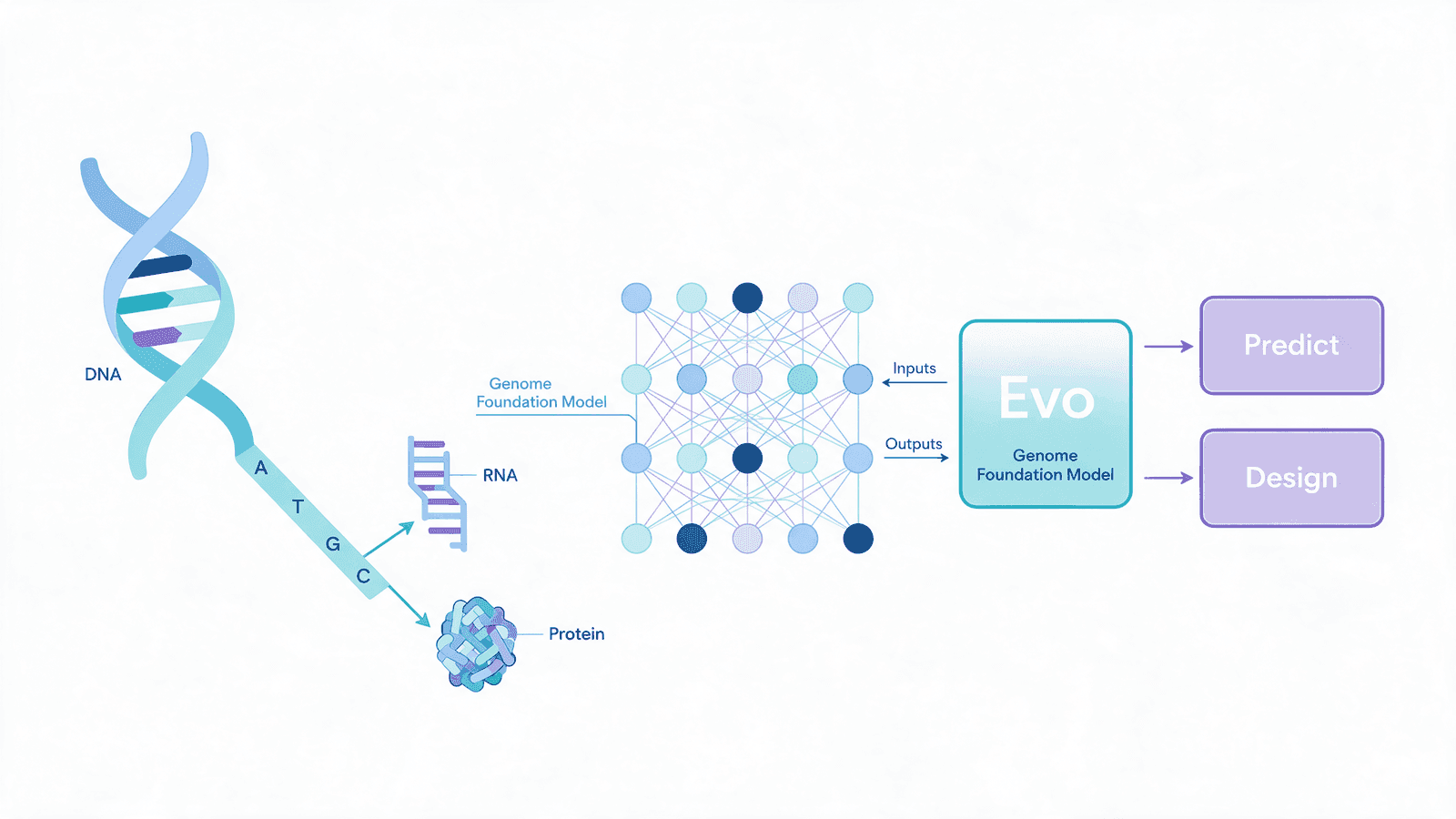
Figure 1 Conceptual overview of Evo: from DNA to prediction and design
【Category】D (AI / Algorithm / Platform)
In the central dogma of molecular biology, DNA writes the instructions, RNA delivers them, and proteins carry them out. In the past we could only decode those instructions one experiment at a time. The Evo protein model takes a different route: it treats vast collections of genomes as a corpus and lets AI learn the “grammar” of life the way it learns a language. It places DNA, RNA and proteins into a single sequence model that can both predict and generate.
1. Where Evo comes from: why do we need a genome-level AI model?
Evo was born from a simple judgment: life's program is written in the genome, and to truly “compute” life, a model must see an entire DNA strand, not just a protein sequence.
To see why, compare it with existing tools.
• Most traditional AI protein tools focus only on the protein sequence (amino acids) or a single mutation, stopping at the single molecule.
• But many functions are determined by several genes, even the whole genome. Evo pushes the modeling scale to the genome, closer to real biological systems.
• An analogy: if a protein language model is an AI that can “write sentences,” Evo is more like an AI that can “read and write whole essays.” The more it reads and the wider the view, the more complete its understanding of biological logic.
Deeper still, no protein sequence exists in isolation. Its position in the genome, surrounding regulatory elements and codon usage bias all affect its expression and function. Evo captures that context, so design no longer fixates on a single molecule.
2. Principles and structure: how Evo models DNA, RNA and protein at single-nucleotide resolution
Evo treats every DNA base as a letter and processes context up to 131,000 or even 1 million bases at single-nucleotide resolution, letting the model transfer learning across the three “languages” of DNA, RNA and protein.
This is the technical root of Evo's versatility, and what sets it apart from many single-protein tools.
• 【Architecture】Evo 1 uses a hybrid architecture (StripedHyena / deep signal processing) combining convolution (capturing local motifs) with attention (capturing long-range dependencies), keeping near-linear scaling of compute and memory at long context.
• 【Training scale】Evo 1: 7B parameters, 131 kb context (131,072 bases), trained on 2.7 million prokaryotic and phage genomes. Evo 2: 40B parameters, 1 Mb context (1 million bases), trained on 9.3 trillion nucleotides across more than 128,000 complete genomes and metagenomes covering all domains of life.
• 【Why it matters】Single-nucleotide resolution lets the model see codons, gene structure and even non-coding regions, not just amino acids. This is the root cause of its zero-shot function prediction across DNA, RNA and protein.
• 【Cross-scale】Because it has seen whole genomes, Evo can also understand how a single-base change affects the fitness of an entire organism, offering a genome-level view for variant assessment and sequence design.
• 【Open ecosystem】The weights and code of Evo and Evo 2 are open source (GitHub, HuggingFace), so researchers can reproduce, fine-tune and integrate them into their own pipelines.

Figure 2 Hybrid neural architecture at single-nucleotide resolution
3. Capabilities and limits: what should Evo predict, and what can it design?
Evo's capability can be summed up in two verbs—predict and design: predicting how gene variants affect function, and designing new proteins, CRISPR systems and even whole genomes; yet it is not omnipotent, and its limits are real.
First, what it does well.
• 【Prediction】Identifying disease-causing mutations (variant effect prediction) and assessing gene essentiality.
• 【Design】Generating new proteins and protein-nucleic-acid complexes, designing functional CRISPR-Cas genome editors, and even producing near-eukaryotic-length genomes.
• 【Co-design】Protein-RNA and protein-DNA co-design; this cross-molecule generation is beyond many single-protein tools.
• 【For engineers】For protein engineering, Evo acts like a broad sampler: it rapidly produces many diverse, expressible candidate sequences, turning “which few thousand should I test” into “the few thousand the model pre-filtered,” sharply cutting early experimental trial-and-error.
• 【Limits】Benchmark studies indicate Evo 2 has “blind spots” in short-range signals such as codon usage bias and is sensitive to some biologically neutral context features. The model yields statistically plausible sequences, not necessarily functional ones; the final verdict requires wet-lab validation. This is the precondition for prudent use.
4. Conditions and workflow: how to use Evo in real protein engineering
Turning Evo's computation into a product calls for engineering discipline: defining the goal, controlling input quality, iterating over rounds, and ultimately returning to the wet lab to validate and screen.
No matter how smart the model, adoption still depends on engineering method.
• 【Define the task】Predict function, find key sites, or design new sequences? Different tasks need different inputs and acceptance criteria.
• 【Control the input】Reference sequences, species background and context must be accurate; outputs should satisfy physicochemical constraints rather than merely “look like the training data.”
• 【Iterative loop】Generate → score/filter (multi-objective evaluation such as energy and structural plausibility) → wet-lab validation → feed real data back to the model, forming an AI plus wet-lab loop.
• 【Combine tools】Use Evo for broad sequence-space exploration, then converge with structure, activity and developability evaluation—far more reliable than “generate once and gamble.”
• 【Evaluation metrics】When evaluating, combine model scores with physicochemical constraints: structural plausibility, solubility, thermal stability and developability, using multiple lines of evidence to cross-check rather than relying on a single score.

Figure 3 AI and wet-lab closed loop for protein engineering
5. Connecting to MatwingsVenus® (protein agent): engineering the AI plus wet-lab closed loop
MatwingsVenus® (晓鹜®) treats open genomic foundation models such as Evo as one “sequence-exploration engine,” emphasizing an engineered loop of computational design, wet-lab validation and data feedback, rather than a single one-shot output from one model.
This is the critical step from foundation model to real product.
• 【Platform positioning】MatwingsVenus®(晓鹜®) is an AI-driven protein intelligence design and process platform focused on turning frontier foundation-model capability into producible candidate sequences and processes.
• 【Pipeline】Sequence generation (broad exploration with models such as Evo) → multi-objective evaluation (activity, stability, developability) → wet-lab screening and scale-up.
• 【Note】Specific model integration and parameters follow official information; this article only describes the platform paradigm and open ecosystem and does not claim “Evo is built in.” Open-source models provide open-ended exploration; professional evaluation and wet-lab work provide convergent delivery; the two complement each other.
FAQ: about the Evo protein model
Q1: How is Evo different from AlphaFold?
AlphaFold mainly predicts three-dimensional structure from sequence; Evo is a sequence language model that predicts and generates directly at the DNA, RNA and protein sequence level. They complement rather than replace each other.
Q2: Can I use Evo directly in my own project?
Yes. The weights and code for Evo and Evo 2 are released open source (GitHub, HuggingFace) and can be deployed as needed; but the generated results still need project-specific evaluation and wet-lab validation.
Q3: Are the sequences Evo generates “real proteins”?
No. Evo generates statistically plausible, evolution-consistent sequences; that is a computational prediction. Whether they are functional proteins must be decided by experimental data, not by model output alone.
Q4: Can Evo guarantee success when engineering a protein?
No. The model outputs candidates; success depends on task complexity, input quality and validation design. The industry-standard approach is broad exploration plus multi-objective screening plus iterative feedback to reduce uncertainty.
Summary
The Evo protein model turns the “language of life” into computable sequences, using genome-scale data and single-nucleotide resolution to span from variant prediction to protein and genome design. Its value lies not only in generating more plausibly, but in establishing the AI plus wet-lab closed-loop paradigm. Real adoption depends on feeding predictions back to experiments and feeding experiment data back to the model. MatwingsVenus® (晓鹜®) follows this compute-validate-iterate chain, combining open foundation models with professional evaluation, wet-lab screening and scale-up, so AI-generated candidates finally become producible.
【Bottom line】Evo turns DNA, RNA and proteins into computable sequences, letting AI both predict function and design proteins and genomes from scratch.
