
What is the ESM Protein Language Model? How AI Reads Proteins from Evolution
Published on October 28, 2026
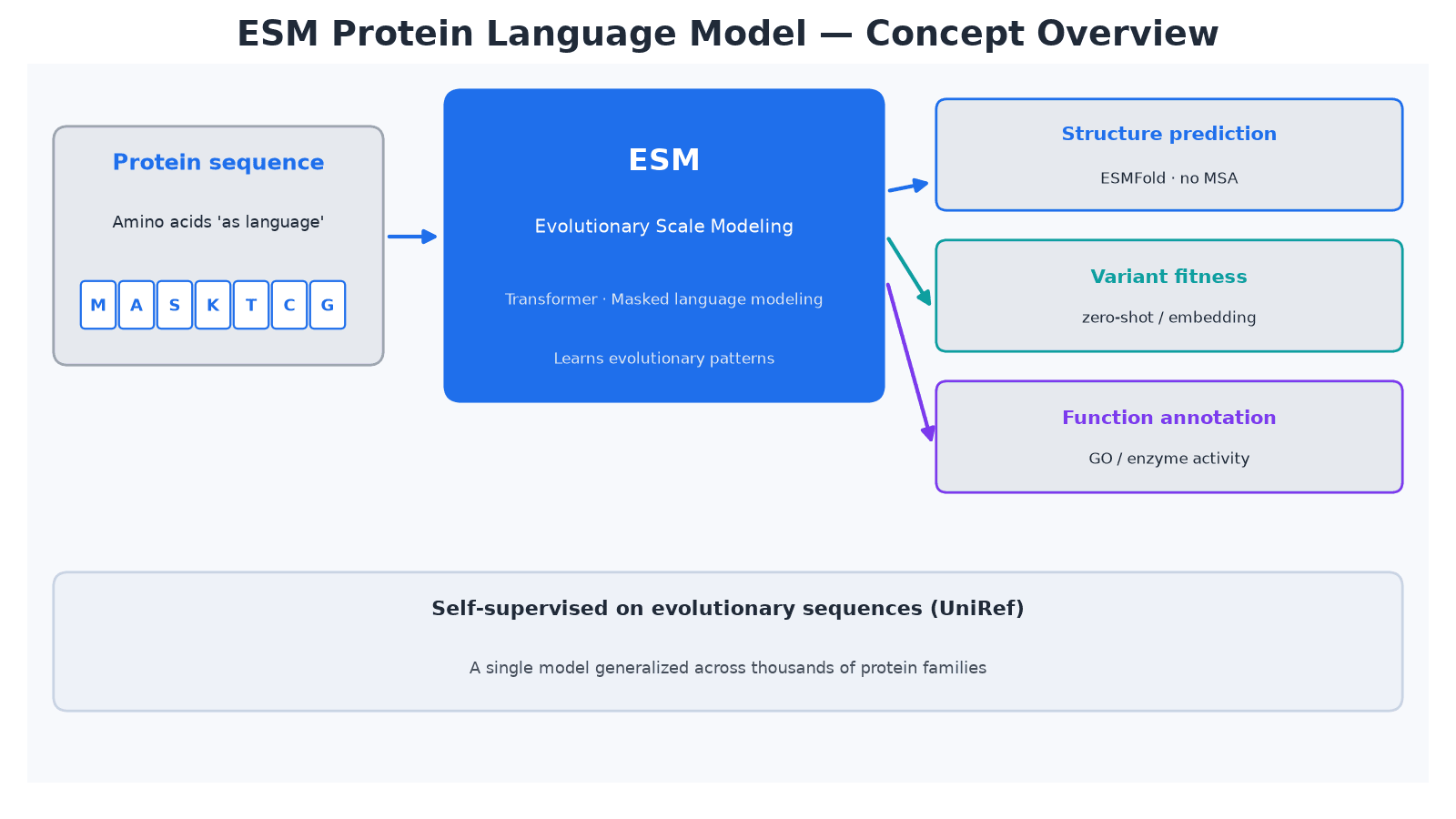
Figure 1|The ESM protein language model turns sequences into structure, fitness, and function predictions.
Introduction
If you hand a computer an amino acid sequence, can it "read" it the way it reads a sentence—figuring out what the protein looks like, what it does, and how useful it is? That is what the ESM protein language model sets out to do: treat the hundreds of millions of sequences evolution has left behind as a textbook, let the AI learn the "grammar" of proteins without human labels, and offer well-grounded guesses where no experimental data exists.
For teams working on enzymes, antibodies, or protein drugs, the real pain point is often "search space too large, experiments too expensive": change just a dozen positions in a protein and the combinations can reach the hundreds of millions, so running every experiment is impractical. The idea behind models like ESM is not to replace your experiments, but to first pick out "the ones most worth doing," so limited experimental budgets are spent where they truly matter.
1. Background: Protein "Language" Is Written in Evolution
ESM stands for Evolutionary Scale Modeling, iterated continuously by the Meta AI (FAIR) team from 2019 to 2023. It is called a "language model" because it treats protein sequences as sentences and the 20 amino acids as a vocabulary, drawing on the Transformer and masked language modeling ideas already proven in natural language processing.
The key insight is that which residue appears at a given position is not random: its neighbors constrain it structurally and functionally, and hundreds of millions of years of natural selection have "written" those constraints into the sequence itself. ESM's goal is to learn this implicit set of constraints from large collections of natural sequences.
This is where "self-supervision" matters: training needs only the sequences themselves, not human labels, so the available "textbook" is nearly limitless—think of the hundreds of millions of protein sequences in UniRef. By contrast, methods that rely on multiple sequence alignment (MSA) simply "miss class" when a protein has few homologs. The value of the language model is that it compresses "evolutionary history" into its huge parameters, so even when facing unfamiliar sequences it can reason from a general understanding of "protein grammar"—something traditional similarity search struggles to do.
2. Principle: Masked Language Modeling + Transformer, Learning Structure Self-Supervised
ESM learns through "masked language modeling": randomly cover some amino acids in a sequence, then ask the model to predict which residue was masked based on context; the better it guesses, the deeper its understanding of the rules behind the sequence—much like a student learning grammar through fill-in-the-blank exercises.
Because it needs no human labels, ESM trains self-supervised on millions to hundreds of millions of sequences. ESM-2, for example, spans from about 8 million to 15 billion parameters and is trained on the UniRef database; larger models generally represent structure better, but at higher compute cost. The "representation" (embedding) can be understood as the model computing a set of high-dimensional numbers for each sequence that "summarize" its structural and functional properties, so downstream classifiers or predictors can be attached.
The "attention" mechanism in the Transformer lets the model "see" other positions across the whole sequence at once when predicting one position. Researchers found that some internal attention heads in ESM correspond to residue pairs that are far apart in sequence but close in the folded protein—meaning 3D structural information is not taught by labels but "emerges" spontaneously while learning sequence patterns.

Figure 2|ESM learns structural information from sequences via masked language modeling.
Following this thread, Meta AI released ESMFold in 2022: by adding a "folding head" on top of ESM-2, it predicts atomic-level 3D structure directly from a single sequence, without multiple sequence alignment (MSA) or templates. Published in Science in 2023, the work showed the language-model route can rival alignment-based methods in accuracy while being faster—often producing a structure in seconds to tens of seconds for a few-hundred-residue protein.
3. Applications and Selection: Choose the Right "Mode"
The ESM protein language model is not a single tool but a "capability panel" that can be unpacked by task. Before using it, ask three things: do I want "description" or "prediction"? Do I have experimental labels? Do I care more about speed or accuracy?
• General representation (embedding):converts a sequence into a high-dimensional vector for downstream classification and clustering, commonly used for function annotation, mining similar proteins, or as "input features" for other models. It needs almost no extra labeling from you.
• Variant fitness prediction:scores single or multiple amino-acid substitutions to estimate their effect on protein function, ideal for zero-shot screening of candidate mutations—prioritizing before any experimental data exists.
• Structure prediction:attach a folding head (e.g., ESMFold) to go from a single sequence to a 3D structure, suited to proteins with few homologs or when you just want a quick look at the backbone.
• Generation and design:next-generation models such as ESM3 (EvolutionaryScale, released 2024) place sequence, structure, and function in a multimodal generative framework, enabling design of entirely new protein sequences—even new variants with very low sequence identity to known fluorescent proteins.
A practical rule of thumb: with no measurements, use zero-shot scoring or a general representation to screen first; with a few dozen to a few hundred assay labels, use the embedding as features and stack a lightweight model; with more labels, consider fine-tuning the full model. Note that "prediction" and "generation" are two different goals—the former tells you which variants are better, the latter writes new sequences—so don't conflate them. Either way, the model output is a "candidate list," not a final answer.
4. Performance, Boundaries, and the Engineering Loop: Prediction Is Not Measurement
The boundary must be stated clearly: ESM offers "well-grounded recommendations and rankings," not experimental values. Its strength is proteins with evolutionary homologs; for de novo designs or sequences lacking evolutionary footprints, prediction confidence drops noticeably. Larger models tend to be more accurate, but at higher inference latency and cost; very long sequences are also limited by the context window. All of these are trade-offs to weigh when choosing.
The practical approach is to place ESM-class models in an "active learning" loop: design a variant library → express and assay → train a fitness model from embeddings plus assay labels → predict and rank the next candidates → return to design. The key is iterating on model predictions together with measured data, rather than using model output as a conclusion directly.
The benefit of active learning is direct: because each round prioritizes testing "the variants most likely to be valuable," you converge on high-fitness variants faster with fewer experiments, shortening development cycles and reducing trial-and-error cost. A more robust practice is to validate on a portion of known results first—checking how accurately the model estimates existing data and whether its ranking is reasonable—before deciding where to use it, so you are not misled by overconfident scores.

Figure 3|Combining ESM embeddings with experimental data forms an active learning loop.
5. From General Model to Deployment: Pairing with MatwingsVenus® (晓鹜®)
ESM-class language models provide an "evolutionary-scale" general prior, and MatwingsVenus® (晓鹜®) layers experiment-data-driven protein engineering on top: using language-model representations to assist directed evolution, structure, and function prediction, forming an "AI inference + measured calibration" loop.
In the MatwingsVenus® (晓鹜®) workflow, general language-model representations are often combined with experimental information such as structure, activity, and stability to form decision-making evidence that better reflects real needs, helping R&D teams invest limited experimental resources in variants and process routes more likely to succeed. Matwings Technology continues to push protein AI toward engineering deployment in this direction, so that "general models" truly serve concrete projects such as targets, enzymes, and antibodies.
6. FAQ
How is the ESM protein language model different from AlphaFold?
AlphaFold relies on multiple sequence alignment (MSA) and template information to predict structure, usually with higher accuracy but requiring homologous sequences. ESM (especially ESMFold) starts from a single sequence, predicts structure faster, and handles cases with few homologs more conveniently. The two are complementary.
Can the ESM protein language model replace experiments?
No. It provides computational predictions and rankings based on evolutionary patterns, not measured values. It is best for shrinking the search space and prioritizing candidates; final conclusions still require experimental validation.
Do I have to write code to use ESM?
Not necessarily at the implementation level. Mainstream models already expose calling interfaces on public platforms; what matters for an R&D team is whether the model can be combined with its own experimental data. Platforms such as MatwingsVenus® (晓鹜®) wrap the underlying models into task-oriented workflows.
Which proteins is ESM best suited for?
It is strongest on proteins with homologous sequences and rich evolutionary information, such as common enzymes, antibodies, and receptors. For de novo designs or proteins lacking evolutionary footprints, prediction reliability decreases and must be judged against real measurements.
7. Summary
The ESM protein language model turns "evolution" into a computable source of knowledge: through masked language modeling plus a self-supervised Transformer, it learns the structural, functional, and fitness rules of proteins from massive sequence data. It excels at giving well-grounded predictions where no experimental data exists, accelerating structure prediction, variant screening, and function annotation—yet it has boundaries: it provides recommendations and rankings, not confirmation. The key to real deployment is embedding such models into a "predict–measure–retrain" loop and amplifying their value with platform tools.