Custom Affinity Ligand Development: From Requirements to Validation
Published on September 7, 2026
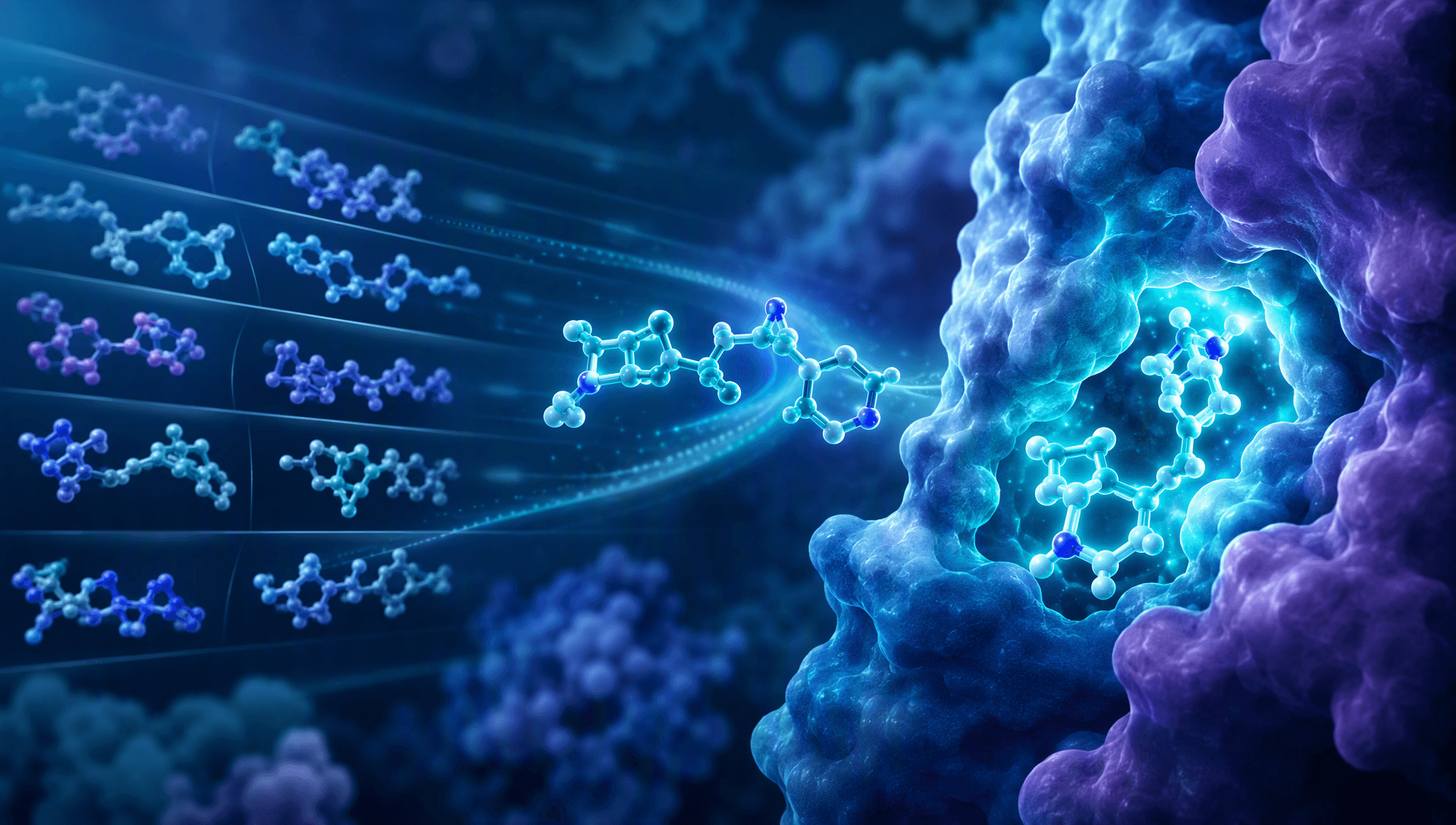
A designed protein ligand recognizes a target through a complementary interface
Introduction
Ligand proteins are protein-based binders designed or selected to recognize a target molecule or a defined target surface. They can support detection, separation, imaging, structural studies, and functional modulation. The central task in custom affinity ligand development is not choosing a fashionable algorithm; it is translating “what should bind, where, how strongly, under which conditions, and with what evidence” into testable specifications. Only then can a team select among database retrieval, natural binder discovery, engineering of an existing scaffold, or de novo design while balancing affinity, specificity, stability, expression, and application constraints.
Custom affinity ligand development starts with five questions
A frequent early-stage mistake is to use “high affinity” as a substitute for a complete requirement. Affinity matters, but epitope location, cross-reactivity, dissociation rate, pH and temperature tolerance, expression host, and immobilization chemistry can decide whether the binder works in practice. An affinity-capture ligand must combine binding with manageable elution. A detection reagent must control background and batch variability. An interface blocker must recognize a functionally relevant surface.
Five groups of inputs should be frozen before design begins:
1. Target definition: sequence, structure, isoform, species, and relevant conformational state;
2. Binding mode: desired epitope, competitive relationship, and whether reversible binding is required;
3. Application environment: buffer, temperature, salt, pH, and complex sample matrix;
4. Engineering constraints: molecular size, tag, host, immobilization, or conjugation needs;
5. Acceptance criteria: affinity, specificity, stability, expression, and functional assay.
Submitting this information to the marketplace operated by MatwingsVenus™(晓鹜™) provides a more useful brief for matching research products and customized services than simply requesting “a ligand protein.” It also exposes missing data before expensive work begins.
Discovery, engineering, and de novo design solve different problems
Custom protein binders can begin from three distinct starting points. Retrieval and discovery search reported antibodies, binding proteins, interfaces, and homologous families before new design is attempted. Existing-scaffold engineering applies functional-site protection, single-mutation scans, multi-mutation modeling, or directed evolution when a workable parent sequence is already available. De novo design becomes appropriate when no suitable scaffold exists or when geometric and application constraints cannot be met by known candidates.
Directed evolution creates genetic diversity and then enriches variants with desired properties through screening or selection; library generation and isolation of target variants are its two central operations. High-affinity ligand development therefore depends not only on library size but also on selection pressure, negative selection, and assays that represent the intended operating environment.
When a parent binder and a defined limitation are available, protein engineering can preserve known strengths while improving a target property. De novo design opens a larger structural space but demands stronger validation of folding, expression, and binding. MatwingsVenus™(晓鹜™) separates the engineering of an existing protein from the creation of a new binder, preventing unlike projects from being forced through a single algorithmic route.

Sequence, structure, and experimental constraints define the candidate landscape
How custom affinity ligand development should rank candidates
Candidate selection works best as a layered funnel. The first layer checks sequence integrity, repeats, unstable regions, and obvious expression risks. The second examines structural feasibility and interface geometry. The third evaluates target binding and off-target risk. The fourth asks whether performance is compatible with the real application. This hierarchy is more interpretable than ranking every sequence by one composite score and makes failure analysis easier.
Computational methods can compress the search space, but they do not directly replace measured affinity. A recent review notes that deep-learning affinity prediction remains limited by database quality, input representation, and model architecture. Even when a model produces an attractive structure or score, confidence measures such as pLDDT, ipTM, and pAE describe structural confidence and should not be presented as Kd, biological activity, or experimental success rates.
Wet-lab progression should use independent evidence. Expression and purity assess manufacturability. SPR, BLI, or ITC can characterize binding kinetics or thermodynamics. Competition assays and panels of related proteins probe epitope behavior and selectivity. Thermal stability, freeze-thaw testing, and performance in the intended buffer reveal application fitness. Ligand protein design becomes product development only when computational ranking and experimental readouts form a closed loop.
Failure patterns often point back to the project definition
If every candidate expresses poorly, the scaffold, signal peptide, boundaries, and host deserve review before more similar sequences are generated. If proteins express but do not bind, teams should re-examine target conformation, epitope accessibility, and assay design. If affinity appears adequate but the application fails, dissociation conditions, nonspecific adsorption, matrix interference, or immobilization orientation may be responsible.
Another mistake is optimizing prematurely for the lowest possible Kd. An extremely slow off-rate is not always beneficial when reversible elution or rapid turnover is required. In detection and enrichment workflows, specificity, background, capacity, and reuse stability can be as important as affinity. Custom affinity ligand development should optimize the intended use, not a single attractive number.
The MatwingsVenus™(晓鹜™)customized service workflow
The marketplace operated by MatwingsVenus™(晓鹜™) can organize ligand protein development as an auditable task chain. Database, literature, and validated-structure retrieval first establish a target and known-binder baseline. The project then branches to natural candidate discovery, existing-scaffold engineering, or de novo binder design. Functional-site mapping, mutation-effect prediction, multi-mutation modeling, folding checks, and physical evaluation can progressively prioritize candidates. Deliverables remain candidate sequences, evidence boundaries, and a wet-lab validation plan rather than unsupported performance guarantees.
Existing-protein optimization can connect functional-site prediction, single-mutation scanning, multi-mutation modeling, and data-driven directed evolution. New-binder projects can connect backbone generation, ProteinMPNN or LigandMPNN sequence design, and folding validation selected for the complex type. Every prediction must remain labeled as predicted, compute-intensive tasks require user confirmation, and experimental results remain the final decision standard.
For efficient scoping, teams should provide the target sequence or structure, known binding evidence, desired epitope, application scenario, buffer environment, affinity and specificity objectives, expression host, and available experimental data. MatwingsVenus™(晓鹜™) can then match relevant research products and computational services to a deliverable that includes design rationale, candidate priority, and validation planning rather than an unexplained list of sequences.

A customized workflow links project definition, design, screening, and validation
FAQ: custom affinity ligand development
Does an available target structure automatically justify de novo design?
No. Known binders and natural candidates should be retrieved first. If a useful scaffold already exists, focused engineering can preserve its expression and stability baseline. De novo design is better reserved for requirements that existing solutions cannot satisfy.
Is the highest computational score the best synthesis candidate?
Not necessarily. Ranking should also consider structural confidence, interface plausibility, sequence liabilities, expression potential, diversity, and off-target risk. A small experimental set should represent different design hypotheses rather than only the top values from one score.
Can ligand protein design begin without experimental data?
It can begin from database evidence, structures, and computational candidates, but uncertainty is higher. The first synthesis and binding round should be treated as information generation that supports later mutation modeling or active-learning cycles.
Conclusion
Custom affinity ligand development is an application-led engineering process. It defines the target and acceptance criteria, chooses among discovery, engineering, and de novo design, narrows the search space computationally, and validates expression, binding, specificity, and stability experimentally. Research products and customized services available through the marketplace operated by MatwingsVenus™(晓鹜™) can connect database retrieval, functional prediction, protein engineering, binder design, and validation planning, reducing unproductive trial and error while keeping every candidate tied to an explicit decision rationale.