Custom Affinity Chromatography Resin: A Development Path from Ligand to Process
Published on September 7, 2026
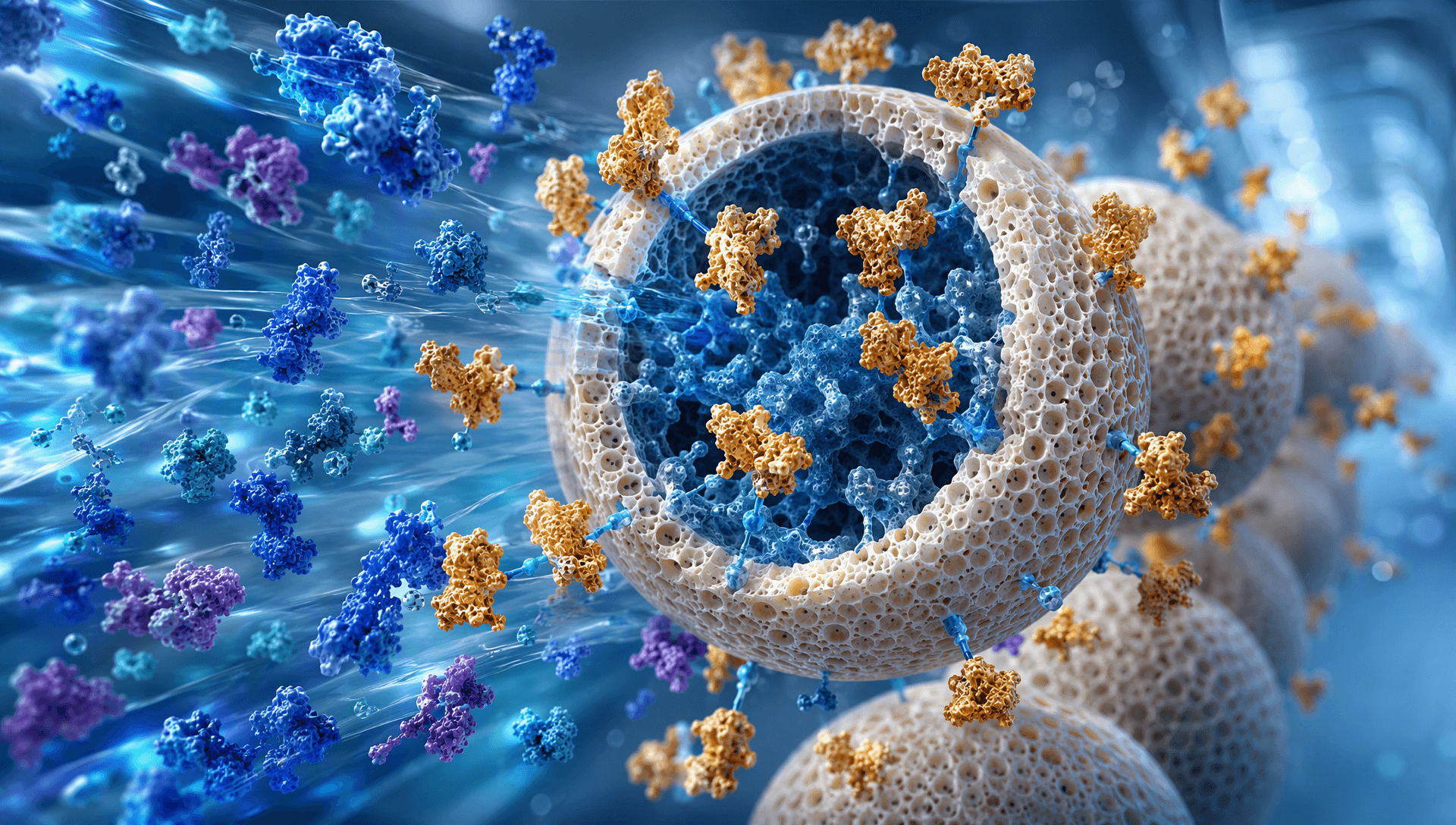
Immobilized ligands on porous beads selectively capture target molecules
Introduction
Affinity chromatography uses a biologically related binding agent as part of the stationary phase to recognize a target selectively and can support the separation, analysis, and characterization of biomolecules. Custom affinity chromatography resin extend that principle into a project-specific combination of target properties, ligand structure, support material, immobilization strategy, and operating conditions. A useful medium must not only capture the target; it must also support mass transfer, selectivity, practical elution, cleaning tolerance, and lot-to-lot consistency. Development should therefore begin with the feed, required purity, process scale, and operating environment rather than affinity alone.
Custom affinity chromatography resin begin with the application boundary
The same target protein can require different media for microscale research purification, diagnostic-reagent production, and process-scale capture. A small experiment may prioritize one-step purity and convenience. Repeated manufacturing cycles add flow rate, pressure drop, dynamic binding capacity, cleaning, ligand leakage, and lifetime. Ranking candidates only by static adsorption can therefore overestimate performance under flow.
Six groups of requirements should be defined:
1. Target and impurity profile: molecular size, conformation, isoform, and major coexisting species;
2. Feed conditions: source, concentration, viscosity, pH, salt, and particle load;
3. Process objective: target capture, removal of a defined impurity, or analytical detection;
4. Equipment boundary: column format, pressure limit, linear velocity, and processing time;
5. Cleaning and regeneration: acid, base, salt, or other exposure and expected cycles;
6. Acceptance criteria: recovery, purity, dynamic binding, selectivity, and repeatability.
Providing these inputs when discussing relevant products and services with MatwingsVenus™(晓鹜™) creates a more useful project brief. It helps determine whether the dominant limitation lies in the ligand, support, immobilization, or process rather than labeling every failure as insufficient affinity.
Ligand, support, and immobilization must be co-designed
Affinity media development has three coupled layers. The ligand—an antibody fragment, protein binder, peptide, or another recognition molecule—must retain binding under process conditions while limiting nonspecific interactions. The support contributes rigidity, hydrophilicity, pore architecture, particle size, and surface chemistry, which affect transport, pressure, and background adsorption. Immobilization controls attachment site, spacer arm, orientation, and ligand density.
A major review of affinity chromatography treats supports, immobilization strategies, and binding agents as joint elements of the technology. A custom affinity ligand that performs well in solution can lose its advantage after coupling because of poor orientation, steric masking, or excessive local density. Ligand density is not simply maximized: too little may restrict capacity, while too much can increase crowding, nonspecific adsorption, or elution difficulty.
Protein ligands also introduce stability and engineering questions. MatwingsVenus™(晓鹜™) can connect database retrieval, functional-site prediction, single-mutation scanning, and multi-mutation modeling to formulate hypotheses for affinity, stability, or expression improvement. These outputs remain computational predictions and cannot replace dynamic binding and cleaning-cycle tests on the coupled medium.

Pore architecture, spacer arms, and ligand density shape separation behavior
How to screen custom affinity chromatography resin
Small-scale screening should compare a matrix of variables rather than a single elution peak. The ligand dimension can include scaffold, attachment site, and density. The support dimension can include material, pore architecture, and particle size. The process dimension can include loading pH, salt, flow rate, wash, and elution. Changing a limited set in each round keeps cause and effect interpretable.
A practical funnel has four levels:
• Static binding and selectivity to remove inactive or high-background candidates;
• Small-column dynamic testing to evaluate breakthrough at a defined residence time;
• Elution and product quality to measure recovery, activity, aggregation, and key impurities;
• Cleaning and cycling to monitor capacity retention, pressure changes, ligand leakage, and repeatability.
The best custom affinity resin is therefore not the option with one maximum number. It is the medium that balances capacity, purity, recovery, flow, and durability for the intended use. A candidate with high loading but harsh elution may damage the target or shorten useful medium life.
Failure patterns should be traced to their mechanism
Low recovery may result from poor capture, overly strong washing, incomplete elution, or product instability in the bed. Co-eluting impurities may reflect ligand cross-reactivity, nonspecific support adsorption, or feed conditions. Rapid pressure increase should trigger checks of feed clarification, particle distribution, packing, and support rigidity. Mechanistic separation of these causes prevents endless buffer changes without a clear hypothesis.
If a soluble ligand binds well but loses activity after immobilization, the attachment site, spacer, and orientation deserve priority. If initial performance is strong but declines after cleaning, teams should distinguish ligand denaturation, ligand leakage, and support change. The value of custom affinity resin development is precisely this integration of molecular recognition, materials, chemistry, and process testing.
The MatwingsVenus™(晓鹜™)customized service workflow
Within a custom affinity chromatography resin project, MatwingsVenus™(晓鹜™) can support upstream ligand work. The task chain begins by retrieving target, known-binder, and structural-interface evidence. It then routes the ligand to natural candidate discovery, functional-site analysis, affinity and stability engineering, mutation-combination modeling, or binding evaluation. Prioritized candidates and explicit risks can then move into coupling, resin screening, and chromatographic experiments.
The boundary matters. Computational tools can reduce the candidate space, but they cannot demonstrate that a support, pore architecture, or ligand density meets process requirements. Media synthesis, dynamic binding, pressure drop, elution, cleaning, and lifetime must be evaluated experimentally. Relevant products and customized services from MatwingsVenus™(晓鹜™) are intended to make ligand selection more evidence-led and translate predictions into testable media concepts, not bypass process development.
Useful project inputs include the target sequence or structure, existing ligand, feed composition, process scale, intended elution, cleaning requirements, and historical data. Complete inputs make it easier to build staged deliverables—ligand candidates, coupling concepts, resin screening, and process verification—with advance or rollback criteria at each stage.

A staged workflow connects target requirements, ligand engineering, media screening, and process validation
FAQ: custom affinity chromatography resin
Does higher ligand affinity always produce better resin performance?
No. A very slow off-rate can make elution harsh, while orientation, density, mass transfer, and nonspecific adsorption can change performance after immobilization. Dynamic testing and product quality should guide the decision.
What should be considered first when selecting a support?
Start with target size, operating velocity, pressure limit, and cleaning conditions. Then compare hydrophilicity, rigidity, pore structure, particle size, and compatible coupling chemistries.
How can small-scale testing better represent scale-up?
Use representative feed and evaluate breakthrough, elution, and cleaning at comparable residence time, bed height, and linear velocity. Static adsorption is an early screen, not a scale-up model.
Conclusion
Custom affinity chromatography resin development aligns ligand, support, immobilization, and operating conditions with real process requirements. Teams should define acceptance criteria first, then narrow options through static screening, dynamic columns, elution assessment, and cycle testing. MatwingsVenus™(晓鹜™) can connect ligand retrieval, functional analysis, protein engineering, and binding evaluation products and services, creating a clearer evidence base and validation path for subsequent media experiments.