Cleaning in Place: A Systems View of Biomanufacturing Quality
Published on September 9, 2026
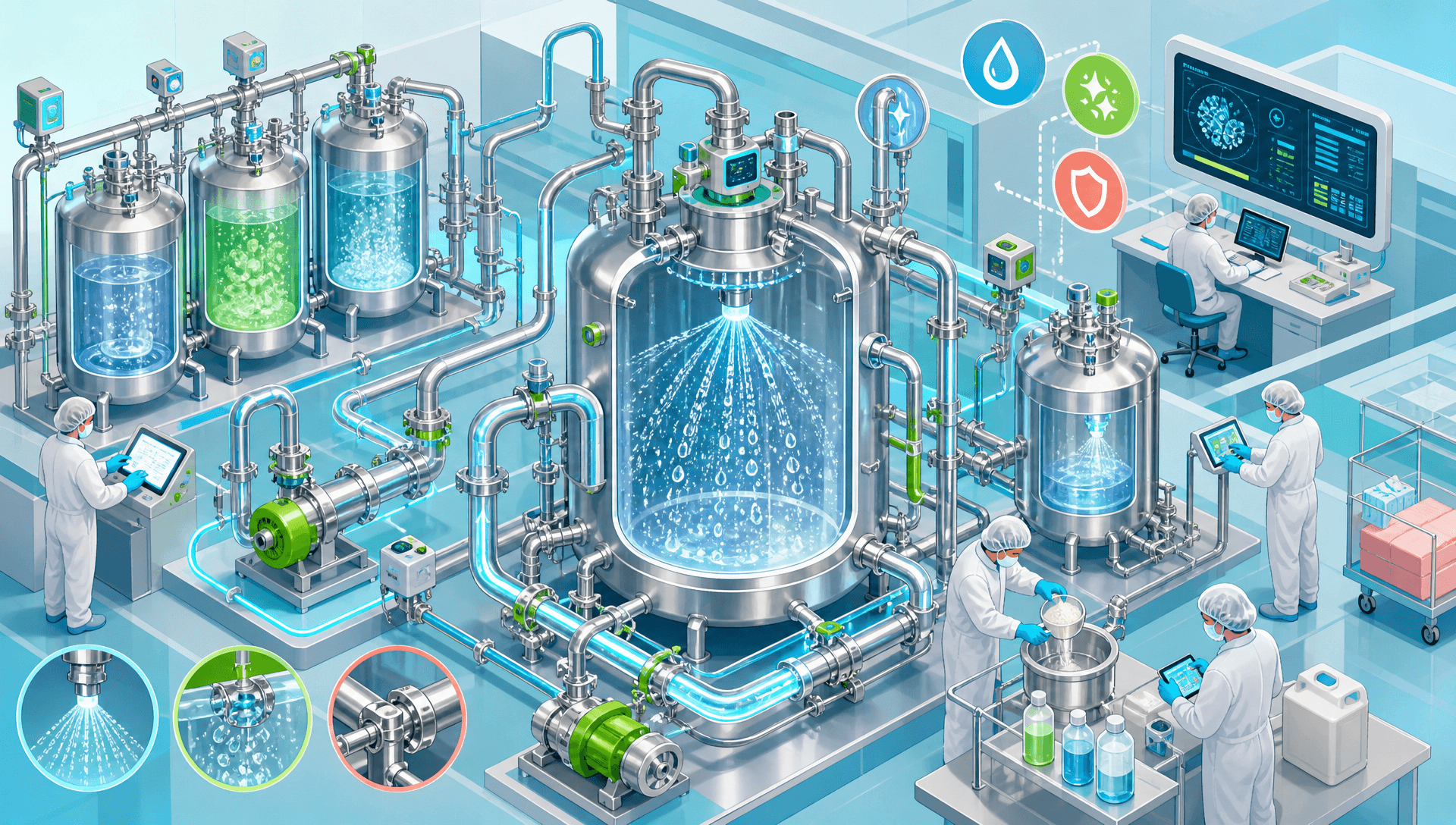
Cleaning in Place connects equipment, fluid flow, chemistry, monitoring, and quality records into a repeatable contamination-control system
Category: Biopharmaceutical Engineering and Protein R&D
Cleaning in Place Is System Recovery, Not an Automated Wash
A late-night batch change often exposes the real maturity of a manufacturing system. The previous material has been drained and the next production window is approaching, but equipment cannot be released because it merely looks clean. Pipe bends, valve cavities, seals, liquid films on vessel walls, and the interior of functional media may retain material that cannot be seen. One deviation in temperature, flow, or cleaning-agent concentration can change the credibility of the entire cycle.
Cleaning in Place generally moves cleaning fluid through equipment and process paths without disassembling the major system. It may include a pre-rinse, chemical cleaning, rinsing, and subsequent treatment appropriate to the equipment. The method can reduce turnaround time and operator variability, but automation is not validation. An effective system must demonstrate that fluid reached the necessary surfaces, delivered sufficient action, and left the equipment in an acceptable state.
The most useful model is system recovery. The hydraulic layer delivers cleaning action. The chemical layer transforms and removes soil. The monitoring layer shows that critical conditions occurred. The quality layer determines whether the result supports the next use. A successful program requires all four.
System Map One: Can Flow Reach Every Product-Contact Surface?
Cleaning begins as a fluid-distribution problem. Spray devices must cover the top, walls, agitator features, and outlet region of a vessel. Fluid in piping must pass through valves, branches, reducers, and return paths. Pumps and heat-transfer equipment must receive adequate flow within their operating limits. Low local velocity, trapped gas, or geometric dead zones can prevent chemistry from reaching shielded residue.
Hygienic design is therefore a prerequisite for Cleaning in Place rather than a corrective action. Drainability, surface finish, slope, seal design, valve geometry, instrument installation, and loop length all influence whether residue and retained liquid can be removed. A cleaning recipe can optimize time and flow, but it cannot indefinitely compensate for equipment that is inherently difficult to cover.
The system boundary must also be explicit. Shared circuits, independently verified branches, temporary hoses, bypasses, supply points, return points, and low-point drainage determine what “cleaned” actually includes. If the boundary is unclear, sophisticated sampling may prove only that part of the system was controlled.
System Map Two: Cleaning Chemistry Must Match the Real Soil
A stronger cleaning agent is not automatically a better one. It must match the soil, equipment material, and product risk. Protein residues can denature and adhere strongly, lipids require different solubilization mechanisms, and nucleic acids or cell debris may form complex mixtures. Temperature, pH, concentration, contact time, and mechanical action combine to determine removal. A change in any variable can affect both cleaning performance and material compatibility.
Alkaline cleaning is widely considered in bioprocessing because it can address multiple organic residues and support microbial control. High pH, however, may also affect protein ligands, polymers, seals, or surface chemistry. Affinity media provides a clear example: cleaning should limit contaminant accumulation without rapidly eroding target-binding function. Research on Protein A media shows that ligand conformation can contribute to performance loss under cleaning stress. A clear cleaning stream alone is not sufficient evidence of continued function.
Cleaning chemistry must therefore answer two opposing questions. Does it remove the intended soil? Does it preserve the materials and biological functions required for the next batch? A robust program establishes a design space among known soil load, equipment compatibility, and functional retention instead of maximizing chemical intensity.

Coverage, chemical action, and process signals jointly determine whether a cleaning event can be interpreted
System Map Three: Inline Signals Are Only Part of the Evidence Chain
Modern CIP systems can continuously record time, temperature, flow, pressure, conductivity, and pH. These data show whether a program ran as configured and support deviation investigations and trend analysis. Yet most inline signals demonstrate process conditions; they do not automatically demonstrate surface residue, microbial status, or restored biological function.
A return conductivity value within range may support a rinse endpoint, but it does not by itself prove that every difficult location was cleaned. A temperature profile can confirm thermal conditions without proving uniform flow coverage. Process data must be connected to a justified sampling strategy, analytical methods, and a defensible assessment of worst-case equipment locations.
Data quality matters as much as sensor quantity. Range, calibration, installation position, sampling frequency, time synchronization, and alarm logic determine whether a record represents the equipment state. If data from multiple systems cannot be aligned, a compliant-looking curve may not explain where the cleaning fluid was when a deviation occurred. High-quality Cleaning in Place requires traceable context, not automation alone.
System Map Four: Validation Makes “Clean” Credible
Cleaning under GMP is not an abstract pursuit of absolute cleanliness. It demonstrates that a procedure can repeatedly control contamination risk within predetermined limits. Product, equipment, soil, cleaning agent, worst-case conditions, sampling location, analytical method, and acceptance criteria must form one logical chain. Risks vary by facility and product, so a general article cannot replace a company’s regulatory assessment or validation plan.
Validation also extends beyond the first successful study. Formula changes, equipment modifications, new products, batch-size shifts, cleaning-agent supply changes, long shutdowns, and interrupted cycles may affect the original conclusion. Cleaning programs belong in change control, deviation management, and periodic review rather than remaining permanently fixed after a report is approved.
This is where Cleaning in Place connects manufacturing efficiency with quality governance. A well-defined system with complete data and rapid disposition can reduce uncertainty during changeover. A fast physical wash supported by fragmented records and unclear boundaries may lose its apparent efficiency in investigation, waiting, and repeated confirmation. Real efficiency means obtaining a credible result the first time.
The Often-Missed Fifth Layer: Biomolecules Inside the Cleaning System
Equipment engineering can treat residue and contact materials as chemical objects, but affinity ligands, enzymes, immobilized proteins, and other functional biomaterials have sequences, structures, and binding sites. Cleaning may alter their conformation, chemistry, or local function, gradually reducing capacity, selectivity, or recovery. This type of change may not trigger an immediate equipment alarm.
Cleaning of affinity media should therefore ask both whether contamination was removed and whether the media still works. Dynamic binding capacity, recovery, selectivity, ligand leakage, product quality, and pressure trends describe functional consequences. Sequence and structure analysis can help explain which regions may be sensitive, which sites should be protected, and whether more tolerant natural homologs or engineered variants deserve evaluation.
Not every CIP program needs computational biology. For stainless process paths with mature procedures, equipment, chemistry, monitoring, and validation remain the priorities. Molecular analysis becomes relevant when the defined problem involves protein-ligand deactivation, loss of binding, candidate-material differences, or molecular engineering. A clear boundary makes the technology more useful, not less.
How MatwingsVenus™(晓鹜™)Adds the Molecular Evidence Layer
When a Cleaning in Place question reaches the protein or ligand level, MatwingsVenus™(晓鹜™) can support the path from evidence retrieval to candidate validation. Users provide a ligand name, identifier, sequence, or structure along with the cleaning environment, required function, and observed performance decline. The platform retrieves authoritative database and literature evidence first, establishing identity, domains, functional sites, homologs, and known variants before routing defined gaps to functional analysis, natural protein discovery, or protein engineering.
MatwingsVenus protein design agent supports structured retrieval across 37 authoritative biological databases and can connect those findings to functional-site and protein-property prediction, candidate discovery, mutation-effect assessment, and multi-site modeling. Its retrieval-first logic prioritizes measurements and curated knowledge, while predictions address explicit unknowns. Outputs distinguish Measured, Predicted, and Unknown. Only resource-intensive computational tasks require user confirmation before execution, and every predicted candidate requires validation under real cleaning exposure, binding, and cycle conditions.
The platform does not replace a CIP control system. It converts “why is the ligand losing function?” into a researchable molecular question. Outputs may identify known sensitive sites, protected functional regions, natural candidates worth comparison, prioritized engineering directions, and associated risks. Laboratory teams can then connect these hypotheses to pre- and post-cleaning structure, binding, capacity, and leakage measurements, creating a process observation–molecular explanation–candidate design–experimental confirmation loop.
MatwingsVenus™(晓鹜™) does not define cleaning recipes, operate equipment, or replace cleaning validation and GMP release. It helps research teams find evidence faster, reduce unguided mutations, and hand computational outputs to executable experiments.
If you are planning Cleaning in Place research involving affinity media, protein ligands, or molecular stability, you can consult relevant products through the MatwingsVenus™(晓鹜™) Mall and align the process question with suitable R&D tools before the project begins.

MatwingsVenus™(晓鹜™) enters when a molecular question appears, adding protein evidence and candidate development to the CIP system
Cleaning in Place Becomes Competitive Through System Coordination
Cleaning in Place is not a feature of one machine or a fixed chemical recipe. It is a map connecting hygienic design, fluid coverage, cleaning chemistry, inline monitoring, analytical confirmation, data governance, and quality validation. A weakness in any layer can turn automation speed into downstream investigation and risk.
The goal is not unlimited cleaning intensity. It is a system in which every condition has a purpose, every signal has an interpretation, and every result supports the next use. When Protein A or another biological ligand is present, molecular structure and retained function also belong in the assessment; visible cleanliness should not hide gradual performance loss.
MatwingsVenus™(晓鹜™) provides the molecular evidence and R&D interface for this larger system—from database retrieval and functional analysis to natural candidates, engineering priorities, and experimental handoff. With clear boundaries and traceable tasks, Cleaning in Place can evolve from background maintenance into a core capability supporting quality, productivity, and long-term process knowledge.