CH1 Affinity Resin: A Practical Guide to Fab Purification
Published on September 3, 2026
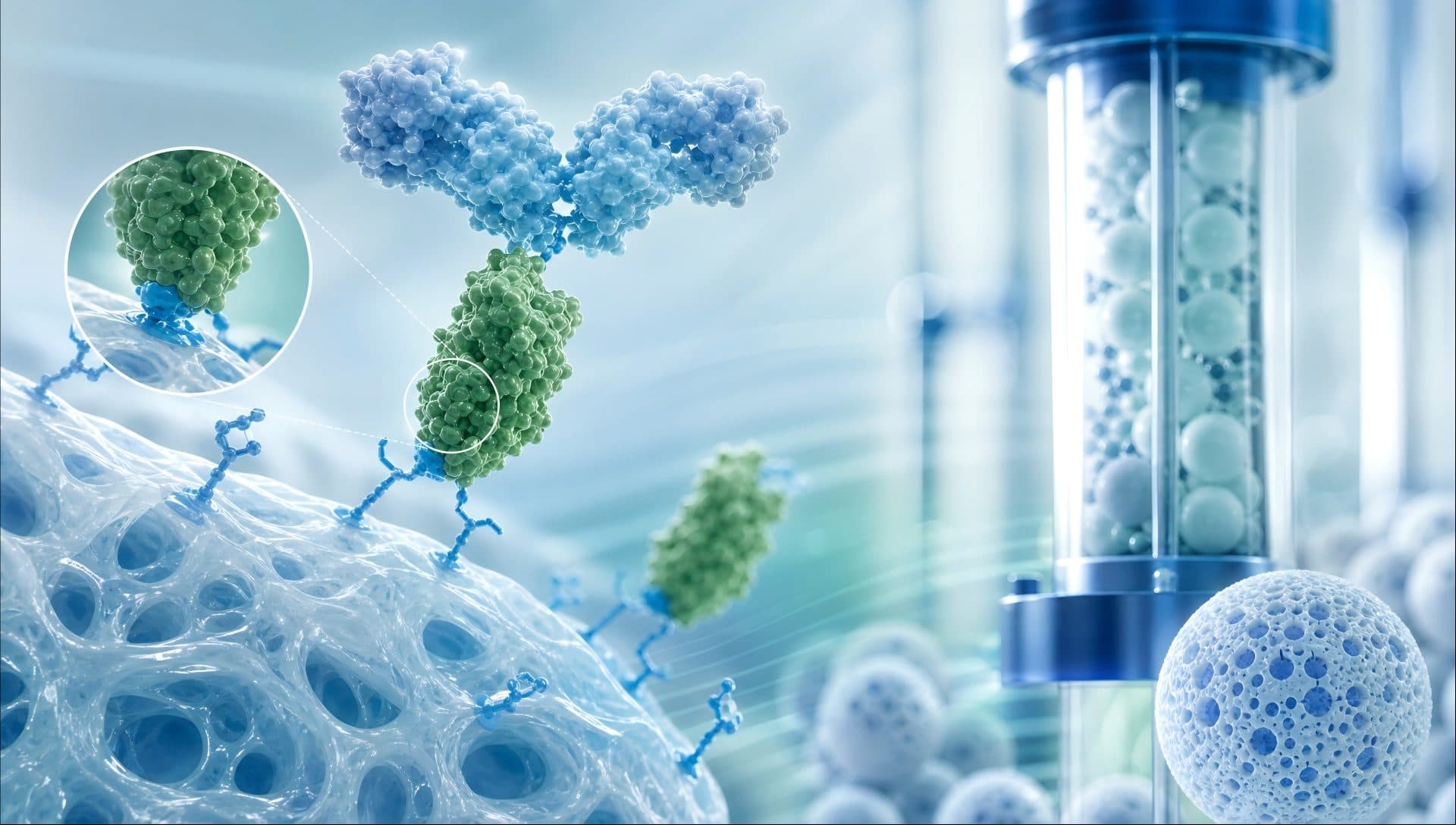
CH1-domain recognition on a Fab fragment by an immobilized affinity ligand
What CH1 Affinity Resin Recognizes
A Fab contains a complete light chain together with the VH and CH1 domains of a heavy chain. An F(ab’)2 links two Fab-like arms through the hinge region. In a CH1-directed medium, an immobilized ligand retains molecules that present an accessible CH1 epitope, while nonbinding host-cell proteins, medium components, and some processing impurities pass through. This creates a capture option for antibody fragments that lack Fc but retain CH1.
The scope must be tied to the selected medium. The instructions for one commercial human CH1-XL matrix list human Fab, F(ab’)2, and all four human IgG subclasses as binding targets and state that recognition is independent of kappa or lambda light-chain type. That statement is product-specific. It does not establish equivalent species coverage for every CH1 ligand and should not be extended automatically to mouse, rabbit, or other nonhuman antibodies.
By contrast, a conventional scFv generally contains VH and VL only, and a VHH is usually a single heavy-chain variable domain. Neither format normally contains CH1. The label “antibody fragment” therefore does not establish compatibility. Sequence boundaries, species, construct architecture, linkers, tags, and the integrity of the expressed product should be reviewed before a resin is selected.

Binding, flow-through, wash, and elution stages in CH1 affinity capture
Selecting Between CH1, Fc, and Light-Chain Capture Routes
The most useful decision question is which accessible domain the target actually retains. An intact IgG contains Fc and may support Fc-directed capture. A fragment with a compatible kappa light-chain subtype may support a light-chain-binding ligand. A human Fab, F(ab’)2, or engineered format that retains CH1 can be evaluated using a CH1-directed capture route.
These options are not interchangeable rankings. In an IgG digest, the feed may contain target fragments, incompletely digested IgG, Fc fragments, enzyme, and aggregates. CH1 recognition can retain CH1-bearing species, but it may not by itself resolve Fab from F(ab’)2, aggregates, or charge variants. In recombinant Fab supernatant, expression level, solubility, heavy/light-chain assembly, host impurities, and feed viscosity can influence effective capacity and pressure behavior.
A practical selection gate therefore asks three questions: Is an accessible CH1 domain present? Does the chosen ligand cover the target species and antibody class? Which remaining critical impurities require an orthogonal step such as ion exchange, hydrophobic interaction, mixed-mode chromatography, or size exclusion? A structurally plausible interaction becomes a process option only after these questions are answered experimentally.
Developing a CH1 Affinity Resin Process
A product manual can define a starting region, not a transferable manufacturing recipe. Under a stated test condition of 10% breakthrough and a two-minute residence time, one CH1-XL matrix reports a dynamic binding capacity of approximately 19 g polyclonal human Fab per liter of matrix. The same instructions suggest 10 column volumes for equilibration, 5–10 column volumes for washing, 3–5 column volumes for elution, and a linear velocity of 50–200 cm/h. These values belong to that medium, sample, and test setup; they are not universal performance claims.
A more defensible small-column sequence is:
1. Characterize the feed. Record target concentration, pH, conductivity, turbidity, aggregate level, and potential protease activity. Clarify, filter, or exchange buffer when needed.
2. Map the binding window. Test a narrow range around an appropriate loading condition and compare breakthrough, recovery, and impurity clearance rather than relying on elution peak height alone.
3. Optimize wash and elution. Monitor activity, fragment integrity, and high-molecular-weight species. If acidic elution promotes aggregation, minimize exposure, neutralize promptly, and evaluate alternative supplier-permitted conditions.
4. Close the analytical loop. Use suitable methods such as SEC, CE-SDS, mass spectrometry, and binding or potency assays to confirm pool identity, purity, aggregation, and function.
5. Evaluate scale-up. Relate scales by residence time rather than linear velocity alone, then assess pressure drop, cycling, cleaning compatibility, and ligand-leachage risk.
A minimum experimental contract can be expressed as:
Input: target sequence and domain annotation, species/class, actual feed composition, and critical quality attributes
Output: a 3 × 3 small-column matrix of binding and elution conditions with recovery, purity, aggregation, and activity data
Next step: define an operating window, connect an orthogonal polishing step, and verify cycling and scale-up behavior
Bispecific Separation: A Molecule-Dependent Opportunity
CH1-specific media may also exploit differences in binding strength among antibody arms or assembly by-products. A 2024 peer-reviewed study found that two CH1-specific resins displayed different binding strengths across monoclonal antibodies. In one asymmetric bispecific antibody case, optimized conditions showed potential to separate the desired heterodimer from homodimer by-products.
This evidence supports screening, not a general promise of one-step mismatch removal. The study also noted that the mechanistic basis of the differential interaction was not fully resolved, performance varied by molecule, and the investigated media targeted human IgG. Development should include the actual heterodimer and both homodimer controls, then measure retention, peak shape, recovery, and resolution before assigning the operation as capture, selective intermediate purification, or exploratory analytics.
Connecting Molecular Evidence to Experiments with MatwingsVenus™(晓鹜™)
Before chromatography begins, sequence, domain, species, subclass, and source evidence often reside in disconnected records. MatwingsVenus™(晓鹜™) can organize a mechanism-focused evidence set through deep research, assemble a target information card through protein database queries, and generate testable hypotheses about stability, solubility, or condition sensitivity through protein function and property prediction.
The output should not be an automated claim that a resin will work. It should be a traceable set of experimental questions: Does the construct retain the complete CH1 boundary? Is it a human format covered by the selected ligand? Could acidic exposure increase aggregation risk? Which assay distinguishes correctly assembled product from mispaired impurities? MatwingsVenus™(晓鹜™) can translate those questions into screening conditions, sampling points, and decision criteria; the next step remains physical testing with the real feed.
This input-to-output-to-experiment chain helps reduce unproductive screening caused by incorrect domain assumptions while keeping literature parameters attached to their original conditions. MatwingsVenus™(晓鹜™) supports evidence organization and hypothesis generation; it does not replace chromatography, process scale-up, analytical method qualification, or product release.

Process-development workflow from domain confirmation to small-column screening and quality control
Conclusion
A CH1 Affinity Resin decision should begin with domain architecture, not with a capacity number copied from a manual. For Fab and F(ab’)2, CH1 recognition offers a capture route that does not depend on Fc. For complex bispecific formats, it may provide additional selectivity, but that opportunity is molecule- and condition-dependent. Keeping species scope, ligand specificity, and operating parameters attached to their evidence—and validating them with small-column and orthogonal analytical data—turns a plausible affinity interaction into a scalable purification strategy.