
What Is the CAZy Database, and How Does It Classify Carbohydrate-Active Enzymes?
Published on November 4, 2026
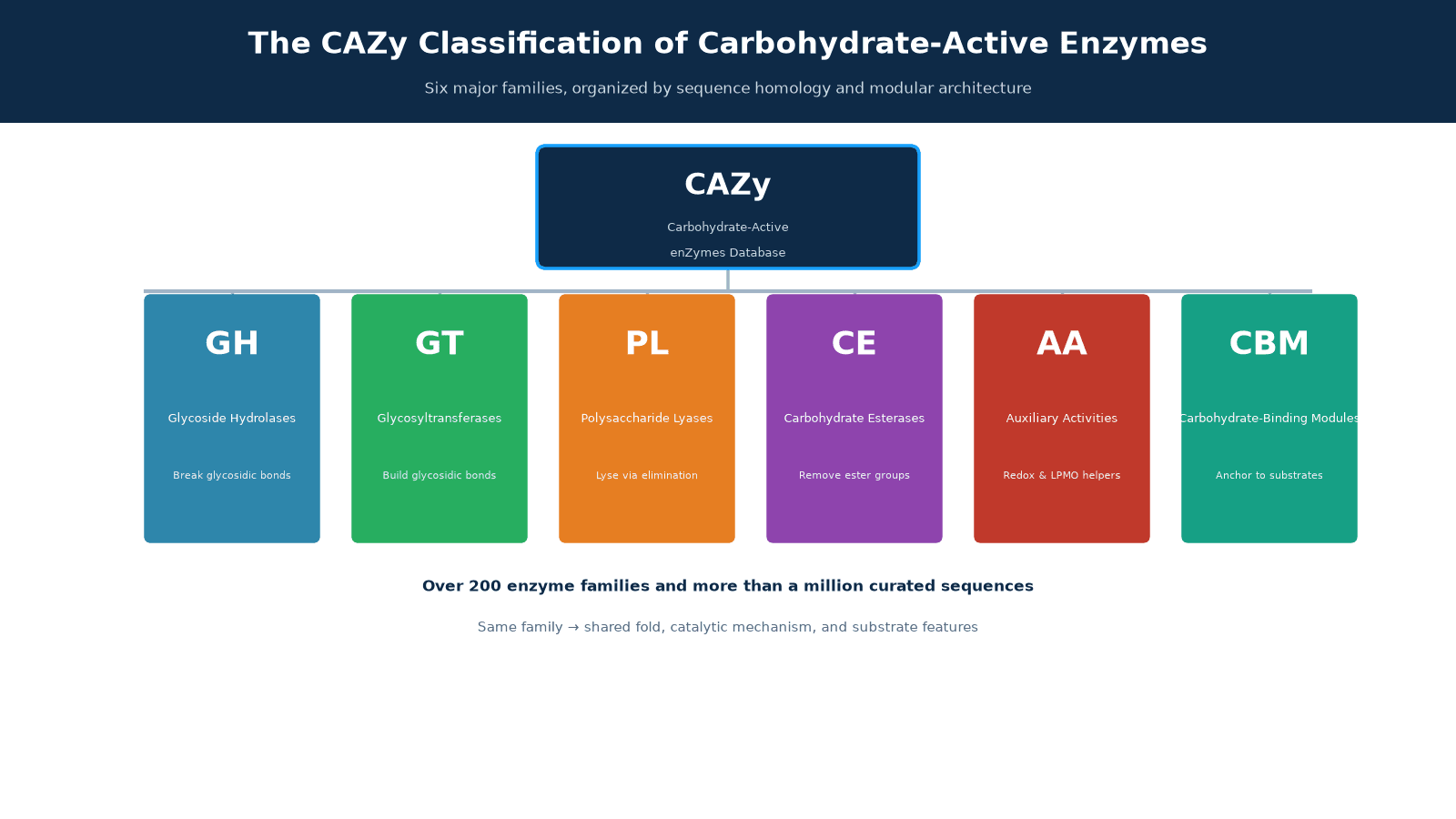
Figure 1 · Overview of the six major CAZy family classes
Classification:E Structure / mechanism / sequence analysis (primary);D Platform / database (cross)
If you study cellulose, starch, chitin, or any polysaccharide, you will almost certainly come across the name CAZy. The CAZy Database (Carbohydrate-Active enZymes Database) organizes the enzymes that build, break down, and modify carbohydrates in nature into a clear “family map” based on their evolutionary relationships. With it, given a sequence you can quickly judge what kind of enzyme it is, roughly how it works, and where it might be used — compressing the path from sequence to mechanism to application into a few clicks.
Background and mechanism: why does enzymology need a “family” classification?
Traditional enzymology names enzymes with EC numbers based on the reaction they catalyse and the substrate they act on, but enzymes that catalyse the same reaction can be unrelated in structure and evolution. CAZy instead classifies by sequence homology, so that a family shares a fold and a catalytic mechanism — which makes it far more useful for enzyme engineering.
EC numbers can only tell you “what it does”; they cannot tell you “what it looks like” or “where it came from”. CAZy takes a completely different criterion: sequence homology. Its roots go back to 1991, when the French scientist Bernard Henrissat first proposed classifying glycoside hydrolases by amino-acid sequence similarity; that idea was later developed by Henrissat, Pedro Coutinho and others into the publicly available database we use today.
This “structure-first” classification matters because enzymes in the same family usually share a fold, a catalytic mechanism and a substrate preference. So a family is no longer just a label — it becomes a predictive tool: know the family, and you can infer how the enzyme is likely to work. This is also why industry cites it widely: rather than exploring an unknown enzyme from scratch, you first see which family it belongs to, then design experiments along that family’s mechanism and substrate preference.
Principle and structure: how does CAZy classify enzymes by sequence homology?
CAZy’s core basis is amino-acid sequence similarity: members of one family share conserved residues, fold topology and catalytic mechanism, so sequence alignment lets you place a new enzyme into a family and infer its catalytic residues and substrate preference.
CAZy divides “carbohydrate-active enzymes” into six classes, each with its own role:
• GH (Glycoside Hydrolases) — cleave glycosidic bonds, the main workhorses for degrading polysaccharides, such as amylases, cellulases and xylanases.
• GT (Glycosyltransferases) — build glycosidic bonds and assemble sugar chains.
• PL (Polysaccharide Lyases) — cleave polysaccharides by elimination, mainly acting on pectin, alginate and similar substrates.
• CE (Carbohydrate Esterases) — remove ester groups from sugars and often work alongside GHs.
• AA (Auxiliary Activities) — take part in redox reactions, including the lytic polysaccharide monooxygenases (LPMOs) that help break down recalcitrant lignocellulose.
• CBM (Carbohydrate-Binding Modules) — do not catalyse, but “grab” the substrate and help catalytic domains get closer to it.
Families are given numbers (such as GH13, GH5, GT2), and some are further split into subfamilies (such as GH13_5). Mechanistically, glycoside hydrolases mainly follow two routes: retaining (double displacement), where the anomeric configuration is unchanged; and inverting (single displacement), where it is inverted. The key catalytic residues on these two routes are usually glutamate (Glu) or aspartate (Asp), and they are highly conserved within a family. In addition, many CAZy enzymes are modular: a catalytic domain is often joined to one or more CBMs by a flexible linker; this “catalysis + binding” arrangement is key to adsorbing and degrading insoluble substrates such as cellulose. As families keep expanding, researchers also introduce “subfamilies” to further distinguish fine differences in substrate specificity while sharing the same underlying mechanism.

Figure 2 · CAZy family classification and the retaining vs. inverting catalytic mechanism
Measurement and selection: how to query, annotate and screen enzymes with CAZy?
Querying a CAZy family needs only one sequence: submit it to CAZy or dbCAN for a homology search to obtain family assignment, EC number and candidate catalytic residues, then combine substrate specificity and enzyme-activity assays to judge whether the enzyme fits your target reaction.
The usual workflow is:
• Input: a single protein sequence (FASTA), or a genome/metagenome dataset.
• Annotation: use the CAZy database, dbCAN (for large-scale metagenome annotation), dbCAN-seq and similar tools to run a homology search and output family and subfamily assignment.
• Interpretation: consult CAZypedia (the companion “encyclopedia”) for the family’s mechanism, structure and known representative enzymes.
• Selection: the family tells you how it is “likely to work”; then validate real activity with assays (e.g. the DNS method for reducing sugars) and pH/temperature profiles before deciding whether to engineer it further.
A frequently overlooked point: a CAZy family is not the same as an EC number. One family may map to several ECs (catalysing different reactions), and one EC may be spread across different families. Strictly, a family answers “evolution and structure”, while an EC answers “reaction type”, so they should be used together. If the sequence comes from an uncultured microorganism (e.g. a metagenome), CAZy annotation is especially valuable: it lets “invisible” enzymes be positioned first and then mined deliberately. Of course, automated annotation can also misjudge, particularly short sequences from metagenomes, so important conclusions should usually be cross-checked with structure prediction and experimental verification.
Conditions and process: how CAZy supports industrial enzyme engineering
In industry, CAZy family information can significantly shorten the screening and fermentation pipeline: once a target family is chosen, you can engineer substrate specificity, thermostability and pH window, then scale up fermentation for food, feed, biofuel and pulp-bleaching applications.
This pipeline can be summarized in one line: CAZy annotation → substrate-specificity screening → enzyme engineering → fermentation scale-up → industrial application.
• Biofuels: cellulases and xylanases degrade lignocellulose into fermentable sugars, key to cellulosic ethanol.
• Food, baking and brewing: amylases, glucoamylases and glucanases are widely used in sugar production, baking and beer brewing.
• Feed enzymes: xylanases and phytases help livestock break down anti-nutritional factors and improve feed efficiency.
• Pulp and textile: hemicellulases and pectinases are used in bio-bleaching and bioscouring, reducing chemical usage.
• Detergent, pharma and nutrition: amylases and glycosidases enter detergents; glycosidases are also used in pharmaceuticals and prebiotics.
The most important process variables in practice are acting pH, temperature, substrate concentration and inhibitors. And the CAZy family gives you the first clue: it foreshadows mechanism and substrate preference, so you roughly know which direction to tune before running experiments, cutting trial and error. In other words, family information is not just “classification” — it is an input to process design: knowing the mechanism lets you set reaction conditions more rationally and understand why an enzyme inactivates at a particular pH or temperature.

Figure 3 · A five-stage workflow from CAZy annotation to industrial enzyme application
Combining CAZy with AI protein engineering: the MatwingsVenus® (protein design agent) discovery approach
Combining CAZy’s “family prior” with AI protein engineering turns enzyme discovery from a needle-in-a-haystack search into an evidence-guided route: let the CAZy family pin down mechanism and substrate preference, then use sequence–structure–function modelling and directed evolution to converge quickly on industrialisable candidate enzymes.
This is the focus of MatwingsVenus® (晓鹜®), an AI-driven protein design and enzyme-engineering platform from Matwings Technology. Within this approach, a typical pipeline is:
1. Family positioning: use CAZy annotation to lock down the candidate enzyme’s family and mechanism;
2. AI modelling: use sequence–structure–function models to predict thermostability, activity and developability;
3. Design and screening: combine directed evolution / computational design to generate mutants and estimate success likelihood;
4. Wet-lab validation: return computational predictions to the laboratory, forming a “design–experiment–learn” loop.
It is worth stressing that both CAZy and AI are “priors” and “predictions”, and neither substitutes for wet-lab experiments: family assignment narrows the range, AI raises efficiency, but final activity and stability still need experimental confirmation. This is the real state of “explainability” coexisting with “capability boundaries” — which for research and industrial users means fewer experiments and faster convergence on industrialisable candidates. For R&D teams, such a “prior-driven + computation-accelerated + wet-lab-closed-loop” combination substantially lowers the cost of blind screening; and in scenarios where credibility matters, every computational outcome should be backed by repeatable experiments as the final evidence.
FAQ
What is the difference between CAZy and EC numbers?
CAZy groups enzymes into families by sequence homology, reflecting evolutionary and structural relationships; EC numbers classify by catalytic reaction type, reflecting function. They are complementary and cannot replace each other, so they are usually used together when judging an enzyme.
Does one CAZy family equal one enzyme?
No. A family often contains many enzymes from different sources with different substrates; members share a fold and mechanism, but substrate preference, optimum pH and thermostability can differ widely. A family is a “category”, not a “single enzyme”, and a family number should not be used as an alias for one specific enzyme.
How can I use the CAZy database for free?
The CAZy website offers a public search interface, searchable by sequence, family, organism or EC number; the companion CAZypedia is a free family encyclopedia, while dbCAN is suited to large-scale automated annotation of metagenomes. Most resources are freely accessible, but please confirm specific licensing on the official pages.
Can CAZy predict enzyme active sites?
It can give clues, not a direct “answer”. Through family alignment and conserved-residue analysis (e.g. the conserved Glu/Asp in glycoside hydrolases), it can suggest candidate catalytic residues; but confirming an active site still requires structural biology or site-directed mutagenesis experiments.
Summary
CAZy is a “family map” of carbohydrate-active enzymes drawn along evolutionary lines. It turns “which enzyme is this and roughly how does it work” into something you can query and infer, helping researchers and engineers avoid detours in enzyme discovery, annotation and engineering. When combined with an AI-driven protein-engineering platform such as MatwingsVenus® (晓鹜®), the “family prior” of enzymology can translate into a more efficient industrial route.
One-line conclusion:CAZy groups carbohydrate-active enzymes into families by sequence homology; a family shares a fold and a mechanism, making CAZy a map for enzyme discovery and engineering.
