Single-Domain Antibody Affinity Resin Selection and Application Guide
Published on September 3, 2026
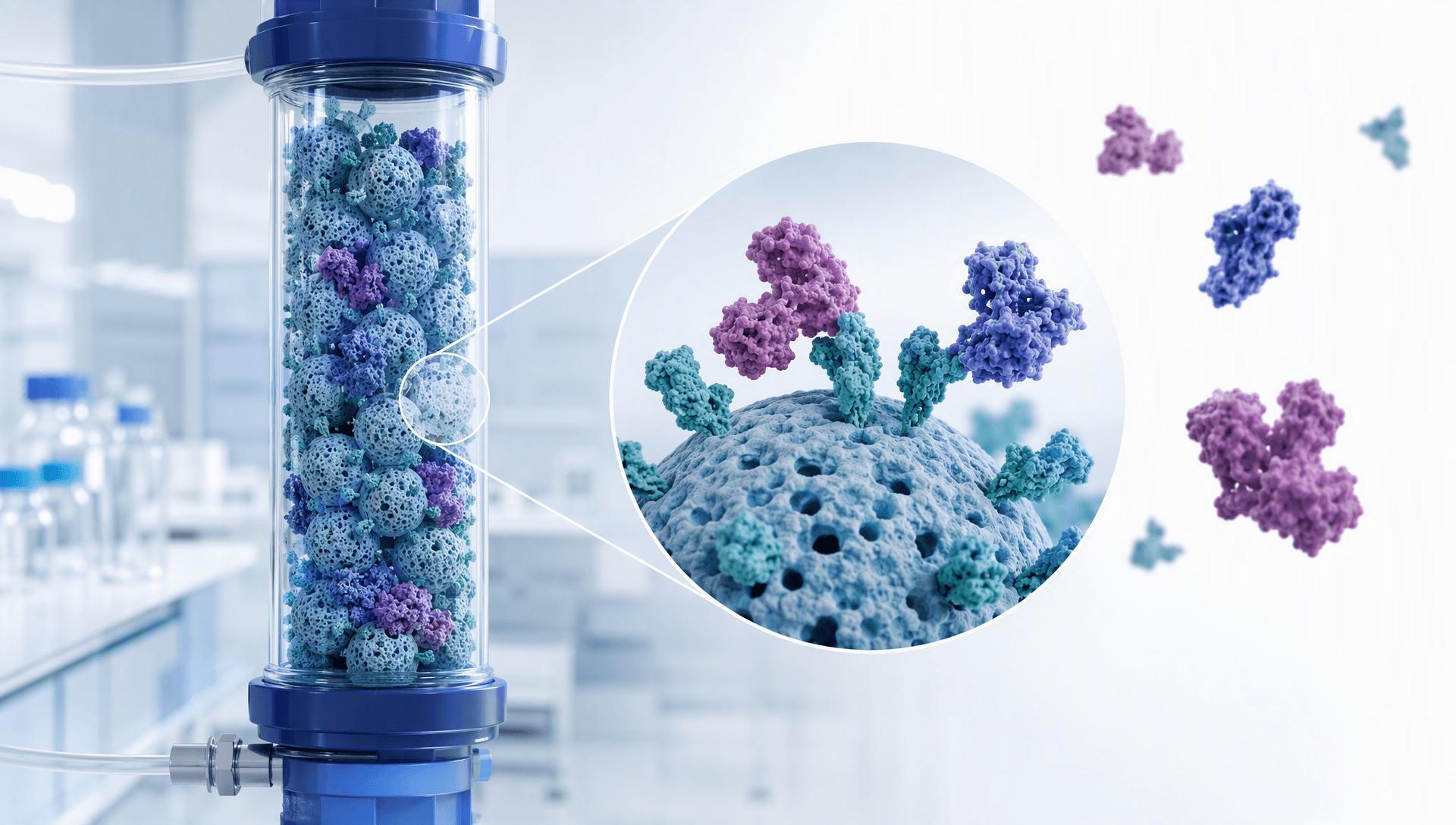
Camelid VHH ligands immobilized on porous resin beads capture a target protein
1. Start with the Single-Domain Antibody Affinity Resin System
In affinity chromatography, the single-domain antibody ligand provides molecular recognition. A porous bead or another solid support carries that ligand. Only after coupling, blocking, equilibration, and quality control do the two become a functional single-domain antibody affinity resin. Consequently, strong solution-phase affinity does not automatically translate into high dynamic binding capacity, efficient mass transfer, or a scalable column process.
Camelid VHHs are single variable domains derived from heavy-chain-only antibodies. Published work has shown that immobilized camelid VHH affinity ligands can perform selective capture and, in specific systems, distinguish closely related molecular forms. This evidence supports their potential for demanding separations, but it also defines an important boundary: performance belongs to a particular ligand–epitope–process combination. It should not be generalized to every VHH or every target.
2. Four questions to answer before selecting a resin
What exactly must be captured?
A platform capture ligand may recognize a conserved region shared by a molecular family. A polishing or variant-separation ligand may instead need to recognize an active conformation, an exposed epitope, or a modification-dependent feature. Before procurement or development begins, decide whether the primary objective is yield, impurity clearance, or discrimination between closely related forms. That choice changes library design, counterselection, and release criteria.
Can the feed environment alter binding?
Cell lysate, culture supernatant, and intermediate process streams differ in salt, pH, host-cell proteins, nucleic acids, and aggregates. Binding measured in a clean buffer is therefore a starting point rather than a process guarantee. Resin selection should ultimately be based on breakthrough behavior, recovery, purity, and impurity removal in representative feed material.
Is the epitope still accessible after immobilization?
Random coupling can obstruct a binding surface. Site-directed coupling may improve orientation, although it also adds molecular and manufacturing complexity. Ligand density, spacer length, pore size, and matrix mass transfer must be evaluated together. Higher ligand density is not always better: steric crowding can reduce the fraction of accessible binding sites.
Does the elution window protect both recovery and product quality?
In one anti-Fc VHH resin study, IgG binding was reported across pH 6.0–9.0, with elution at pH 5.0. Static binding capacities measured for different IgGs ranged from 3.40 ± 0.53 to 15.04 ± 0.37 mg/mL. These data illustrate that a camelid-derived ligand can create an attractive process window. They also show why isolated numbers must be interpreted carefully: capacity depends on the target species, ligand, matrix, assay format, and operating conditions. The values are not specifications for unrelated commercial products.

Immobilized VHH ligand binds a target, impurities are washed away, and the target is eluted
3. Validating a Single-Domain Antibody Affinity Resin for Process Use
A candidate single-domain antibody affinity resin should be compared with the same feed and harmonized test methods. A practical evaluation package should cover at least five dimensions:
• Recognition and selectivity: positive and counter-screening against the target, related proteins, host-cell proteins, and relevant aggregates;
• Binding and transport: both static capacity and dynamic binding capacity at the intended flow rate, with a clearly defined breakthrough criterion;
• Recovery and quality: yield, purity, retained activity, aggregate profile, and clearance of critical impurities rather than elution-peak area alone;
• Process tolerance: acceptable ranges for pH, salt, temperature, cleaning solution, residence time, and storage;
• Cycle stability: capacity retention, ligand leakage, backpressure, and baseline behavior over repeated cycles.
A lower-risk procurement path is staged: screen a small quantity, test a small column, challenge it with representative feed, and only then decide whether to scale. If supplier information presents theoretical affinity but omits ligand density, recommended flow rate, cleaning conditions, storage requirements, or lot-control data, request further documentation or perform an internal qualification study.
4. MatwingsVenus™(晓鹜™)Platform Workflow and Marketplace Selection
When an off-the-shelf specification does not fit a specialized target, the question shifts from “Which resin should we buy?” to “How can we obtain a selective ligand that tolerates immobilization and regeneration?” MatwingsVenus™(晓鹜™) supports an evidence-first protein R&D framework that can connect authoritative database and literature retrieval, protein-function assessment, engineering of existing proteins, and design of new binders.
The task chain can be made explicit:
• Task input: target protein or structure, feed type, intended epitope, required selectivity, acceptable elution range, and proposed matrix;
• Platform output: known-binder and interface evidence, sequence and structural risks for candidate ligands, traceable predictions, and a wet-lab validation plan;
• Next step: express candidates, measure binding kinetics, immobilize the ligand, and run small-column studies before using capacity, recovery, impurity clearance, and cycle stability to decide whether to iterate or scale.
When exploring relevant R&D capabilities through the MatwingsVenus™(晓鹜™) marketplace, bring this minimum project brief rather than asking only for a “high-affinity ligand.” Computational outputs must be labeled as predictions and cannot replace experimental data. Platform capability descriptions also do not establish inventory, lead time, or performance for a particular resin SKU; current marketplace information, technical documentation, and project confirmation remain the governing sources.

Evidence retrieval, ligand assessment, design iteration, immobilization, and chromatography validation workflow
FAQ
Is a single-domain antibody affinity resin the same as Protein A resin?
No. Protein A typically uses native domains that recognize selected antibody Fc regions. A VHH-based affinity medium can be developed around a chosen target and epitope, which may be an antibody, another protein, or a particular molecular form. Whether it is a practical alternative depends on the target, impurity profile, elution constraints, robustness, and process economics.
Is a camelid VHH affinity ligand always more stable than a conventional antibody ligand?
No universal conclusion is justified. VHHs are often considered when small size, engineering flexibility, and physicochemical tolerance are desirable, but actual stability remains sequence- and process-dependent. Compare capacity retention and ligand leakage under the intended cleaning and cycling conditions rather than relying on a class label.
What evidence supports scale-up?
Define acceptance thresholds before testing: dynamic binding capacity at the target flow rate, recovery, purity, critical impurity clearance, retained product activity, acceptable elution conditions, and cycle life. Scale-up evaluation should begin only after a small column meets those thresholds with representative feed. Static capacity or a single successful purification is insufficient.
Conclusion
The best single-domain antibody affinity resin is not simply the material associated with the highest affinity number. It is the system that converts molecular recognition into a robust, testable, and scalable purification window. Selection should begin with the target epitope and feed composition, then use harmonized tests to evaluate immobilization, transport, elution, and cycling. Where a custom ligand is needed, MatwingsVenus™(晓鹜™) can move evidence retrieval, candidate assessment, and design decisions earlier in the workflow—while wet-lab chromatography remains the final authority for procurement and scale-up.