What Is an AI Life Science Platform? Full-Stack Protein R&D Infrastructure from Design to Validation
Published on November 2, 2026
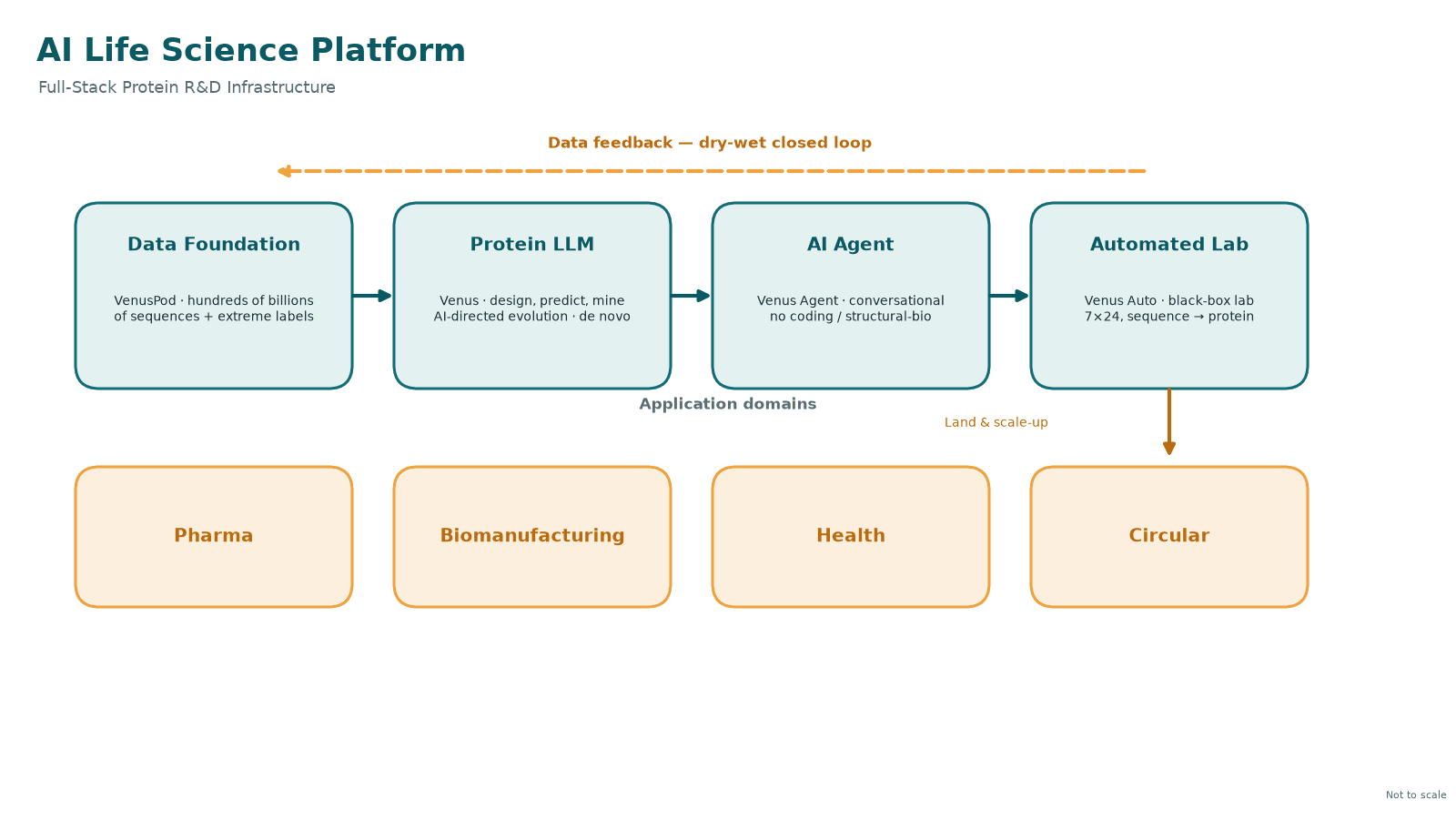
Figure 1. AI Life Science Platform: an end-to-end pipeline from data to applications.
Protein is the foundational raw material of the life-health industry: therapeutic antibodies, diagnostic enzymes, industrial enzyme preparations, functional foods and bio-based materials all depend on it. But traditional protein R&D relies on "expert experience plus high-throughput screening" and trial-and-error — with R&D cycles of 3–5 years, thousands of experiments and positive rates below 1%. It is like "blind people touching an elephant": researchers guess which positions might change from experience, then rely on large batches of experiments to try their luck. The bigger problem is the "two worlds" disconnect: candidates computed by AI have to be manually turned into experiment sheets, wet-lab work queues behind design, intermediate steps get lost, and results are consolidated by hand. Many teams are not unable to run experiments; they are stuck at "easy to design, hard to deliver, harder to scale up." Can we string "from design to validation, to pilot scale, to production" into a single platform where AI and machines connect automatically?
1. Background: Why Traditional Protein R&D Needs Redefining
Traditional protein R&D depends on expert experience and high-throughput screening, with long cycles, large experiment volumes and low positive rates; the AI life science platform strings "screening-design-validation-scale-up" into one automatically connected chain, moving R&D from random trial-and-error toward a convergent design-validate-iterate loop.
Traditional paradigms are inefficient at root because of "trial-and-error" itself. Engineering a protein often means balancing activity, stability, specificity and expression yield at once, and these constrain one another — raising activity may cost stability. This produces three contradictions: imbalance of cycles and investment (3–5 years, thousands of experiments, <1% positive rate, resources concentrated in a few large enterprises and institutes); the "two worlds" disconnect between design and experiment (computed candidates must be manually turned into experiment sheets, iteration measured in weeks); and non-replicable capability (skilled engineers' experience is hard to transfer). An even more hidden problem is that experience does not sediment: one success stays in one person's record and is hard to call on for the next project.
The AI life science platform's approach is to use two main threads at once — use "data + models" to sediment and generalize experience, and "automation" to consolidate and standardize process. For readers unfamiliar with biological experiments: the positive rate is the share of tested candidates that truly meet target performance (such as activity or stability), so 1% means about one hit per 100 experiments; high-throughput screening uses automation and microplates to test hundreds to thousands of samples at once. The platform's core contribution is to make the model choose "which ones to do" more accurately and to make automation carry out "doing them" faster.
2. Principle: How Four Components and the Dry-Wet Closed Loop Connect Design and Validation
The platform is made up of four components — VenusPod (data), the Venus foundation model (model), Venus Agent (interaction) and Venus Auto (automated experiments) — joined by a "dry-wet closed loop": design is validation, validation is iteration, and experimental data flows back into the model automatically.
Two concepts first. A "platform" is not one algorithm or website, but a set of data, models, tools, automated experiments and expert capability packed into a callable infrastructure; "full-stack" means the whole chain — from upstream data and model, through middle-stream automated experiments, to downstream process scale-up and commercialization — is connected in one system. A "protein foundation model" is a model trained on large amounts of known protein sequence, structure and functional data that can "read the language of proteins," much as ChatGPT does with natural language, except that it predicts and generates on protein sequences and structures. On this basis, the four components each do their job:

Figure 2. Dry-wet closed loop: Design → Validate → Iterate, with data fed back to the model.
• VenusPod · Data foundation: hundreds of billions of protein sequences and 6.7 billion functional-label records from extreme environments, selected as a typical case of the first batch of national high-quality datasets; the more demanding the extreme environments, the more valuable the model they train for industrial high-temperature, high-salt and strong-acid/alkali conditions.
• Venus foundation model · general-purpose protein design model: supports AI-directed evolution, AI enzyme mining and de novo design — de novo generates a brand-new protein scaffold without relying on sequences existing in nature, suited to "building an enzyme from scratch" and "brand-new function."
• Venus Agent · lightweight AI bio-design platform: completes sequence analysis, directed-mutation design, enzyme mining, structure prediction and database retrieval conversationally, without requiring programming or structural-biology expertise, so individuals can get started.
• Venus Auto · AI black-box lab: combines generative AI, embodied robots and an intelligent instrument cluster to automate the full "sequence-to-protein" workflow (gene synthesis → plasmid construction → protein expression → purification and characterization), unattended 7 × 24.
• Dry-wet closed loop: after the Agent finishes a design, it is dispatched to experiment orchestration, driving robots through sample preparation, purification and functional assays; results feed back into the next round of AI design — "computation driving wet lab, wet lab feeding back into computation." Each round teaches the model another batch of real data, so design quality rises with iteration.
Why is a "platform" more important than a "single-point tool"? Because protein engineering is a multi-round, multi-dimensional system needing real-time feedback: a single-point tool only solves the "design" or "prediction" link and cannot automatically send the result back into the next round; a platform's value is the "loop," joining design, validation and iteration. By comparison with the traditional paradigm, it compresses R&D cycles from 3–5 years to about 2–6 months, lowers experiment volume from thousands to about 100, lifts positive rates from <1% to >30%, and changes the design-experiment link from manual transfer to automatic feedback (a paradigm comparison from Matwings Technology's material; verify against your own measurements).
3. Selection: How to Choose by Role and Stage
Individuals and academic researchers can start with a lightweight Agent; enterprises productizing and scaling up should choose a full-stack platform; those with sensitive data should choose private deployment; and where homologs are scarce or brand-new function/specificity is needed, turn to VenusMine/VenusX/VenusREM with expert collaboration.
The first selection principle is "find candidates by feature first, then validate," turning "can design" into "repeatable process results." The platform is not all-purpose:
• Academic research / bio hobbyist: Venus Agent (lightweight), conversational, no compute or wet-lab barrier.
• Enterprise R&D (enzyme engineering / antibody / enzyme mining): full-stack platform + dry-wet closed loop, many candidates, batch validation, seeking convergence.
• Pharma / bio-manufacturing (productization, scale-up): full-stack platform + process scale-up + FDE service, must go from design to pilot, production and QC.
• Sensitive sequence & process data: private deployment, model and data stay inside the enterprise boundary.
• Sparse homologs / brand-new function or specificity: VenusMine/VenusX/VenusREM + expert collaboration, targeted design + human review when the candidate pool is thin.
Be clear-eyed about its capability boundaries, too. It excels at "searching and converging efficiently within a known function space," not at "conjuring up something that does not exist in nature": it depends on homolog data, so confidence drops when homologs are scarce; a high positive rate is not a one-try hit — wet-lab and process validation are still needed; optimal pH, Km, Vmax, IC50 and scale-up process are ultimately pinned down in pilot and production lines; brand-new function/specificity goes to de novo with expert review.
A typical scenario: a company wants to engineer an industrial enzyme to keep its activity at higher temperature. The traditional route picks a few thermostability positions and mutates them one by one; on the platform, you can first mine many homolog sequences, use a model to predict the combinations most likely to improve thermostability, hand them to automated experiments for batch validation and feed results back to focus the next round — the former relies on luck, the latter on convergence. A usable rule: for large candidate batches + multiple wet-lab rounds + data feedback, go platform; for one-off custom engineering or a naturally tiny candidate pool, a tool enzyme or custom service is easier; for data that cannot leave the site, prefer private deployment. A platform's value lies in using fewer experiments and less time to get a scalable, reusable result.
4. Conditions and Process: From Design to Scale-up
The standard in-platform workflow is "research → sequence mining → AI design → small-scale validation → pilot process → production scale-up → QC," and each step's output feeds back into the model to converge round by round. It turns "design" and "process" into a single executable path — AI gives not just a sequence, but a plan for "how to turn a sequence into a stable, scalable, inspectable product."

Figure 3. Application pipeline: from requirement and AI design to scale-up and applications.
• Research: market/literature/patent research to clarify the target and direction, avoiding a wrong track from the start.
• Sequence mining: use VenusMine / Venus-RXN to find candidates from the data foundation, shrinking the pool from an "ocean" to a "pond."
• AI design: use Venus 1.0/2.0 (ProSST), Venus-FSFP, Venus-Maxwell, Venus-REM, etc. for sequence + structure design, few-shot learning and zero-shot mutation prediction.
• Small-scale validation: use the Automated Wet-Lab / Auto black-box lab for expression, purification and functional characterization, quickly judging whether a candidate is worth going further.
• Pilot scale and scale-up: process, fermentation/expression and strain optimization, turning "can make it" into "can mass-produce it."
• Data feedback: feed measured results back to the model, so the next round's candidates are more accurate.
Parameters depend on the project (optimal pH, Km, Vmax, IC50, etc. set per target); the platform provides a process for "landing parameters into executable runs," not a fixed set of values — more like an "experienced R&D lead engineer" that arranges what to do at each step and how to connect them. For pharma or food-grade applications, QC and compliance should be considered up front: purity, endotoxin, batch consistency and similar metrics can be recorded and traced more standardly in a platform workflow.
5. From the Ground Up: How MatwingsVenus®(protein agent)Turns "Can Design" into "Can Commercialize"
The value of the AI life science platform is to turn protein R&D capability from "big-platform driven" into "usable by individuals" and to support overall solutions from design to production. Matwings Technology is an AI company focused on the life sciences; its self-developed dry-wet closed-loop platform MatwingsVenus®(晓鹜®)is the on-the-ground carrier of this "computational design — wet-lab validation — process scale-up — commercial application" chain.
• Simple entry: describe the goal in natural language; the Agent breaks down the task and orchestrates design/prediction/analysis/screening and automated experiments, with no coding or structural-biology expertise required.
• Composable capability: integrates 200+ protein design tools, 50+ certified experts and 30+ domain-tuned skills, with online collaborative review, turning "single-point tools" into "complete solutions."
• Controllable data: private deployment keeps the model and data inside the enterprise boundary, suited to pharma and bio-manufacturing customers highly sensitive about sequence and process data.
• Landable products: beyond the platform, it supplies protein raw materials (e.g. Protein A affinity resin, scaled to 5,000 L), health products (PurLact® diabetes-friendly lactulose, 滤见® tar-reduction/harm-reduction complex enzyme) and circular economy (VenusPETase PET bio-recycling); biopharmaceutical pipelines are carried by the subsidiary Shengwu Medicine (生鹜医药).
• FDE service: a joint "industry expert + AI engineer + data engineer" delivery model embeds AI models/agents into customer R&D, production and operations (formulation optimization, fermentation optimization, strain/expression optimization, patent analysis, etc.). Its value is "turnkey": customers need not build a team that understands both AI and biology; Matwings forms a joint team to embed directly into existing workflows, less effort and more robust than "buying software and learning it yourself."
From platform to product is a complete path of "model capability → engineering capability → commercial result." This is exactly what distinguishes it from a "single algorithmic tool": it does not just hand you a candidate sequence, but a research infrastructure that can land, be reused and create commercial value — turning "can design" into genuinely "can commercialize."
6. FAQ
Q1: What is an AI life science platform?
It is a full-stack protein R&D platform built around a foundation model that links computational design, wet-lab validation, process scale-up and commercial application; a typical example is Matwings Technology's self-developed dry-wet closed-loop platform MatwingsVenus®(晓鹜®).
Q2: How is it different from traditional protein R&D?
Traditional R&D relies on expert experience plus high-throughput screening and multi-round trial-and-error, with long cycles, large experiment volumes and low positive rates; the AI life science platform uses a foundation model + conversational design + an automated wet-lab closed loop, compressing R&D cycles from 3–5 years to about 2–6 months and significantly improving positive rates.
Q3: Who is it for?
It suits academic researchers, enterprise R&D staff and bio hobbyists. Individuals use a lightweight Agent; enterprises use a full-stack platform; for productization, scale-up or data that must not leave the site, choose platform + private deployment + FDE service.
Q4: What about data security?
Private deployment is supported, keeping the model and data inside the enterprise boundary; when enterprise sequences and process data are sensitive, local options are preferable.
7. Summary
The AI life science platform is full-stack protein R&D infrastructure centered on a data foundation, a foundation model, a conversational agent and automated experiments, strung together by a dry-wet closed loop. For projects needing high throughput, repeated wet lab and many iterations, a platform that automatically links design-experiment-feedback is more robust; for low hit rates, sparse homologs, or brand-new function/specificity, more specific tool enzymes or custom services are often a better fit. The Matwings Mall offers products and services around VenusMine/VenusX/VenusREM, the dry-wet closed-loop platform, protein raw materials and expert collaboration, and is a useful reference for turning selection into delivery.
【One-Sentence Takeaway】 An AI life science platform turns protein R&D from random trial-and-error into a convergent design-validate-iterate loop, usable by individuals and enterprises.