
What Is an AI Life Science Agent? How It's Reshaping Life Science Research
Published on October 29, 2026
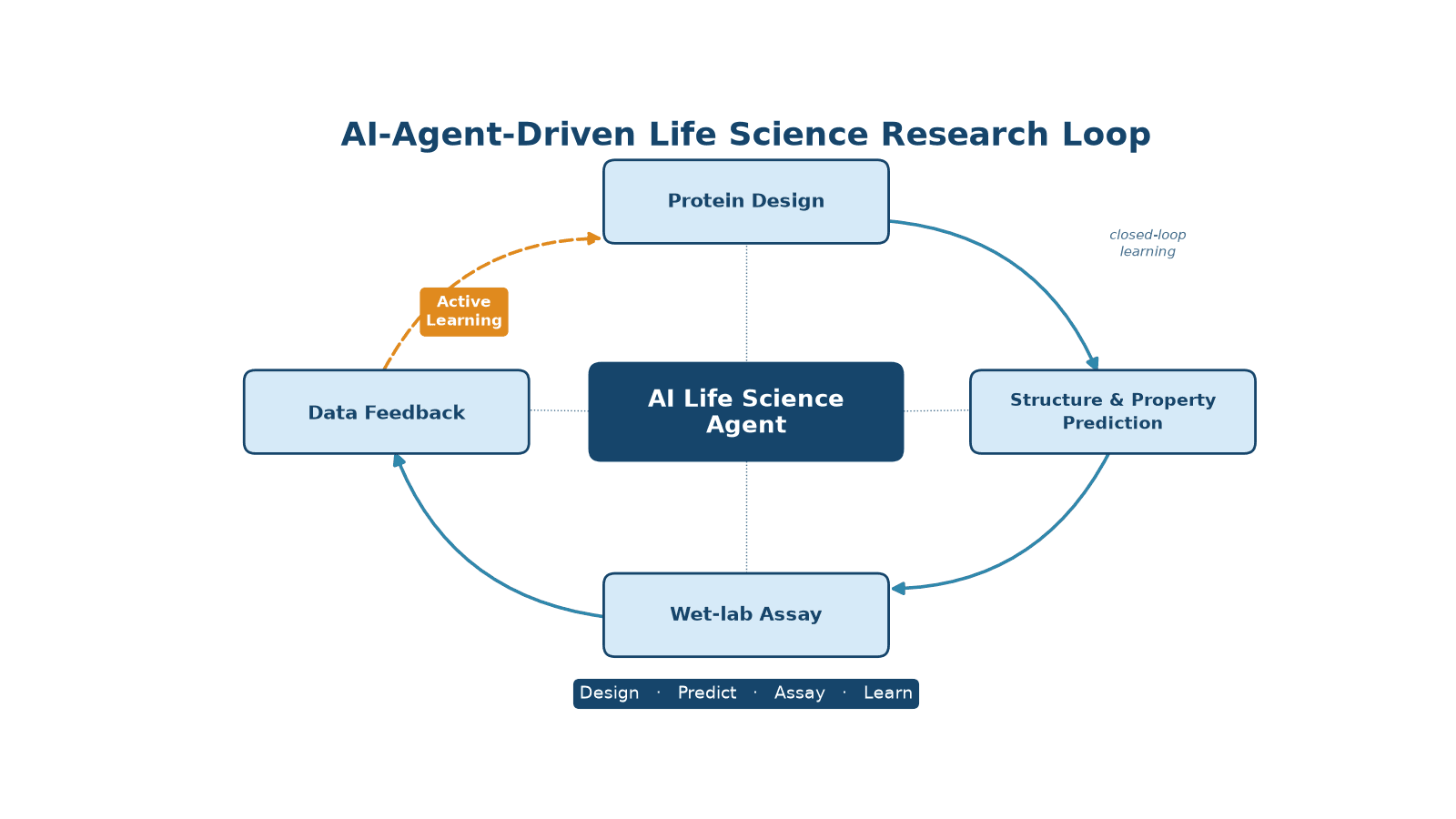
Figure 1 Overview of the AI life science agent research loop
From "computing a sequence for you" to "running a full experiment round for you," AI's role in life science is undergoing a fundamental shift. The vehicle behind this shift is the AI life science agent — a software system that can sense a task, plan actions, call on multiple tools, and keep learning from its results. It is not a bigger model; it is a "research pipeline" that strings tools and decisions together. It sits between "a model that computes" and "automation that acts" — it understands both molecular language and experimental workflow. The figure below summarizes its role in a real R&D setting.
Background & Challenge: Why Does Life Science Research Need an AI Agent?
Traditional protein engineering relies on trial and error, with a single mutation often taking weeks or months to validate; an AI life science agent compresses the "design—predict—assay—learn" loop into a continuously iterable cycle, rewriting that pace.
The deepest tension in life science research is between the explosive growth of explorable space and the slow, costly nature of wet-lab validation. In protein engineering, for instance, a protein of about 300 amino acids has far more variable sequence combinations than a laboratory could ever test one by one, and each validation round involves time-consuming steps such as expression, purification, and activity measurement.
In the past, research tools were mostly "single-point": some were good at modeling, some at prediction, and some at experiments — but they were fragmented and required heavy manual orchestration and expert judgment. The value of an AI life science agent is precisely that it strings these single-point tools into an autonomous loop, letting data flow automatically between stages, cutting redundant work, and shifting researchers' attention from "orchestration" to "decision-making."
• Large space: sequence space grows exponentially; exhaustive manual search is not feasible
• High cost: wet-lab cycles are long and unit costs are high, so work must be "targeted"
• Scattered data: design and experimental data are often disconnected and fail to form a learning loop
Behind this tension are three drivers: the growing accumulation of experimental data makes models increasingly usable, falling compute costs make large-scale sequence search feasible, and R&D competitive pressure calls for shifting from "random trial" to "targeted design." In antibodies, enzymes, and vaccines, teams have tried using models to replace some random screening, but single-point models deliver limited benefit — only when prediction and experiments are truly connected in a loop does the value of "intelligence" land in the R&D workflow.
Principles & Structure: How Does an AI Life Science Agent Work?
An AI life science agent consists of a large-language-model brain plus domain tools plus memory and feedback: it understands goals, breaks tasks into steps, calls design and prediction models, and turns experiments into reusable knowledge for active learning.
We can break it into four interacting parts (figure below):

Figure 2 How the agent works in protein engineering
• Perception layer: reads the user's goal and inputs, such as a protein sequence, a target, or an activity metric
• Decision layer: uses a large language model (LLM) as the "brain," breaks the goal into executable steps, and decides what to do first or next
• Tool layer: calls domain tools on demand — protein sequence design, structure prediction, property prediction, sequence alignment, scoring and filtering
• Memory/feedback layer: records each round's results, updates scores and constraints, and drives "active learning" to pick the candidates most worth validating next
A fitting analogy is: it is like a research assistant skilled at using all kinds of specialized software. The assistant does not necessarily run experiments itself, but knows which tool to use at which stage, how to interpret results, and how to arrange the next step. The difference is that the agent records and reviews every step automatically, so its loop is far faster than manual work.
Take affinity maturation as an example: given a target and an antibody sequence, the agent first runs structure and epitope analysis, then generates candidate mutations in batches; it scores the candidates with property prediction and selects a few high-value combinations; after these candidates are validated in the wet lab, the results flow back to the scoring function, and the next design round restarts on more accurate information. Throughout, the researcher only defines the goal and reviews the key checkpoints.
Capabilities & Evaluation: How Do You Measure an AI Life Science Agent?
Evaluating an agent means looking beyond a single model's accuracy to its end-to-end completion in real projects — the efficiency, success rate, and reproducibility from input to improved candidates, not just a model score.
Measuring an AI life science agent is not about a single model's score on a benchmark. Loop-level metrics better reflect real value:
• Task completion: from the user's goal to delivered candidates, does it complete the full "design—predict—assay—learn" loop
• Tool-call success rate: can the agent select and reliably call the required models
• Experiment consistency: the hit rate of predictions against real wet-lab validation — the key to "is it trustworthy"
• Iteration efficiency: rounds and cost required to reach the target, not single-prediction accuracy
It is also important to be clear about capability boundaries:
• It is good at: tasks with quantifiable objectives, historical data, and automatic scoring, such as affinity engineering and stability optimization of antibodies or enzymes, and developability assessment
• It is not good at: poorly-defined open-ended problems, novel targets with scarce data, extreme cases requiring strong physical-law constraints, and non-computational issues such as regulation, ethics, and clinical judgment
So, when you read an agent evaluation report, it pays to ask three things: which dataset were the metrics computed on (a public benchmark or your own experimental set), does the report include a wet-lab hit rate, and does it distinguish simulated values from measured ones. Treating a "model score" as an "experimental success rate" is a common source of misreading.
Conditions & Process: How Do You Deploy an AI Life Science Agent in a Project?
Deploying an agent in a real project requires three things: a clear quantifiable objective function, structural experimental data that can be fed back, and an iterative process connecting "predict—validate—redesign."
Bringing an agent into a real project is less about "showing off" and more about process and data (figure below):

Figure 3 Agent-driven design and validation workflow
• Objective definition: turn "what we want" into a quantifiable function, such as affinity, thermal stability, expression yield, or immunogenicity
• Data feedback: use a standardized wet-lab process so each round's results are structural and traceable enough to be "learned"
• Tool chain: sequence design, structure prediction, property prediction, and scoring/sorting, combined on demand
• Active learning: validate only the most "informative" candidates each round to avoid blind enumeration and control experimentation cost
• Human-machine collaboration: the agent handles bulk and high-frequency operations, while researchers define goals, interpret results, and manage exceptions
For teams trying this for the first time, start with a minimal viable loop: pick a project with a clear endpoint and a manageable sample size, run "design—predict—scoring" on existing data first, then add one round of wet-lab feedback. Once this small loop is validated as trustworthy, expand the goals and tool chain gradually rather than chasing an "all-purpose agent" from the start.
How MatwingsVenus®(protein design agent) Fits Into This Agent Ecosystem?
MatwingsVenus®(晓鹜®) connects callable tools such as protein design, structure modeling, and property prediction into the "design—predict—assay—learn" agent workflow, so research and engineering collaborate in one loop.
Within the AI life science agent ecosystem, what is actually "called" is the set of reliable computational and design tools underneath. MatwingsVenus®(晓鹜®) is an AI computing platform for biopharma R&D, positioned to provide a reliable, accessible "tool surface" — including modules such as protein sequence design, inverse folding, structure prediction, and property/developability assessment, which the agent can schedule on demand.
• Multi-round design: supports continuously updating constraints and goals across iterations, rather than producing a one-shot result
• Result consolidation: stores design, prediction, and screening results from each round in a structured way to support subsequent active learning
• Engineering collaboration: aligns with the R&D chain of Matwings Technology(天鹜科技), smoothing the connection between computational design and wet-lab validation
For users, three points can help judge whether a platform can serve well as a "tool surface": is it explainable (can it state the basis and confidence of a prediction), is it integrable (can it connect to your own data and workflows), and is it reproducible (are results traceable and auditable). These three points determine whether the agent ultimately learns a reliable signal or noise.
It should be noted that this article is introductory and educational. For the specific product capabilities, integration methods, and data performance of MatwingsVenus®(晓鹜®), please refer to official announcements; this article does not rely on any unverified data. For teams that want to truly run an agent, the keys remain objective definition, data quality, and tool reliability.
FAQ
How is an AI life science agent different from an ordinary AI prediction model?
An ordinary AI model only completes a single "input—output" step, such as predicting structure from a sequence. An AI life science agent is a system that autonomously plans, calls multiple models, and updates itself based on results, upgrading single-point prediction into a "design—predict—assay—learn" loop. That is the essential difference.
Can an AI life science agent fully replace wet-lab experiments?
No. The agent is responsible for "computing well and selecting well," while the wet lab is responsible for "doing it for real and verifying it." Predictions must be cross-checked against real experiments; the agent reduces the number of experiments and improves hit rate through active learning, but it cannot replace validation itself.
What kinds of projects are suitable for an AI life science agent?
Projects with quantifiable objectives, historical data, and automatic scoring are suitable, such as antibody or enzyme affinity/stability optimization, developability assessment, and sequence-space screening. For poorly-defined objectives, scarce data, or problems dependent on strong physicochemical constraints, proceed cautiously with expert judgment.
How important is data quality for an AI life science agent?
Data quality determines whether the loop can truly converge. If experimental data is not standardized or traceable, the model learns noise and "active learning" gets misled. Structural, feed-backable, and reproducible experimental data is a precondition for deploying an agent.
Summary
The core value of an AI life science agent is not to replace scientists but to compress the costly "design—predict—assay—learn" chain into an automatically iterable loop. Its boundaries are equally clear: in scenarios with quantifiable objectives, feed-backable data, and reliable tools, it can significantly improve R&D efficiency; in scenarios requiring physical laws, regulation, and ethical judgment, it remains a supporting tool. The right way to use it is to treat it as a research collaborator that can call specialized tools, and to work with it using clear objectives and reliable data.