
AI-Driven Protein Engineering: From Trial and Error to Predictable Protein Design
Published on October 27, 2026
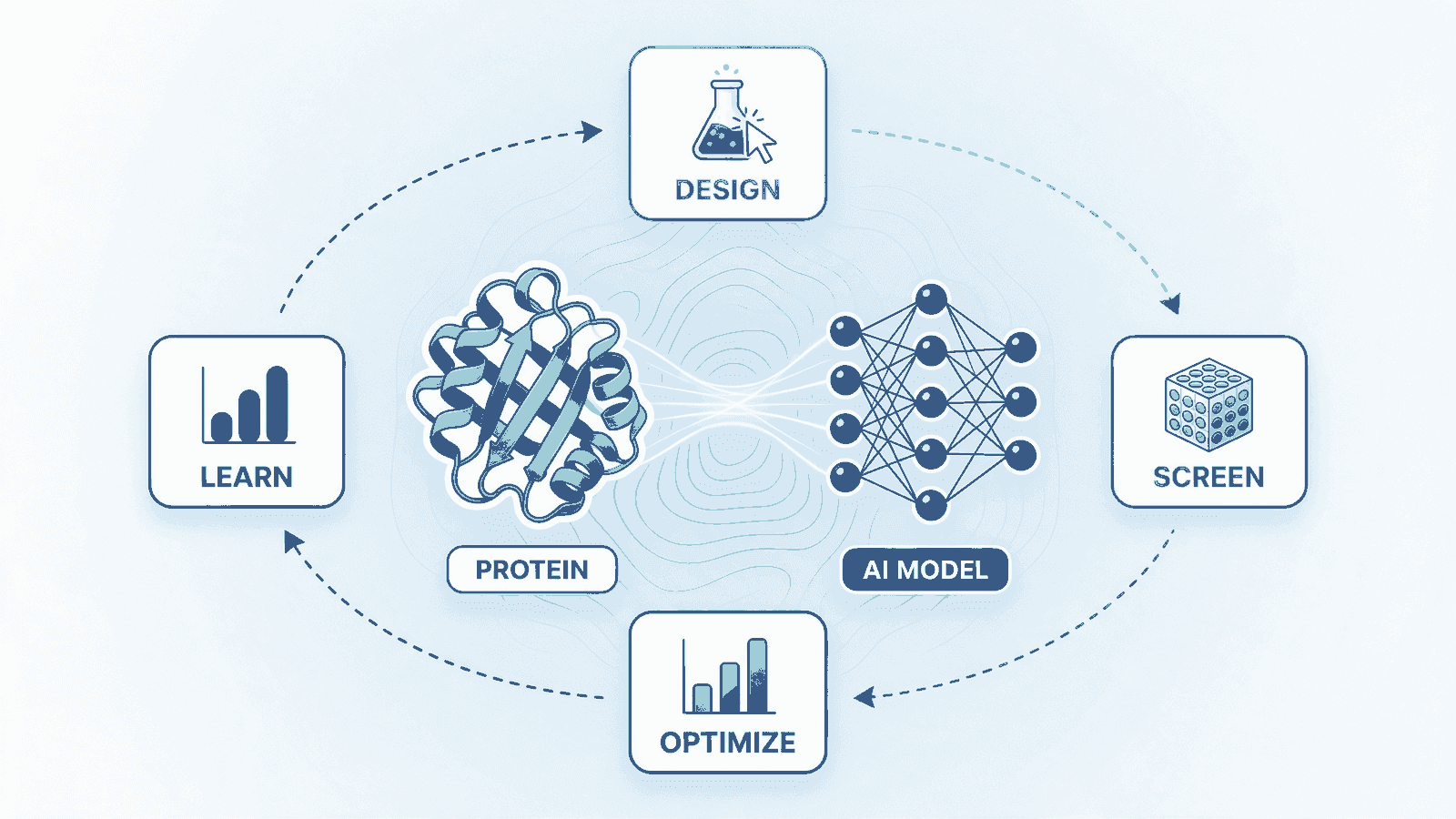
Figure 1 AI-driven protein engineering: design and screening closed loop
Category: C (Directed evolution / protein engineering: method/process + AI closed loop); cross-reference D (AI / algorithms / platforms)
Proteins are the molecular machines of life. From the enzymes that catalyze reactions and the antibodies that recognize targets, to functional proteins used in therapeutics and industrial manufacturing, their performance often determines whether a product can succeed and whether a technology can be commercialized. To improve a protein you already have—making it more heat-stable, more stable, more active, or even able to bind a new target—traditional approaches rely on random mutations and repeated trials: costly, slow, and unpredictable, with many good ideas getting stuck at "we can't improve it."
AI-driven protein engineering was created to change that. It brings machine learning and protein language models into protein engineering, replacing guesswork with data-driven design and turning "can we find a better protein?" into a problem that can be approached with algorithms and confirmed with experiments. Understanding this logic helps you judge whether the path fits your project, and how to evaluate whether a given approach is truly reliable.
Why Does Protein Engineering Need AI?
Traditional protein engineering relies on random mutations and large-scale screening, which is expensive and often inefficient; AI-driven protein engineering uses machine learning to learn patterns from existing data, so it can locate better-performing proteins with far fewer experiments, turning luck into prediction. This works because the relationship between protein sequence, structure, and function is highly non-linear: experience alone rarely tells you which mutation truly works, while an algorithm can surface hidden patterns from large datasets.
Three forces are converging to make this possible:
• The search space is enormous: a protein often has hundreds of mutable positions, and the number of single, double, and triple combinations explodes, making it unrealistic to test everything by hand.
• Data is accumulating fast: sequencing, structure determination, and high-throughput assays produce massive labeled data, which becomes the learning material for models.
• Experiments remain the bottleneck: compared with AI computation, wet-lab work is more expensive and slower, so algorithms must first narrow down the most promising candidates and spend limited experiments wisely.
To use an analogy: traditional practice is like searching for a key in a dark room, while AI is like drawing a map based on the lock's design, telling you which keys are most likely to fit before you try them on site.
Of course, AI is not all-powerful; it also depends on sufficient, reliable data. The less or messier the data, the harder it is for a model to give trustworthy predictions. That is exactly why mature approaches always treat experimental validation as a necessary step, rather than letting the algorithm "explain itself" alone.
How Does AI-Driven Protein Engineering Work?
The core of AI-driven protein engineering is to let a machine-learning model learn the mapping between sequence, structure, and function, then use active learning on a fitness landscape to actively select the most valuable mutations to validate, forming an automatic "predict–experiment–re-learn" loop. You can picture the fitness landscape as rolling hills where the peaks represent the best-performing proteins; the AI's job is to climb toward the high ground quickly rather than wandering aimlessly.
• Protein language model: treats an amino-acid sequence like a sentence, learning sequence patterns and "grammar" from a large corpus of natural proteins, so it can predict how a mutation affects stability, activity, or solubility.
• Fitness landscape: abstracts "protein sequence → performance" into a terrain where similar sequences sit close together and better performance sits closer to the peaks.
• Active learning: the model predicts first, the experiment validates only a few high-potential candidates, and the results feed back to refine the next prediction, iteratively approaching the optimum.
• Dry-wet closed loop: AI computation (dry) and real laboratory measurement (wet) alternate and calibrate each other, making predictions more accurate over time while avoiding false optimism that only exists in simulation.
For example, an industrial enzyme needs better thermostability. The model first predicts stability for a batch of candidate mutations and selects a few most promising variants; the lab synthesizes and tests these variants and feeds the measured thermostability back to the model; the model corrects itself and proposes the next round of candidates. Iterating this way, a small number of experiments often approaches high-performance regions that random screening would struggle to reach—this is the core value of AI-driven protein engineering.

Figure 2 Active learning on a fitness landscape
How Do You Evaluate Whether an AI Protein Engineering Approach Is Reliable?
To evaluate an AI protein engineering approach, look at whether it gives verifiable predictions, whether it closes the loop with real experimental data, whether it stays robust on unseen proteins, and whether it provides repeatable wet-lab validation. A model that seems "smart" is not the same as one that works; the key is whether predictions are confirmed by experiments and keep improving.
You can ask these questions:
• Is there a real data closed loop? Do predictions go into wet-lab work and do results flow back into training? Or is it a one-off "predict and stop"?
• Does it work on proteins it has never seen? Is it still robust outside the training data? If it only works on familiar sequences, its value is limited.
• Does it express uncertainty? Does it say which predictions are trustworthy and which need experimental confirmation, instead of asking you to trust the numbers blindly?
• Is it repeatable and deliverable? Is a wet-lab platform and an engineering workflow included, so that a nice prediction can become a producible process?
A simple check: if a solution only tells you "the result is great," but cannot explain why and does not ask you to confirm with experiments, be cautious. In contrast, an approach that clearly separates "prediction" from "measurement" and is willing to keep iterating with data is more trustworthy.
Key Conditions and Workflow for Putting AI Protein Engineering Into Practice
To make AI protein engineering truly practical, you need high-quality data, reusable models, automated wet-lab work, and an engineering workflow working together, forming a complete chain from sequence design to scale-up production. If any link is missing, a "beautiful prediction" may stay on paper and never become a usable product.
• Data: traceable, well-aligned, high-quality data on structure, sequence, and activity is the prerequisite for a reliable model; the more standardized the data, the more stable the prediction.
• Model: an iterative, interpretable model that can report confidence is more trustworthy than a black box that only scores.
• Wet lab: automated expression, purification, and high-throughput screening enable fast validation and timely feedback of results to the model.
• Process: after validation, further optimize the candidate toward scale-up, purification, and stable delivery before it can be genuinely produced.
In terms of workflow, it generally goes through "data preparation—model training—candidate design—wet-lab validation—model retraining," and the further along you go, the closer you get to real process parameters, and the clearer it becomes whether the protein is worth scaling up.

Figure 3 Full workflow from AI design to scale-up production
How Does MatwingsVenus®(晓鹜®) Connect AI and Wet Lab Into a Closed Loop?
MatwingsVenus®(晓鹜®) links algorithmic prediction, wet-lab experiments, and expert experience into a deliverable engineering chain, which is the practical form of the "dry-wet closed loop." It means users do not have to choose between "understanding algorithms" and "doing experiments"; instead, the two support each other and push the project forward together.
• Dry-wet closed-loop platform: connects AI design, sequence optimization, and experimental validation, so computation and real data keep calibrating each other and reduce the risk of "prediction not matching measurement."
• Wet-lab capability: provides systematic support for expression, purification, and screening, so predictions can be validated and results can flow back, truly closing the loop.
• Expert center: brings in experts familiar with protein engineering and process to help judge plans, interpret data, and avoid common pitfalls, cutting the cost of trial and error.
For users, the value of this closed loop is saving detours: algorithms narrow the search space, wet-lab work validates results, and experts steer the direction—the three together give every step a basis and make progress more predictable.
Related products/services deep links: to apply AI protein engineering to your own project, see Dry-Wet Closed-Loop Platform (/en/dry-wet-closed-loop-platform), Wet-Lab Services (/en/products/wet-lab), and Expert Center (/en/products/expert-center).
FAQ
What is the difference between AI protein engineering and traditional directed evolution?
Traditional directed evolution relies on random mutation and large-scale screening, using volume to increase the odds of finding a better protein; AI protein engineering first builds models and then iterates with direction, finding the optimum with fewer experiments, making it more efficient and lower cost—though it also depends more on data quality and model capability.
Do AI-designed proteins always need wet-lab validation?
Yes. Every AI prediction is only a candidate hypothesis and must be confirmed by measuring real performance in the lab. Experimental data are both the validation tool and the "fuel" that keeps improving the model—exactly why the dry-wet closed loop matters.
What problems can MatwingsVenus®(晓鹜®) help me solve?
It serves users who need to engineer proteins: if you have an enzyme, antibody, or other target protein and want to improve activity, stability, or binding, MatwingsVenus®(晓鹜®) can connect AI design with wet-lab validation and provide expert support, bringing your approach closer to a deliverable process.
What applications is AI protein engineering suited to?
It suits any scenario where you want a better protein with fewer experiments, such as thermostability and activity engineering of industrial enzymes, stability and affinity optimization of antibodies and functional proteins, and directed design toward specific substrates or targets.
Summary
AI-driven protein engineering upgrades "design and validation" from experience-driven to data- and algorithm-driven, obtaining better proteins with fewer experiments and faster iteration, and using the dry-wet closed loop to deliver predictions as producible processes. Its value is not that "AI replaces people," but that it combines human experience, algorithmic computation, and experimental validation into a force that makes protein engineering more efficient and more reliable.
Explore MatwingsVenus®(protein design agent)
If you are doing protein engineering and want AI to help you avoid detours, feel free to contact Matwings Technology to get selection advice, submit a sample, or request a quote.