
What Is an AI Biofoundation Model, and Why Is It the Underlying Engine for Protein & Drug R&D?
Published on November 4, 2026
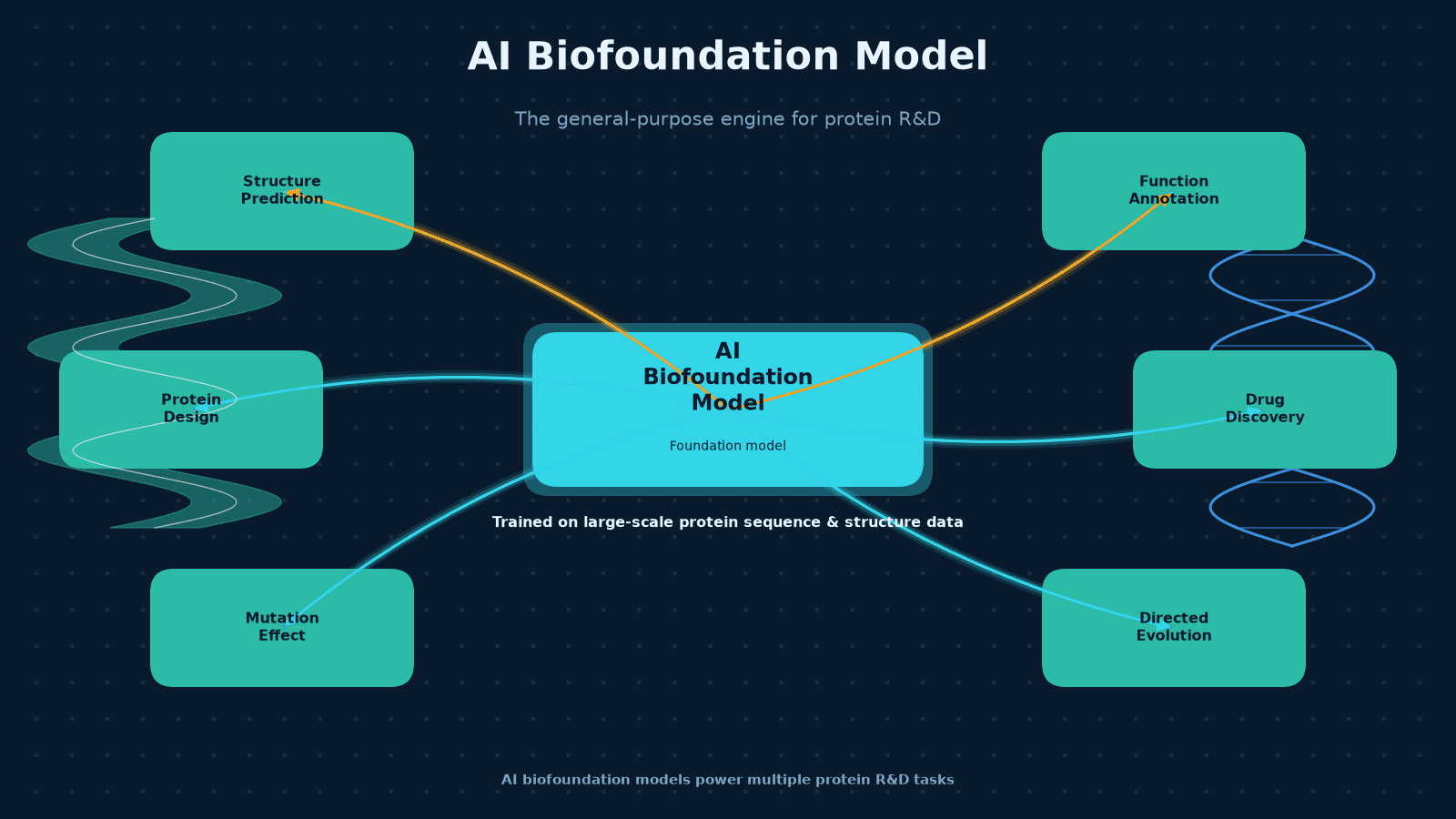
Figure 1 AI biofoundation model: a general engine driving many protein R&D tasks
If protein R&D is like ‘reading a language’, an AI biofoundation model is like a large model that first reads a massive corpus of ‘protein text’ and then adapts quickly to specific tasks. It does not solve one problem; it provides a reusable set of general abilities. Below we walk through its background, principles, capability limits and deployment workflow, so you can see both its value and its limits.
1. Background & mechanism: from ‘one task, one model’ to ‘a general base + quick adaptation’
An AI biofoundation model is an AI model pre-trained on large-scale protein sequence, structure and function data and then fine-tuned for specific tasks; it shifts protein R&D from ‘one task, one model’ to a ‘general base + quick adaptation’ paradigm.
Traditional bioinformatics R&D is often ‘one task, one model’: to predict the structure of a protein you train a separate model; to annotate an enzyme’s function you build a new one. The result is scarce labelled data, poor generalization and heavy duplicated effort, which becomes a bottleneck on efficiency.
A foundation model is first pre-trained with self-supervised learning on large amounts of unlabelled data to learn general patterns, then adapted to various downstream tasks by fine-tuning or prompting. GPT and BERT are examples in language; in biology, models built for protein sequence and structure are often called protein language models (PLMs).
· Sequence explosion: known protein sequences already number in the hundreds of millions, but structure and function annotation remains ‘one in a million’.
· Value of a foundation model: it compresses the evolutionary, structural and functional patterns hidden in massive unlabelled sequences into transferable representations, easing the labelling shortfall.
· Analogy: a student who first reads many textbooks builds broad knowledge, then learns a specific subject much faster.
In short: conventional models are ‘a single-point attack with limited labels’, while a foundation model is ‘build a foundation from big data first, then build whatever you need on top’. This kind of general base is exactly the underlying capability Matwings Technology focuses on for protein design.
For industry, this paradigm shift means: where you once needed many trial-and-error experiments to locate one viable sequence, you can now have a foundation model screen a huge space quickly and confirm with a limited set of wet-lab experiments — compressing a development cycle from months to weeks.
2. Principles & structure: pre-training, representation learning and fine-tuning
The core workflow of an AI biofoundation model is self-supervised pre-training on huge protein sequence and structure data to learn general representations, then fine-tuning on tasks such as structure prediction and function annotation, achieving good performance with far fewer labels.
Pre-training: treat an amino-acid sequence as a ‘language’ and train with self-supervised objectives such as masked prediction or contrastive learning. While ‘reading’ massive sequences, the model naturally learns evolutionary selection, structural and functional clues hidden in them.
Representation learning: the model maps each sequence into a high-dimensional vector (embedding), so similar sequences and functions cluster near each other in vector space. This gives similarity search, function annotation and property prediction a shared base.
Fine-tuning: continue training on labelled downstream data, or add structure modules (folding head, attention layers), for structure prediction, activity/affinity prediction, or sequence generation and design.
· Relation to specialized models: AlphaFold and the like are ‘downstream-task’ models focused on structure prediction; a biofoundation model is the more upstream ‘general base’ supporting many tasks, and the two are often combined.
· Common architectures: mostly Transformer / attention as the backbone, which may fuse a sequence language model (PLM) with structure-aware modules.
To remember it quickly: first ‘read many textbooks’ to build broad knowledge (pre-training), then ‘learn a specific subject’ to develop expertise (fine-tuning).
Notably, the multi-task representations also bring ‘zero-shot / few-shot’ ability: even when a task has few labels, the model can give usable predictions using the general patterns learned during pre-training — especially valuable for cold-start protein projects.

Figure 2 Workflow: pre-training – representation learning – fine-tuning
3. Capability limits & selection: not just parameter count
AI biofoundation models differ widely in data scale, architecture and task coverage, so selection should focus on their sequence/structure data handling, measured downstream performance and interpretability — not just parameter count.
What it can do: structure prediction, function and family annotation, property prediction (stability, solubility, expression), sequence generation and design, and mutation-effect assessment.
What it cannot do (limits): the model’s output is a probabilistic inference and cannot replace real experiments; extrapolation to sequences far outside the training distribution (e.g. extreme novel scaffolds) is limited; and there is a risk of ‘plausible-but-wrong’ hallucinations.
· Pre-training data: species coverage, sequence length, whether it includes structure and function information.
· Architecture & scale: parameter count, number of attention layers, whether it includes structure modules.
· Task coverage: which downstream tasks are supported and whether public benchmarks exist.
· Measured performance: validation results on the target task, not marketing claims.
· Interpretability & cost: whether confidence/attention is provided, and the compute and inference overhead.
So start by clarifying the task: do you want to ‘predict a property’ or ‘design a new sequence’? Then match a model. The only truly critical question is whether it has been validated on your own task.
Another often-overlooked point is ‘out-of-distribution generalization’: the farther the target sequence is from the training data, the more likely the model is to give a confident but wrong judgment. So for highly novel designs, budget for wet-lab re-checks and treat low-confidence results with care.
4. Engineering workflow: a closed loop from sequence to wet-lab validation
To actually use an AI biofoundation model in protein engineering, you need a closed loop of ‘model prediction → wet-lab validation → feedback retraining’, plus standards for data, compute and validation protocols, so prediction becomes reproducible performance gain.
A deployable workflow usually has five steps:
· 1) Sequence input & data preparation: unify formats, deduplicate and filter quality.
· 2) Model inference: choose or fine-tune a suitable foundation/specialized model and output candidates with confidence.
· 3) Candidate ranking & filtering: filter by predicted score, diversity and expressibility.
· 4) Wet-lab validation: express, purify and measure activity, stability or affinity.
· 5) Data feedback & active learning: feed measured results back to retrain the model so it improves with data.
On conditions and process, a few points matter:
· Data standards: consistent batches and accurate labels, to avoid ‘dirty data’ polluting the model.
· Compute budget: evaluate inference cost and resource usage and choose a feasible model size.
· Validation protocol: reproducible metrics and proper controls, so results stand up when you return to the bench.
· Human-machine collaboration: the model proposes candidates, the experiment determines ground truth, and both are indispensable.
The value of the whole loop is turning ‘AI prediction’ into ‘reproducible experimental evidence’, rather than leaving it as a paper-and-silicon score.
To tell whether the loop works, look ultimately at the ‘wet-lab hit rate’ and ‘improvement per iteration’: the fraction of candidates that pass validation, and whether the model’s prediction error on the target property drops each round. These two metrics say more than a raw prediction score about whether the model is truly usable.

Figure 3 A closed engineering loop from sequence to validated protein
5. Matwings Technology & MatwingsVenus®(protein agent): turning an AI biofoundation model into an engineering service
MatwingsVenus®(晓鹜®) platform combines an AI biofoundation model with a high-throughput wet-lab validation loop for enzyme, antibody and protein-engineering scenarios, offering an integrated service from design and prediction to screening and validation.
MatwingsVenus® (晓鹜®) is an integrated platform for protein design, prediction and screening from Matwings Technology, dedicated to turning the ‘general ability’ of an AI biofoundation model into an engineering service that companies can actually use.
· Use a biofoundation model for sequence generation and mutation design to quickly shrink the search space.
· Pair it with wet-lab design, screening and data feedback to form a ‘prediction–validation’ loop.
· Cover enzyme engineering (activity, stability, substrate specificity), antibody and protein-design scenarios.
The platform emphasizes a ‘AI prediction + experimental validation’ two-engine approach: the model proposes candidates, experiments determine ground truth, and data flows back to retrain, reducing blind trial and error and shortening iteration cycles. For concrete performance figures and cases, please rely on measured data — we make no unverified marketing claims.
6. FAQ
What is the difference between an AI biofoundation model and AlphaFold?
AlphaFold focuses on one specific ‘downstream task’ — structure prediction; an AI biofoundation model is the more upstream ‘general base’ pre-trained on massive sequence/structure data and supports many tasks such as structure prediction, function annotation and sequence generation. They are often combined: the foundation model supplies general representations, AlphaFold supplies high-accuracy structures.
Can an AI biofoundation model replace wet-lab experiments?
No. The model gives probabilistic inferences and candidates; wet-lab work (expression, purification, activity assays) determines ground truth. The value of a foundation model is shrinking the search space and reducing blind experiments — not replacing validation.
How can small teams use an AI biofoundation model?
Start by accessing open-source or cloud sequence/property models via API, mainly for scoring and ranking, then verify with a small number of wet-lab experiments. You can also use an engineering platform such as MatwingsVenus®(晓鹜®) that hands the model-and-screening loop to ready-made tools, lowering the entry barrier.
How reliable is the prediction, and how do you verify it?
Reliability depends on measured performance on the target task and whether the input falls within the training distribution. Check whether the model provides confidence/attention, evaluate it on an independent, reproducible validation set, then confirm with wet-lab results; be conservative for high-risk decisions.
7. Conclusion: an AI biofoundation model is a starting point, not the finish line
An AI biofoundation model converts massive biological data into reusable general ability and is an important starting point for protein and drug R&D; but the real value comes from the closed loop of ‘model prediction + wet-lab validation’ and continuous data iteration. Choose the right model, run the workflow and align with experiments to turn the technology dividend into real products and services.
An AI biofoundation model becomes a general engine for protein R&D by pre-training on massive biological data, but downstream results still need wet-lab validation.
