AI Protein Design Tools: Choice Keys & Capability Boundaries
Published on November 2, 2026
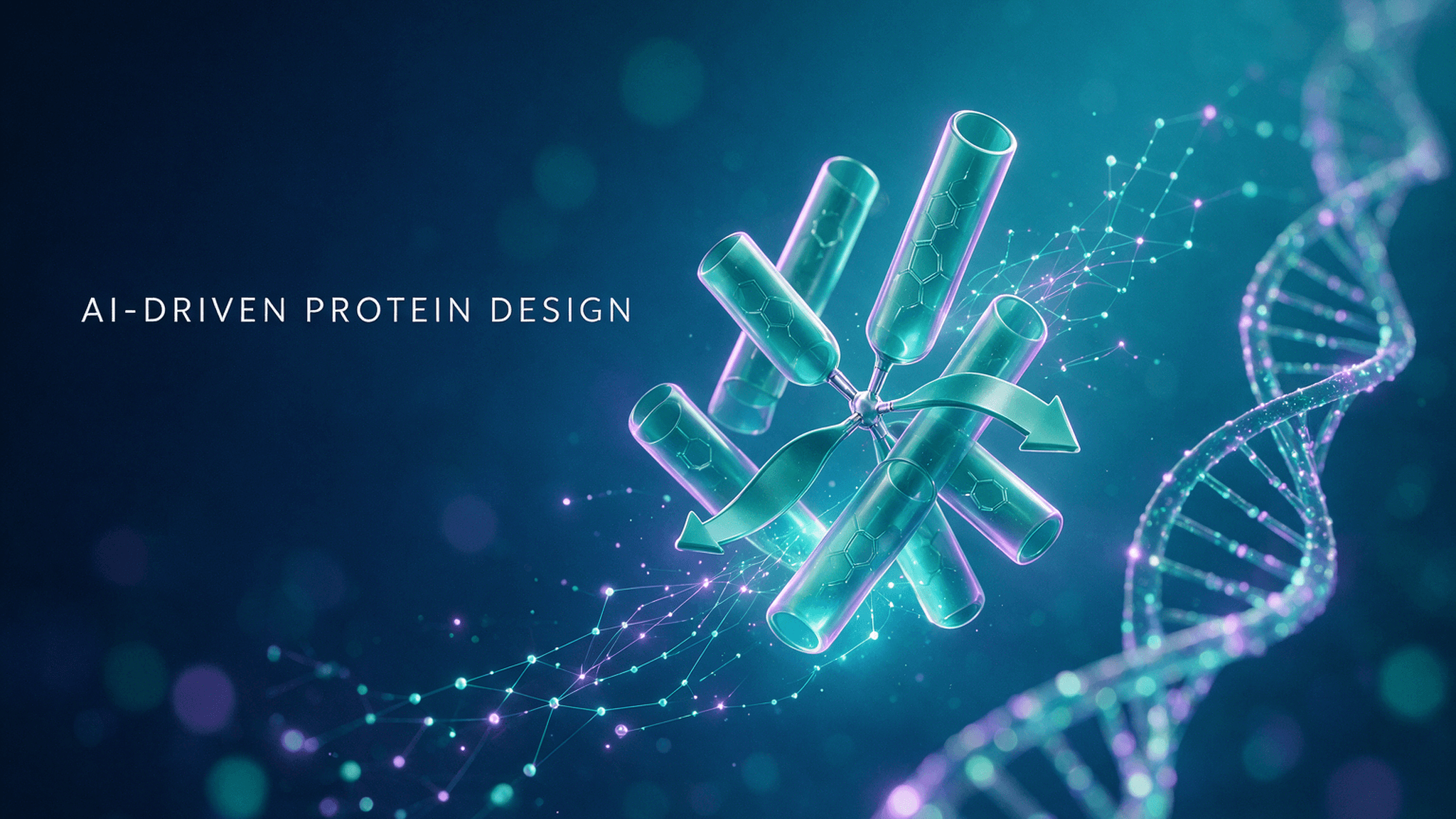
Fig 1: AI protein design landscape: from sequence input to wet-lab validation
AI-driven protein design is reshaping enzyme engineering, antibody discovery, and biopharma R&D. This article groups mainstream AI protein design tools into four categories — structure prediction, generative design, property prediction, and closed-loop platforms — and clarifies each one's capability boundaries and selection logic. One idea runs through it all: however strong the model, it only makes predictions; value is realized only when those predictions are validated by wet-lab feedback in a closed loop.
Why AI Protein Design Tools Are Needed
Traditional protein engineering (directed evolution) often screens very large libraries of variants — costly, slow, and throughput-limited. AI protein design tools act as a navigator: they learn sequence–structure–function relationships, fit fitness landscapes, predict beneficial mutations, generate new backbones, and compress candidate space so that limited wet-lab budget is spent on the molecules most likely to succeed.
But be clear about the boundary: AI does not replace wet-lab work — it narrows the search space, raises the first-pass hit rate, and iteratively reduces uncertainty through 'predict → validate → feed back'.
How AI Protein Design Tools Work & Where They Stop
By output type, mainstream AI protein design tools fall into four categories:
• ① Structure prediction: predict 3D structure from sequence (or known structure) for complexes and antibody–antigen interfaces; gives structural clues, not final quantitative affinity.
• ② Generative design: given a backbone or constraint, generate new backbones, sequences, or binders for new functions or interfaces.
• ③ Property/function prediction: score mutation effects and predict stability, solubility, activity, and fitness landscape — ranking which variants to make.
• ④ Closed-loop platform: integrate prediction, wet-lab screening, and active learning into an iterative R&D loop.
Capability boundaries matter: prediction ≠ experimental evidence; sequence alone cannot establish quantitative claims like binding affinity without structure/docking/assay support; models depend on training data and generalization across targets is not guaranteed. So distinguish 【measured】 from 【predicted】, and never cite a predicted value as an experimental conclusion.

Fig 2: The dry-wet loop: prediction drives the experiment, experiment trains the model
How to Choose: Match the Tool to the Task
Ask about the 'task' before the 'tool':
• Have a starting structure, want to enhance binding or stability → structure prediction + mutation scoring;
• Need a new backbone, new function, or new binder → generative design;
• Only have a sequence, want to optimize properties quickly → sequence-level property prediction;
• Need verifiable, iterative, accumulable results → closed-loop platform.
Real projects usually combine several tool classes and hand every round of predictions to wet-lab acceptance before feeding the model. The key to selection is not 'which model is strongest' but 'which combination closes the loop'.
From Prediction to Wet Lab: The Closed-Loop Workflow
A typical dry-wet closed loop has five steps: ① AI candidate generation; ② construction/expression/purification; ③ activity or property assay; ④ data feedback to the model; ⑤ active learning to design the next batch. Process essentials: standardize assay conditions and data, feed back negative results, and control the size of each iterative batch, so every wet-lab run becomes a 'memory' for the model.
This is where an AI tool's value is truly decided — prediction says 'what is worth testing'; the experiment answers 'what actually happened'; the two advance together.

Fig 3: A selection workflow matching AI protein design tool categories to tasks
How MatwingsVenus® Helps
MatwingsVenus® organizes protein design around a 'dry-wet closed loop': AI drives candidate design; the wet-lab platform handles construction, expression, purification, and activity assays; the expert center provides protocol and data-analysis support; and the dry-wet closed-loop platform turns 'predict → validate → iterate' into a reusable R&D loop.
We follow a transparency principle: we clearly distinguish 【measured】, 【predicted】, and 【unknown】, never package a predicted value as an experimental conclusion, and accept every AI output with wet-lab evidence so R&D decisions rest on verifiable data.
Related Products / Services
• Expert Center
• Dry-Wet Closed-Loop Platform
Frequently Asked Questions (FAQ)
1. Can AI protein design tools directly deliver a usable protein?
Usually not in one step — AI outputs candidates and predictions that must be validated and iterated in the wet lab before becoming usable molecules.
2. Can a predicted result be cited as experimental evidence?
No. A prediction is a ranked hypothesis; a wet-lab measurement is the evidence; the two must be kept distinct.
3. Can I do AI protein design without an experimental structure?
Yes. Some models predict structure or properties from sequence, but quantitative claims such as binding affinity still need structure and assay support.
4. What's the difference between structure prediction, generative design, and property prediction?
Structure prediction answers 'what does it look like', generative design answers 'what to build', property prediction answers 'how well it works' — they complement each other.
5. How do I choose the right AI tool for my project?
Match it to the task — ask whether you need a structure, a new backbone, or property optimization, then whether you need loop closure.
6. Does AI protein design always need wet-lab work?
For publishable, translatable, reproducible outcomes, almost always — the closed loop is where value is delivered.
7. How does it relate to traditional directed evolution?
It augments rather than replaces — AI narrows the search space, while directed evolution provides wet-lab validation and data accumulation.
Conclusion
The value of AI protein design tools depends on whether predictions are continuously validated in the wet lab and fed back to the model. Choose tools by task, and always accept results with experimental evidence. MatwingsVenus® brings AI design and wet-lab validation together in a dry-wet closed-loop platform — an iterative, traceable R&D system where every prediction is grounded in verifiable data.