AAV empty/full capsid separation and Empty Capsid Removal
Published on September 4, 2026
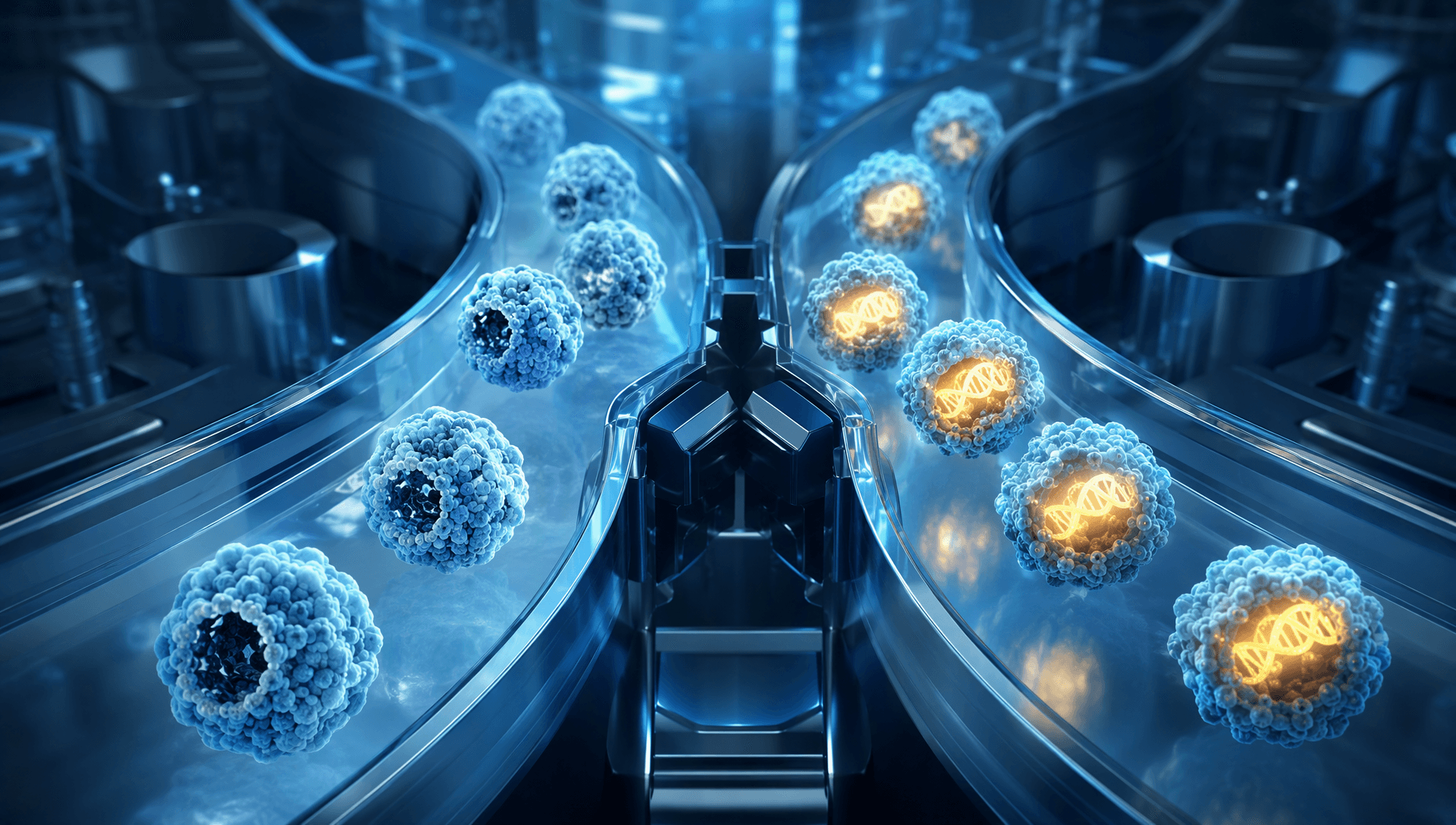
AAV empty/full capsid separation is not a stand-alone polishing trick. A robust empty capsid removal strategy connects upstream packaging, feed characterization, separation mechanism, orthogonal analytics, recovery, and scale-up requirements into one verifiable process framework.
As AAV programs move from research batches toward clinical and commercial manufacturing, the meaning of “purity” becomes more demanding. The process must retain capsids carrying the intended genome while reducing empty, partially packaged, overpackaged, aggregated, or otherwise undesired particles. Because empty and full capsids have nearly identical external protein architecture, a capture operation may recover both populations efficiently without resolving them. Empty capsid removal therefore needs to be designed across the process rather than appended as a late corrective step.
Why AAV empty/full capsid separation sets the process ceiling
An empty capsid does not contain the intended complete vector genome, yet it contributes to the total capsid signal. Total particle measurements can therefore mask meaningful differences in genome-containing particles and lot composition. Partial packaging further complicates a simple empty-versus-full model by creating intermediate populations.
The useful separation signals are mainly associated with the packaged nucleic acid: it changes buoyant density and can alter overall charge behavior. These differences are real but sensitive to serotype, payload, capsid engineering, buffer composition, pH, conductivity, temperature, and feed impurities. A resin and gradient that work for one program should not be assumed to transfer unchanged to another.
A practical development target must balance four questions: the required enrichment of genome-containing capsids, acceptable recovery loss, scalability, and the ability of analytical methods to support lot-to-lot decisions. A clean chromatogram is not enough unless collected fractions are confirmed for particle composition, genome integrity, and biological function.
Choosing a route for AAV empty capsid removal
Density-gradient ultracentrifugation separates particles by buoyant density and remains useful for small-scale research, feasibility studies, and preparation of reference material.Its constraints include operator dependence, throughput, equipment utilization, and manufacturing scale-up. The method can be appropriate when sample quality matters more than production throughput, but platform transfer should be considered early.
Anion-exchange chromatography uses charge differences associated with genome packaging and can fit more naturally into closed, automated, and scalable workflows after affinity capture.However, a scalable mechanism is not a universal recipe. Stationary phase, mass-transfer format, buffer chemistry, pH, conductivity, salt type, additives, loading, residence time, and gradient design can all change resolution and recovery.

AEX exploits charge differences for empty capsid removal, but operating conditions remain product specific
When one gradient provides insufficient resolution at high loading or low starting full-capsid content, teams may evaluate micro-steps, fractionated elution, orthogonal operations, or a second loading pass, as demonstrated in a recent two-pass AEX study.Additional selectivity comes with trade-offs in time, buffer use, hold volume, recovery, and operational complexity. The decision should consider recovered full capsids per batch and process robustness, not purity alone.
Affinity chromatography is effective for capture and removal of many host-derived impurities, but it recognizes external capsid features shared by empty and genome-containing particles. A practical sequence is therefore “capture for recovery, polish for composition”: establish a relatively clean and controlled feed first, then use a charge- or density-sensitive operation for enrichment.
Build a scalable loop from upstream burden to downstream polishing
A successful AAV empty/full capsid separation program starts before the polishing column. Production host, plasmid design and ratio, transfection state, culture conditions, and harvest timing can influence packaging outcomes. If the incoming empty-capsid burden is high, downstream enrichment may require greater losses, more cycles, or more complex fractionation. Upstream work does not replace purification; it moves purification into a manageable operating region.
A downstream train can be structured as clarification and nuclease treatment, concentration and buffer exchange, affinity capture, compositional polishing, and final formulation. Each operation should have defined inputs and outputs. For AEX development, inputs include serotype, total capsids, vector genomes, starting particle composition, aggregation, residual nucleic acid, pH, and conductivity. Outputs should cover fraction composition, recovery, purity, genome integrity, and suitability for the next unit operation.
Development can proceed at three scales. High-throughput small-volume studies identify stationary phases and buffer windows. Representative-feed studies then challenge loading, gradient shape, flow rate, and collection limits. Scale-up studies assess shifts in peak shape, pressure, mixing, system delay, and pool boundaries. Recording failed conditions is valuable because it prevents later teams from repeating unsupported parameter transfers.

Upstream burden reduction, downstream polishing, and orthogonal analytics form one scalable control loop
Co-develop analytics with the separation process
AAV empty capsid removal cannot be demonstrated without reliable analytics. Analytical methods should explain what happens across fractions, unit operations, and lots—not simply report a final ratio. Sedimentation velocity analytical ultracentrifugation can resolve particle populations; analytical ion-exchange methods can support rapid comparison of charge variants; mass photometry, mass spectrometry, electron microscopy, and combined genome/capsid assays can add orthogonal views.
Every method has assumptions, resolution limits, and sample requirements. A stronger strategy uses a high-resolution reference method to establish population composition and a routine method to support process screening and lot monitoring. If methods disagree, the team should investigate aggregation, partial packaging, standard assignment, baseline integration, and dilution conditions rather than selecting the most favorable number.
The process scorecard should extend beyond full-capsid percentage. Total capsids, vector genomes, recovery, aggregation, host-cell protein, residual DNA, payload integrity, and functional assays should be reviewed together. This quality-oriented approach is consistent with the FDA’s 2020 expectation that gene therapy IND CMC information support safety, identity, quality, purity, and strength, including potency.It also reveals whether a condition selectively removes empty particles or damages genome-containing particles and downstream stability.
Where MatwingsVenus™(晓鹜™)fits in the development workflow
AAV process development spans literature, databases, serotype information, analytical methods, operating variables, and experimental results. MatwingsVenus™(晓鹜™)can support multi-source retrieval and structured research at project initiation, helping teams organize public evidence by serotype, payload, production system, separation mechanism, and analytical method while distinguishing measured, predicted, and unknown information.
For programs involving a specific capsid sequence, structure, or functional question, MatwingsVenus™(晓鹜™)can connect to authoritative protein database retrieval and protein-function workflows. These capabilities help narrow information gaps and define validation tasks; they do not replace chromatography hardware, purification media, or wet-lab confirmation.
A concrete task chain begins with the target serotype, payload design, production system, feed profile, candidate mechanisms, and quality objectives. The platform retrieves relevant literature and database records, organizes applicability limits and conflicting evidence, and produces a structured list of candidate routes, variables, and validation needs. The development team then confirms decisions through DoE, small-scale chromatography, and orthogonal analysis. The value of the digital workflow is better question selection and evidence continuity—not an unverified purification promise.
For AAV empty capsid removal, vector analytics, or related research tools, visit the MatwingsVenus™(晓鹜™) Mall to consult on relevant products and discuss options appropriate to the program stage.
FAQ
Should empty capsids always be minimized as far as technically possible?
The target should reflect route of administration, dose, product risk, process capability, analytical confidence, recovery, and stability. Extreme depletion is not automatically better if it causes substantial full-capsid loss or poor lot consistency.
Can one AEX method serve every AAV serotype?
AEX is a scalable candidate mechanism, but no fixed setup is optimal for all wild-type and engineered capsids. Stationary phase and operating conditions should be screened for the actual serotype, payload, and feed.
Why is polishing needed after affinity capture?
Affinity capture primarily recognizes external capsid features and removes many process impurities. It typically does not provide sufficient discrimination between particles with similar exteriors but different genome content.
What shows that an AAV empty/full capsid separation method is ready to scale?
Evidence should include resolution and recovery at representative loading, stable pool boundaries, lot-to-lot reproducibility, pressure behavior, cycle time, buffer tolerance, media lifetime, and agreement across orthogonal analytical methods.
From removing empty capsids to controlling product composition
A mature process does more than produce one attractive separation profile. It explains where empty capsids arise, which mechanism separates them, how operating variables affect selectivity and recovery, and how independent analytical methods confirm the outcome. By connecting upstream burden reduction, fit-for-purpose polishing, orthogonal analytics, and structured evidence management, teams can turn an isolated success into a reproducible and scalable manufacturing capability.