Behind the Treasure of WAIC2026: A Post-2000 'Genius Teen' AI Crossover Started with Family Bonds
Published on July 19, 2026
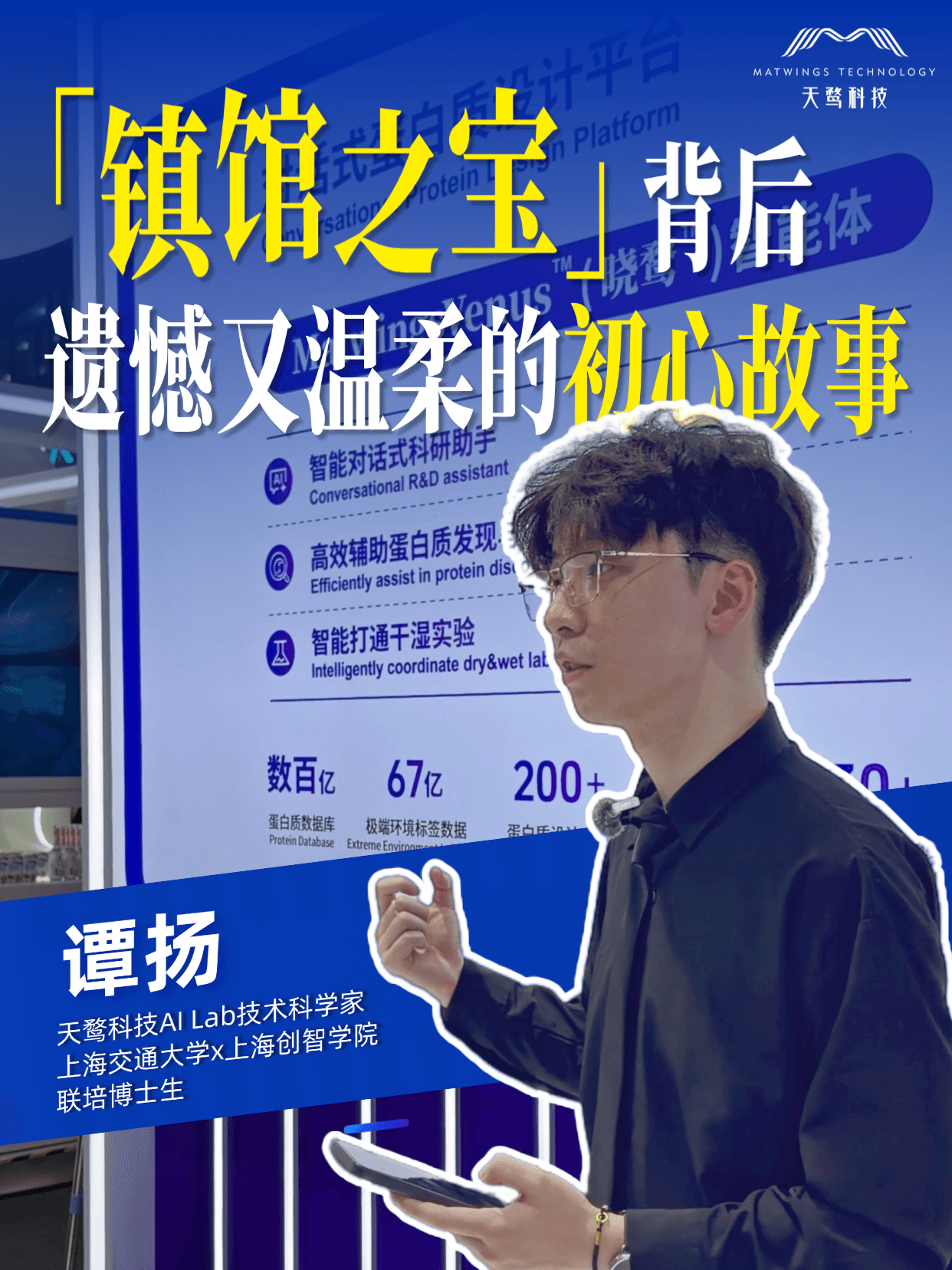
In an era where almost everyone is chasing general AI and high-paying jobs at big tech companies,
why would a computer science PhD, who has won numerous awards and published tons of outstanding papers, willingly give up the mainstream paths in computing (like natural language processing and computer vision) to dive into the unfamiliar world of biological research?
Tan Yang is the lead developer of the MatwingsVenus™ (Xiaowu™) AI agent, the crown jewel product of Matwings Technology showcased at WAIC2026.
His leap into AI across fields started with a simple, heartfelt obsession with family.
01.
Can my expertise really help others?
After his grandmother was diagnosed with Alzheimer's, Tan Yang started thinking across fields. No matter how good his coding was, how could it solve real-world problems? The first monoclonal antibody drug his grandmother used pushed him out of the familiar computer track and into protein research, trying to use AI to empower life science research.
-1.jpg%3F2026-07-20T02%253A20%253A44.455Z&w=3840&q=75)
AI LAB FOR PROTEIN DESIGNER
Starting from scratch, he once managed to boost the activity of the Cas12i3 enzyme fivefold in a short time using a prototype of a self-developed model. This breakthrough made him confident that AI could transform traditional scientific research and tackle tough problems in life sciences R&D.
But individual breakthroughs have their limits—technology needs systematic support and team effort to move beyond papers. In the open and inclusive research environment at Matwings, backed by the company's real industry data and professional support, Tan Yang's original passion took root and grew. What were once scattered algorithm prototypes have evolved into a comprehensive AI protein research platform that genuinely applies the technology and addresses real industry needs.
-1.jpg%3F2026-07-20T01%253A43%253A39.615Z&w=3840&q=75)
AI protein lab
02.
Making Protein Research No Longer So 'Hard'
For a long time, protein research has been plagued by long cycles, high trial-and-error costs, and difficulties in practical application. Even with the major breakthroughs like AlphaFold from the 2024 Nobel-winning research, it can only predict protein structures—it only solves the basic problem of 'seeing the protein' and can’t support the industry's needs for functional development.
On this basis, the MatwingsVenus™ (Xiaowu™) large model achieves a key leap from 'structure prediction' to 'function creation': it can predict and design protein functions directly based on sequences, directly addressing the industry’s core concern of 'how to actually use it.' This is also its main innovation that sets it apart from other AI protein tools on the market.

AI PROTEIN AGENT
The MatwingsVenus™ (Xiaowu™) AI agent, built on the core capabilities of this large model, takes it a step further by connecting the entire workflow from AI design to experimental validation, reshaping the paradigm of protein R&D:
Top-notch global accuracy: Relying on tens of billions of protein sequence datasets, the model's performance has long ranked first on Harvard Medical School's ProteinGym leaderboard.
Full wet and dry loop: Supports protein design driven by natural language dialogue on the platform, seamlessly connecting to self-developed dark laboratory experiments for validation, completing the entire process of protein design, experimentation, and iteration in one go, greatly lowering the threshold for research.
Tenfold efficiency boost: R&D cycles are shortened from 2-5 years to 2-6 months, drastically reducing costs and improving efficiency.
Real industry application: So far, Matwings has completed 40 successful transformation projects, with 10 already implemented at production scale, covering sectors like innovative drugs, health, and circular economy, turning lab technology into real industry outcomes.

AI PROTEIN DESIGN
A post-2000 'wonder kid'
Breaking boundaries across fields
And reaching the top stage at WAIC
At Matwings, youth is the new force daring to break through
We always look forward to walking alongside young people full of passion
And exploring the long-term future of AI in life sciences together!
个人简介

AI LAB SCIENTIST: YANG. TAN
Born in 2000, a technical scientist at Matwings Technology AI Lab, leading the development of the conversational protein design AI agent MatwingsVenus™ (Xiaowu™). Currently a 2025 joint PhD student at Shanghai Jiao Tong University & Shanghai Chuangzhi Institute.
Selected for the 2025 China Association for Science and Technology Young Talent PhD Program, has received over 20 provincial and national awards including multiple national scholarships. Published 13 academic papers as first or co-first author in conferences and journals like NeurIPS, ICLR, and eLife, with a total of 26 papers and 600 citations. Serves as a reviewer for journals and conferences such as NMI, ICML, and ICLR. Related research was ranked #1 on Harvard Medical School's ProteinGym protein engineering leaderboard, and open-source models and datasets have been downloaded over 300,000 times on HuggingFace. Participated in the development of Shanghai Jiao Tong University's Venus series large models and the Zhaoyan large model at the Shanghai-Chongqing AI Research Institute.