Protein Sequence Analysis Software Recommendations: More Than Just Queries, It's R&D
Published on August 11, 2026
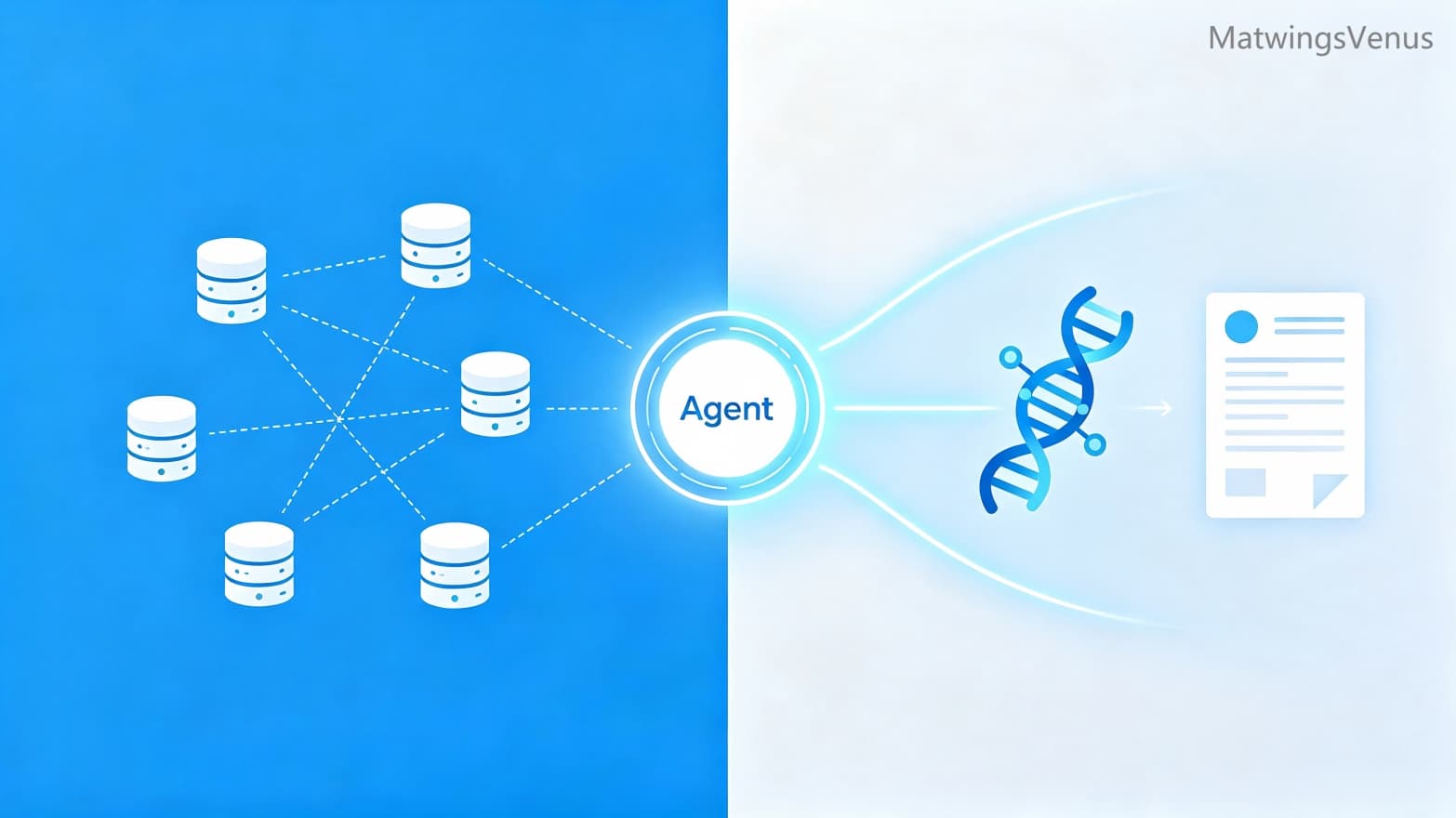
Protein sequence analysis is the starting point for protein engineering and bioinformatics research—from homology search and domain prediction to functional annotation, every step has its corresponding specialized tools. But the reality is: the more tools there are, the lower the efficiency becomes.
UniProt for functional annotation, PDB for experimentally determined structures, AlphaFold DB for predicted structures, Reactome for pathway analysis, STRING for interaction network retrieval… Working on a single protein often requires jumping between five or six databases and tools. The constant switching between interfaces, incompatible formats, and scattered results consume a significant amount of time that should have been spent on thinking.
The real problem is not a shortage of tools, but the lack of a unified "orchestration hub" among them.
In April 2026, Matwings Technology officially launched the conversational protein R&D agent MatwingsVenus™ (Xiaowu™) . It is not a toolbox of stacked features, but an agent-centric, one-stop protein R&D platform that automatically orchestrates the entire workflow from sequence analysis to experimental validation.
I. Three Pain Points of Traditional Protein Sequence Analysis

Three Research Bottlenecks
Pain Point 1: Constant database switching, extremely low efficiency. Research on a single protein often requires accessing multiple databases such as UniProt, PDB, STRING, and Reactome. Each tool has its own interface and operational logic. Information is scattered across platforms, requiring manual organization and repeated cross-referencing. This "jigsaw puzzle" style of working consumes a tremendous amount of time.
Pain Point 2: Tool silos, workflows cannot be connected. From sequence alignment to structure prediction, from functional annotation to pathway analysis, each step requires switching tools, re-entering parameters, and re-interpreting output formats. As Matwings Technology noted at an industry forum: "Current protein AI models are functionally single-purpose, and traditional AI tools struggle to support a complete R&D closed loop."
Pain Point 3: The gap from "analysis" to "validation." After analysis is complete, how do you translate computational results into experimental protocols? In traditional workflows, sequence analysis, protein design, and wet-lab validation are three disconnected phases. Information transfer relies on manual effort—inefficient and error-prone.
II. MatwingsVenus™ (Xiaowu™): Turning "Database Hopping" into "Conversation"

MatwingsVenus™
On April 24, 2026, Matwings Technology released the conversational protein R&D agent MatwingsVenus™ (Xiaowu™) . Unlike traditional single-point AI tools, MatwingsVenus™ breaks through two major technical boundaries: "from sequence directly to function" and "natural language-driven experimentation" —it can not only "read" sequences but also "design" proteins; it does not just "give answers" but can also "execute experiments."
In July 2026, MatwingsVenus™ stood out among hundreds of exhibiting products to be selected for the "Treasure of the Hall" award at the World Artificial Intelligence Conference (WAIC), representing the AI for Science field.
The platform is built around an agent-centric architecture for one-stop protein R&D, supporting billion-scale real-labeled protein data retrieval, integrating 200+ protein design tools, 50+ platform-certified experts, and 30+ domain-expert-tuned Skills. Users simply input task objectives in natural language, and the system automatically decomposes tasks, orchestrating the appropriate design, prediction, analysis, and screening capabilities.
III. How Is Protein Sequence Analysis Done on MatwingsVenus™ (Xiaowu™)?
Step 1: Protein Query—Parallel Retrieval from 30+ Databases, One-Click Integration
In May 2026, the "Protein Query" feature of MatwingsVenus™ underwent a major upgrade. The platform now integrates 30+ databases, covering 400+ specialized tools, spanning multiple dimensions, including protein sequence, structure, functional annotation, pathway analysis, interaction networks, and expression analysis. Users simply input their protein-related query, and the system performs parallel retrieval across multiple databases, automatically integrating and uniformly outputting the results—eliminating the hassle of constant database switching and manual cross-referencing.
Step 2: From "Query" to "Design"—Natural Language-Driven Full-Process R&D
Query is just the starting point. MatwingsVenus™ is equipped with two core capabilities—"AI-directed evolution" and "AI enzyme discovery" —breaking through the traditional "sequence-structure-function" prediction paradigm to achieve fully closed-loop design directly from function to primary sequence. In June 2026, the platform added three core models—BoltzGen, LigandMPNN, and Protenix—to its "Protein Generation" module, further strengthening the complete capability from sequence analysis to protein design.
Step 3: From "Design" to "Validation"—Conversational Dry-Wet Closed Loop
After analysis and design are complete, MatwingsVenus™ can automatically interface with automated wet labs—once the Agent completes the design, it automatically imports results into plasmid ordering and experiment orchestration workflows through a self-built communication mechanism, driving robots to complete sample preparation, protein purification, and functional assays. Experimental results are fed back to the next round of AI design, forming a "conversational dry-wet closed loop" iteration.
What are the final results? Traditional protein R&D cycles are reduced from 2–5 years to 2–6 months, experimental samples from tens of thousands to around one hundred, and the per-sample success rate increases from 1% to 30%.
IV. Who Should Use MatwingsVenus™ (Xiaowu™)?

Four User Profiles

V. Summary
The essence of protein sequence analysis is not the number of tools, but the connectivity efficiency between them.
What MatwingsVenus™ (Xiaowu™) provides is not another single-point analysis tool, but an agent-centric, one-stop protein R&D platform. From parallel retrieval across 30+ databases, to natural language-driven protein design and optimization, to closed-loop validation through automated wet labs—it compresses the traditional 2–5 year R&D cycle to 2–6 months, transforming the fragmented workflow of constant database hopping and manual integration into a continuous experience that feels like "getting it done through conversation."
As Matwings Technology stated at an industry forum: the real bottleneck in AI-driven protein R&D is not the model itself, but whether the full pipeline from design to experimentation can be closed. MatwingsVenus™ closes that loop, delivering a fully integrated, end-to-end R&D solution.