
How Do Protein Structure Generation Models "Invent" Proteins from Scratch?
Published on October 28, 2026
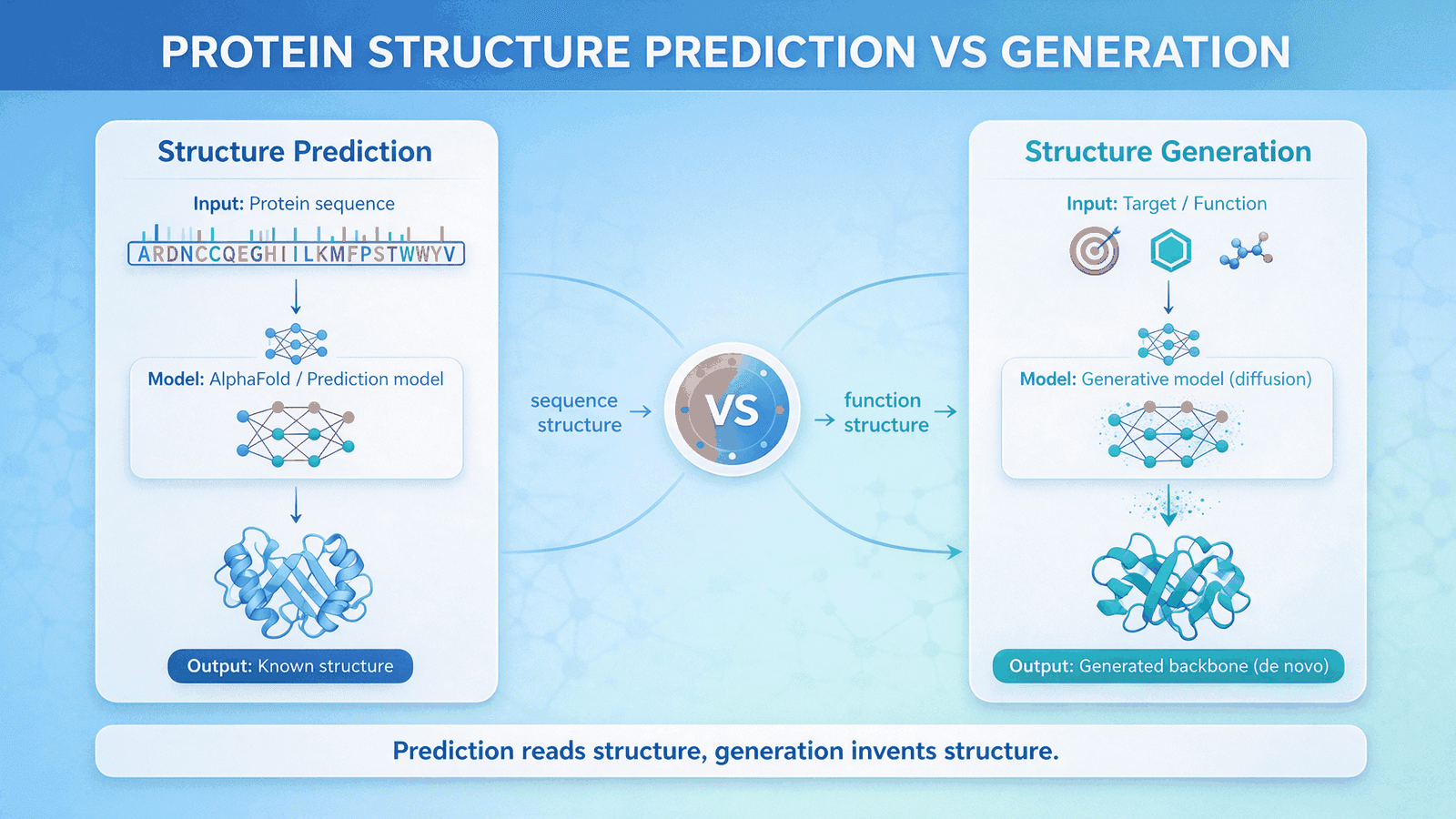
Figure 1: Protein structure generation versus structure prediction
【Category】 D (AI / Algorithm / Platform: concept science + capability boundary); cross-category E (Structure / Mechanism / Sequence analysis)
Proteins are not just the parts of life — they are also the basis of enzymes, antibodies, biomaterials, and more. In the past, AI helped us see what a protein "looks like." Today, protein structure generation models are helping us build proteins that do not yet exist in nature. Behind this is a fundamental shift from "prediction" to "creation."
From "Predicting Structure" to "Generating Structure": What Has Really Changed?
Protein structure generation models work in the opposite direction from structure prediction: a prediction model reads a known sequence and infers the shape it folds into, while a generative model starts from a desired function or shape and invents an entirely new protein backbone and sequence.
• Structure prediction (e.g., AlphaFold): given an amino-acid sequence, the model predicts the 3D structure it folds into. Its achievement was predicting the structure of a known sequence to near-experimental accuracy.
• Structure generation: it reverses the question — given a target (bind a specific target, adopt a symmetry, accommodate a functional site), generate a new protein backbone and its sequence.
• The key difference: a prediction model can only answer "what does this sequence look like"; it cannot answer "what sequence should I use to get a new protein with a specified function." That is exactly where generative models come in.
• Complementary, not substitutes: prediction models "verify," while generative models "create." Real engineering pipelines usually chain the two: generate a backbone → design a sequence → validate by prediction.
This capability lets researchers tackle design goals that were hard to reach before: a brand-new binder for a target, symmetric self-assembling structures, or a designed scaffold around an enzyme active site. In other words, generative models offer an explorable "design space" rather than a restatement of a known sequence.
How Does a Diffusion Model Step by Step "Carve Out" a Protein Backbone?
Protein structure generation models are often built around "diffusion denoising": the model starts from a blob of random noise and, guided by constraints such as a functional site, symmetry, or binding target, iteratively denoises until it converges on a plausible protein backbone.
Think of a sculptor: from a chaotic block, they repeatedly "remove the excess" until a hidden form emerges. A diffusion generative model does the same — starting from a random structure and removing noise step by step until a plausible protein backbone remains.
• The RFdiffusion idea: it fine-tunes the RoseTTAFold structure-prediction network on a structure-denoising task, turning a network that "predicted structure" into a diffusion model that "generates structure" — either unconditionally or under constraints such as target binding, symmetric assembly, or enzyme active sites.
• Ways to constrain: you can fix the coordinates of a functional site (hard constraint / inpainting), or guide with soft constraints such as symmetry and geometric priors; SE(3)-equivariant networks keep the operations consistent under rotation and translation.
• What is generated is "backbone coordinates": the model first produces the main chain; a subsequent "sequence design" step assigns amino acids to it, and structure validation filters out inconsistent candidates.
It is worth stressing that generative models can act on different "objects": some generate structure directly (backbone coordinates, e.g., RFdiffusion), while others generate sequence in an autoregressive/language-model way and hand the result to structure prediction for validation. Both are "generative protein design"; they differ in whether generation is anchored in geometry or in sequence. For structure generation, the hard part is the coordinate frame — a protein has no fixed origin, so the model must stay equivariant under rotation and translation (SE(3) equivariance), otherwise the same structure gets drawn in different orientations and is geometrically inconsistent. This is what decides whether a generated backbone truly "looks like a protein."

Figure 2: Diffusion denoising mechanism of protein structure generation models
How to Tell Whether a Protein Structure Generation Model Is Worth Using?
Choosing a protein structure generation model comes down to three things: whether it can controllably satisfy design constraints, whether it produces diverse and "real-looking" backbones, and whether it connects smoothly to sequence design, structure validation, and wet-lab testing.
• Controllability: can you specify functional sites, symmetry, binding targets, or overall shape? Only a model that generates "on demand" is useful for engineering.
• Diversity and quality: can it produce many diverse candidates at once, and are the backbones "naturally foldable"? Early methods often produced only a single deterministic structure — limited in diversity and possibly unfoldable.
• Downstream compatibility: generated backbones must be accepted by a sequence designer, validated by structure-prediction and scoring tools, and eventually tested in the lab. A model that cannot enter the loop is hard to use.
• Look at experimental hit rate, not just computed output: beyond ideal geometry, ask about the success rate after wet-lab testing. Advanced de novo protein design pipelines now reach experimental success rates near 20%. When selecting a model, weigh real hit rates rather than only model-side metrics.
A single model that "outputs something nice" is not the same as "usable." A more practical approach is to combine computed metrics with experimental hit rate: run a first filtering pass with structure validation and scoring tools, then send a small batch into the lab, and use the experimental data to calibrate the next round. That keeps the model's computed performance attached to real value.
From Model to Experiment: The "Generate–Validate" Loop of Protein Structure Generation
A generative structure model only proposes candidate backbones. To turn them into usable proteins, you must complete the full loop: structure generation → sequence design → structure validation → wet-lab screening → data feedback.
• Structure generation: the diffusion model produces hundreds or thousands of candidate backbones at once.
• Sequence design: a model such as ProteinMPNN designs an amino-acid sequence for each backbone.
• Structure validation: models such as AlphaFold predict whether the designed sequence actually folds into the target backbone, discarding inconsistent candidates.
• Wet-lab screening: expression and purification, then tests of activity, stability, and developability.
• Data feedback / active learning: results are fed back to the model to drive the next iteration, forming an active-learning engine that "gets better the more it is used."
• Candidate volume and the screening funnel: a single run can produce hundreds or thousands of backbones, but only a few actually reach the lab; what drives cost and success is how efficiently the "computed candidate → experimental validation" funnel is built.
• Iteration is the key: single-round hit rates are limited; it is repeated loop iteration that raises success, lowers cost, and shortens development cycles.

Figure 3: The generate–design–validate–test–learn engineering loop
Putting Protein Structure Generation Models into a Platform Protein-Engineering Pipeline
MatwingsVenus® (晓鹜®) embeds protein structure generation models in an end-to-end protein design platform, bringing "generate–validate–screen–iterate" into a single workflow so researchers and industrial users can obtain experiment-ready candidates faster.
• Unified workflow: the platform combines structure generation, sequence design, structure validation, and wet-lab guidance, reducing the cost of switching between multiple tools and datasets.
• Design for real-world deployment: it connects "generative models" with an engineering system that is verifiable, screenable, and iterative — serving enzyme engineering, antibody design and optimization, and de novo design of functional proteins.
• From design to candidates faster: with loop iteration and active learning, it reduces blind experimentation and turns compute into experiment-ready candidates and reusable design data.
• Lowering the barrier: for teams without a computational background, the biggest value of a platform is not having to build the models and data pipelines yourself while still gaining the efficiency of generative design.
• The specific models, training data, and performance metrics used by the platform are subject to official disclosures from MatwingsVenus® (晓鹜®).
FAQ
What is the difference between a protein structure generation model and AlphaFold?
AlphaFold belongs to "structure prediction": it takes a sequence and outputs the structure it folds into, answering "what does this sequence look like." A protein structure generation model belongs to "structure generation": it takes a target function, shape, or constraint and outputs a new backbone and sequence, answering "how do I build a new protein with a specified function." The two are complementary and are commonly chained in a single flow of "generate backbone → validate by prediction."
Can a protein structure generation model directly deliver a usable enzyme or antibody?
Generally not in one pass. It first proposes candidate backbones, which still need sequence design, structure validation, and wet-lab expression and activity screening. Only after repeated "generate–validate–screen" iterations can it approach usable enzyme or antibody candidates; the experimental hit rate is the key metric for whether it is "usable."
Will using generative models replace wet-lab work?
No — instead, it uses computation to make wet-lab work more efficient. Generative models can sharply reduce the number of candidates that need testing and raise screening hit rates, but final expression, folding, activity, and stability still need experimental verification. The real role of AI is to use limited wet-lab resources where it counts, shortening cycles and lowering cost.
What does a team need to use protein structure generation models?
Three things: first, usable generation/design models and compute; second, sequence design and structure-validation tools that can accept the candidates; third, wet-lab capability to validate and feed back data. For most teams, a more efficient route is to use a platform such as MatwingsVenus® (晓鹜®), which puts models, validation, screening, and data management into one workflow.
Summary: Protein Structure Generation Models Move Protein Design from Prediction to Creation
Protein structure generation models push the focus of AI from "reading structure" to "creating structure," and through a "generate–validate–screen–iterate" loop they turn design capability into a deployable protein-engineering tool.
For researchers, this means no longer relying solely on natural proteins. For industry, it means enzymes, antibodies, and new materials can move faster from "idea" to "candidate."
【One-sentence conclusion】 Protein structure generation models move AI from "predicting structure" to "creating structure," enabling new proteins to be designed against a desired function.