
Protein Sequence Generation: How AI "Writes" Proteins the Way We Write Code
Published on October 28, 2026
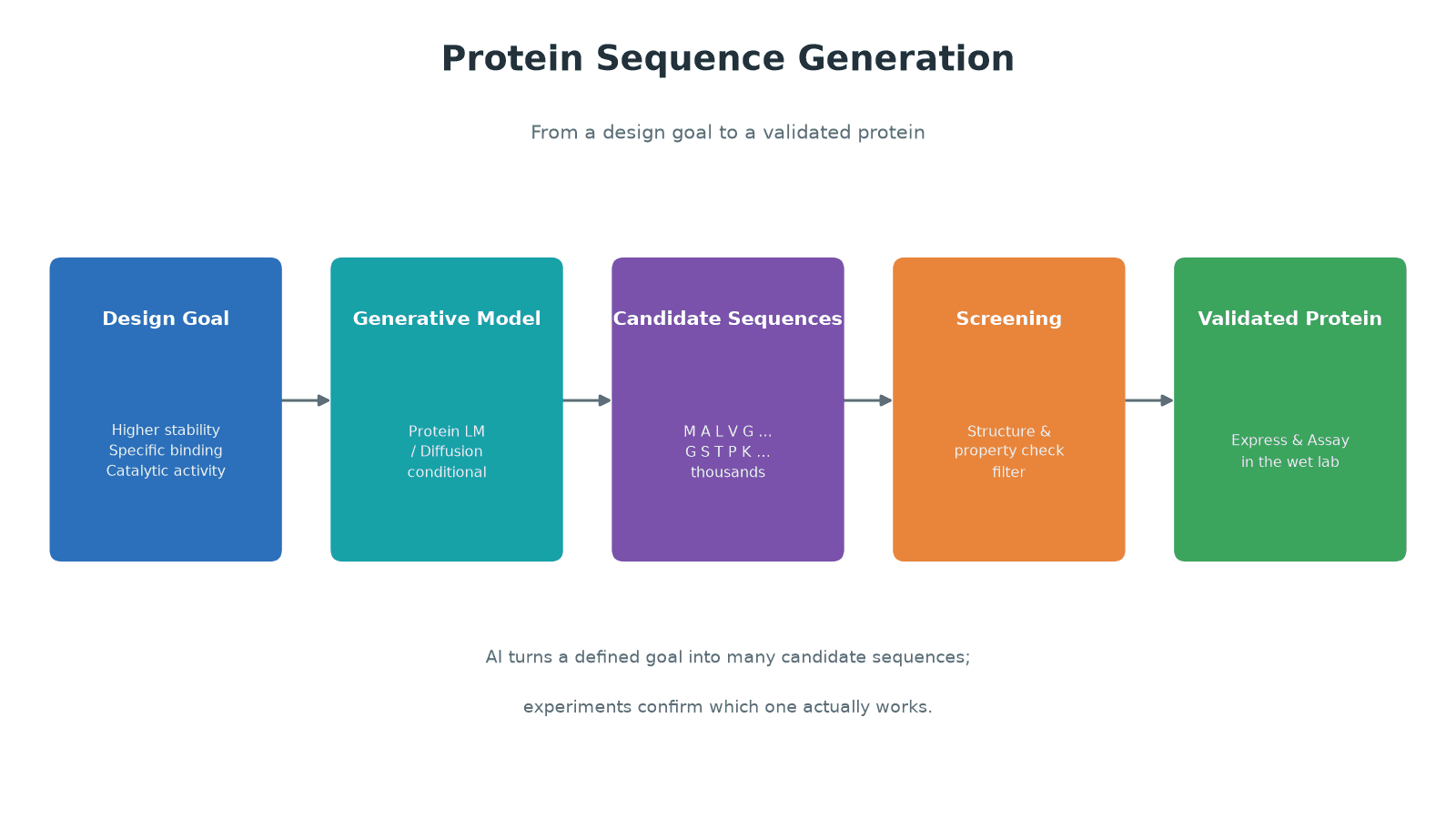
Figure 1: From a design goal to candidate sequences; experiments validate the usable protein.
[Category] D (AI/Algorithm/Platform); cross C (Directed Evolution/Protein Engineering)
A protein is a long chain built from about 20 amino acids linked in a specific order. This order—the sequence—determines the three-dimensional structure the protein folds into and the function it performs. Natural proteins are numerous, yet they often fail to meet industrial and medical needs: some are not heat-stable enough, some have low catalytic efficiency, and some cannot precisely bind a target molecule.
In the past, scientists relied mainly on directed evolution: introduce random mutations, then prepare many variants and screen them. One round can mean testing thousands of candidates—slow, expensive, and often like "rolling the dice." Protein sequence generation changes this search approach: the model first learns from data which orderings are more plausible and more likely to carry a target function, then returns directional candidates that dramatically shrink the search space.
Think of it this way: random mutation is like "groping in the dark," while sequence generation is like "reading a map before setting off." It does not guarantee success on the first try, but it gets you closer, faster.
Why do we need to "generate" proteins?
Protein sequence generation turns the accidental engineering of "mutate first, screen later" into a directed process of "design first, validate later," making protein development more efficient and more controllable.
· The natural library is limited: many needs have no ready-made answer in nature, so we must "write" new sequences.
· Directed evolution is costly: one round of random mutation plus screening can mean thousands of variants, straining time and budget.
· Generative models give direction: they learn the sequence–function pattern from data, offer evidence-based candidates, and let you focus validation.
· Analogy: directed evolution is like "groping in the dark"; sequence generation is like "reading a map before setting off."
What is the core principle of protein sequence generation?
Protein sequence generation usually builds on a protein language model or a diffusion model that learns the statistical regularities of amino-acid sequences and samples new candidates conditionally on the desired properties.
An amino-acid sequence resembles "language": 20 amino acids act like letters, functional motifs and domains act like words, and folding and interaction rules act like grammar. This similarity is exactly why the protein language model emerged—trained on massive natural sequences, it learns which orderings occur more often and are more likely to fold into a stable structure.
There are three common generation modes:
· Autoregressive generation (like writing word by word): the model predicts the most likely next amino acid at each step, "writing" the whole chain one residue at a time.
· Masked generation (like fill-in-the-blank): some positions are hidden and then predicted.
· Diffusion models (like developing from noise): start from a blob of "noise" and gradually denoise it into a plausible sequence.
More important is conditional generation: the target property (higher thermal stability, stronger catalytic activity, better binding affinity) is used as a constraint, so the model only returns candidates that satisfy it. Behind this lies a core concept—the fitness landscape—which maps how sequence changes relate to functional changes. What the model does is essentially "hill-climbing" on this map, moving toward higher-fitness regions.
A caveat: generation is not a guarantee. The model returns candidates that "look plausible"; whether they truly fold, express, and function still requires downstream validation.

Figure 2: Conditional generation on target properties, then moving up the fitness landscape.
How do we evaluate whether a generated sequence is reliable?
A generated sequence is only a candidate; it must pass computational scoring, structural feasibility and developability checks, and wet-lab validation before its real function is confirmed.
First do in-silico screening. Step one is structure: use a structure-prediction model to see whether it folds into the intended conformation. Step two is property: use predictors to estimate solubility, stability, and aggregation propensity. Step three is "developability": similarity to natural sequences, immunogenicity risk, and overall compatibility.
Computational screening quickly weeds out many unreliable candidates, but the true "judge" is still the wet lab—expression, purification, and functional assay: synthesize the candidate as a gene, express it in cells, and measure whether it actually delivers the expected activity, stability, or binding. Only sequences that pass experiments count as truly "usable."
This brings the closed loop: feed experimental data back to the model so the next generation is more focused and higher quality. This iterative "generate–screen–experiment–regenerate" cycle is the heart of active learning, and it makes each experimental round more valuable.
From "generation" to launch: how to set up the process and conditions?
A complete protein sequence generation project usually follows five stages—define target, generate with a model, screen in silico, validate in the wet lab, and feed data back—with conditions tuned to the target protein and its use case.
1. Define the target: higher activity? stronger stability? higher yield? more precise binding? The clearer the goal, the more directional the conditional generation.
2. Model generation: let the model produce hundreds or thousands of candidate sequences.
3. Computational screening: quickly filter with structure and property predictors, keeping only a few high-quality candidates.
4. Wet-lab conditions: the most project-specific part. Expression host (E. coli, yeast, mammalian cells, etc.), medium, induction temperature and time, purification buffers, and assay methods all need tuning to the target protein and its purpose.
5. Data feedback: record each round's results, key parameters, and failures, and feed them back to the model so the next round is more efficient. Iterate until the target is approached.
A common misconception is that "more generation is better." In fact, finding the right balance between the computational and experimental sides—neither wasting compute nor burning money on pointless experiments—is what truly drives cost and success rate.

Figure 3: Generate–screen–validate–learn: the dry–wet loop makes data more focused.
How does MatwingsVenus®(protein agent) turn "sequence generation" into productivity?
MatwingsVenus®(晓鹜®) integrates generative design with a wet–dry closed loop, coordinating sequence generation, function prediction, and high-throughput screening to make protein engineering from "idea" to "deployment" faster and more reliable.
As the AI protein design platform of Matwings Technology (天鹜科技), MatwingsVenus®(晓鹜®) is turning protein sequence generation from a lab topic into a reusable productivity tool. It links multiple capabilities into one chain: from VenusX functional-residue mapping, to VenusREM single-point scanning and VenusPrime multi-site epistatic modeling, to VenusFold structure prediction and VenusG property prediction, with VenusMine structure mining—covering every stage of "design–predict–screen–validate."
What matters most is the wet–dry closed loop: AI generates and predicts, the wet lab validates and feeds back, and active learning maximizes the information gained per experiment, approaching the target sequence in a shorter time. This approach serves multiple scenarios, such as improving enzyme catalysis, maturing antibody affinity, designing thermal-stable proteins, and designing new binding proteins from scratch.
For business, this means a shorter development cycle, lower trial-and-error cost, and higher success rate. Specific performance numbers should come from real project data; nothing here is speculative.
FAQ
FAQ 1: Can protein sequence generation directly "produce" a usable protein?
Not in one step. The generative model returns candidates; they must pass computational screening and wet-lab validation to become truly usable proteins.
FAQ 2: What is the difference between protein sequence generation and directed evolution?
Directed evolution relies on random mutation plus large-scale screening, while sequence generation relies on model-driven design. They are often combined: generation provides direction, and experiments validate function.
FAQ 3: Will generative models "invent" proteins that don't exist?
Models can generate sequences that are plausible but not found in nature—precisely their value. But structure and function validation must confirm their usability, avoiding "looks plausible yet does not fold."
FAQ 4: Can we do sequence generation without protein structure data?
Yes. A protein language model learns regularities from sequences alone; with additional structure or functional labels, it can perform more targeted conditional generation.
Summary
Protein sequence generation turns protein engineering from "taking a chance" into "directed design," and the key lies in the closed-loop collaboration of models, data, and wet-lab validation.
Recapping: in principle, it uses protein language or diffusion models to learn sequence regularities and sample conditionally; in evaluation, it must pass computational screening and wet-lab validation; in process, it follows the five-stage "target–generate–screen–validate–feedback" loop; and in platform, MatwingsVenus®(晓鹜®) uses a wet–dry closed loop to turn these stages into productivity. As data and compute grow, sequence generation will become faster and smarter—but experiments remain the final gate.
[One-sentence conclusion] Protein sequence generation moves design from "accidental mutation" to "directed generation"—a key link in AI-driven protein engineering.