Protein Binder Design: A Complete Guide from Computational Generation to Directed Evolution
Published on October 27, 2026
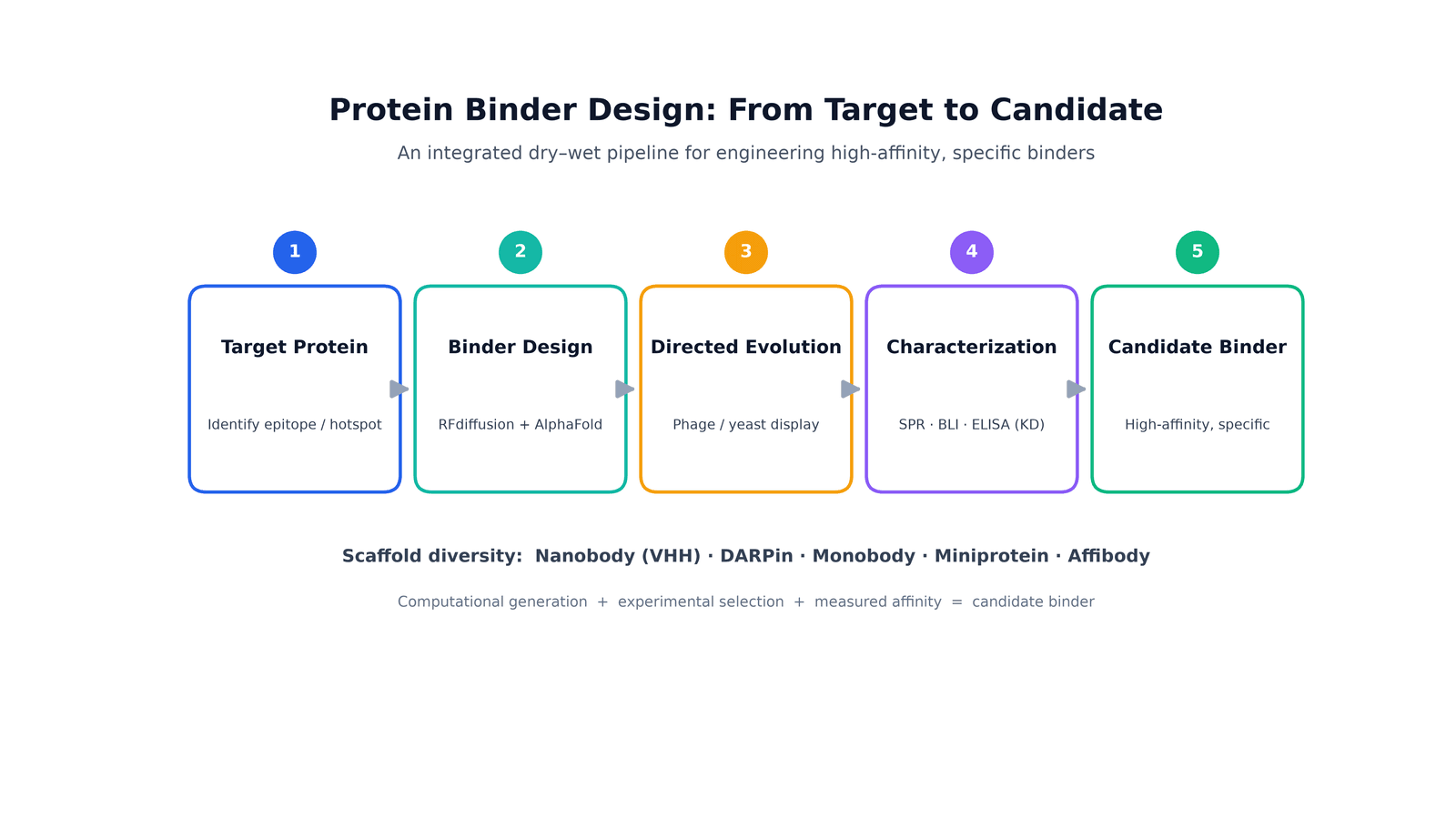
Figure 1 Concept panorama of protein binder design: a dry–wet closed-loop pipeline from target to candidate
Category: C (Directed Evolution / Protein Engineering), also D (AI / Algorithm / Platform)
Protein Binder Design: How to Obtain a High-Affinity Binding Molecule from a Target?
Protein binder design is the use of rational design or computational methods to generate functional protein molecules that recognize a target protein with high affinity and specificity. It answers a core question: given a target, how can we quickly and controllably "build" a small protein that binds it precisely. Today binders are no longer limited to antibodies—VHH nanobodies, DARPins, monobodies, affibodies and miniproteins are entering drug, diagnostic and research-tool development at scale.
Why start from design? Traditionally, binders were isolated from immunized animals or natural libraries—slow, stochastic, and hard to tailor. Computation and directed evolution make design programmable: we can predict from structure which sequences are likely to bind, and we can also "domesticate" candidates to a target affinity through high-throughput selection. This shift from passive discovery to active design is among the most important advances in protein engineering of the past decade.
Why Do We Need Protein Binder Design?
Protein binder design is a core of protein engineering: by combining computational generation with directed evolution, it makes obtaining high-affinity binding molecules faster, more controllable and more reproducible.
· What is a binder? Any protein fragment that specifically recognizes and binds a target protein. Affinity is measured by the dissociation constant KD; a smaller KD means stronger binding.
· Why it is needed? Natural antibody discovery is slow, batch-variable and complex to control for immunogenicity; binders are typically smaller, more stable and soluble, easier to express and modularize, and can be generated "on demand" by computational design.
· Core applications: therapeutic drugs (neutralizing/blocking/targeting), diagnostic and assay reagents, targeted delivery carriers, intracellular labeling and structural-biology tools, and affinity-chromatography ligands (e.g. Protein A/G/L for antibody purification).
· A closed-loop mindset: first generate candidates from structural information, then select high-affinity clones experimentally—alternating and accelerating each other.
It is worth stressing that a binder is not an antibody. Antibodies are immunoglobulins, whereas a binder is a broader concept: any functional protein that specifically binds a target. This brings more freedom—when facing enzymes, receptors, viral proteins, membrane proteins or intracellular proteins, we can trade off size, stability and production method more flexibly.
Clarifying the application goal before design is essential: is it for blocking signalling, neutralizing a toxin, or for detection or delivery? Different goals impose different requirements on affinity, specificity, epitope position and even in-vivo behaviour, which directly shapes the scaffold and workflow.
Principles and Structure of Protein Binder Design
Binder recognition depends on precise matching of shape complementarity with non-covalent interactions such as hydrogen bonding, hydrophobic and electrostatic contacts; the complementarity-determining regions (CDRs) or key designed interface residues determine affinity and specificity.
· Binding-interface mechanism: the epitope and the binding face are complementary in shape, charge and hydrophobicity; major forces include hydrogen bonds, hydrophobic contacts, salt bridges and π-stacking, and higher interface complementarity usually means stronger affinity.
· CDRs and variable regions: in VHH nanobodies, CDR1–3 carry most of the binding function; the long CDR3 can reach into target pockets and is the main target of affinity maturation.
· Common scaffolds and their structures: VHH nanobody (single-domain, ~15 kDa, long CDR3, can engage hidden epitopes); DARPin (ankyrin repeats, rigid α-helices, modular); monobody (human fibronectin type III domain, ~10 kDa, stable and soluble); affibody (protein A Z domain, small binding face); miniprotein (small tailor-made scaffold).
· Computational design principle: RFdiffusion uses a diffusion model to generate backbones complementary to the target (with hotspot or edge-β-strand conditioning); ProteinMPNN "translates" the backbone into an amino-acid sequence by inverse folding; AlphaFold2 then verifies whether the fold matches the design.
· Quantifying affinity: KD = koff / kon; SPR and BLI measure the association and dissociation rate constants separately, yielding KD precisely.
From an energetic point of view, stable binding requires the interface to be highly complementary in both shape and chemistry. Designers often use "hotspots" to locate the residues that contribute most of the binding free energy; RFdiffusion can generate backbones around these hotspots so the designed interface resembles the natural binding surface. It is worth being clear that computational models still give structural hypotheses, which must ultimately be validated and corrected by experimental data.
When weighing scaffolds, four points usually matter: molecular size and interface scale, expressibility and solubility, tolerance to engineering, and how easily the binder can be modularized (made multivalent, conjugated to a drug, or tagged). Together these determine the binder's "plasticity" in later development.

Figure 2 Binder–target recognition interface and common scaffolds: CDR loops engage the epitope, driven by shape, van der Waals and hydrogen bonding
Assay and Selection of Binders
Binder evaluation centres on quantitative affinity and specificity: ELISA measures endpoint binding for high-throughput screening, SPR and BLI measure KD and on/off rates in real time, DLS/SEC assesses monomeric state and stability—guiding the scaffold and screening path that best fit the target.
· ELISA: simple, high-throughput, measures endpoint binding; good for initial screening and batch comparison.
· SPR: real-time, gives kon, koff and KD simultaneously—the gold standard for affinity and kinetics, but needs immobilized target and moderate throughput.
· BLI: real-time, no flow cell, low sample use; suitable for high-throughput coarse screening and affinity ranking.
· ITC: directly measures binding thermodynamics without labels, but needs large samples and has low throughput.
· Selection logic: whether the target is a pocket or a flat epitope, the target affinity, expression system, stability/solubility requirements and development stage (coarse screen / maturation / scale-up) jointly decide the scaffold and whether to lead with computation or evolution.
When interpreting KD, look at affinity and kinetics together. Two binders may share the same KD, but one binds fast and dissociates slowly while the other binds slowly and dissociates fast; in scenarios that need to "lock onto" the target (e.g. antibody drugs, affinity chromatography), slower dissociation is usually preferred. So beyond KD, kon, koff and residence time are also monitored.
Reliable binder assessment is best done with orthogonal methods: use SPR/BLI for kinetics, ELISA to quickly compare batches and specificity, then DLS/SEC and thermal-stability assays (e.g. differential scanning fluorimetry, DSF) to confirm protein quality. Only when affinity, specificity and stability all pass is a candidate worth advancing.
Conditions and Process: the AI Dry–Wet Closed Loop
A typical binder workflow is the dry–wet closed loop of "computational design → library construction → display screening → affinity maturation → validation": the AI end generates and ranks candidates in silico, while the wet-lab end feeds back data via display technology and binding assays, iterating toward the target.
· Computational design: input target structure and hotspots → RFdiffusion generates backbones (tens of thousands of candidates) → ProteinMPNN designs sequences → AlphaFold2 verifies and scores structures.
· Library construction: apply site-saturation mutagenesis (SSM) or error-prone PCR (epPCR) to candidates to build phage or yeast display libraries.
· Display screening: phage display is low-cost and uses prokaryotic expression; yeast display is eukaryotic and enables flow-cytometry (FACS) quality control and multi-parameter sorting.
· Affinity maturation: a second round of mutation and selection on initial hits to lock in key residues that improve affinity and specificity.
· Validation: clone, express and purify → measure KD by SPR/BLI/ELISA → check monomeric state, thermal stability, specificity and functional activity.
· Key process parameters: library quality and diversity, number of screening rounds and enrichment, wash stringency, expression/purification conditions, and assay repeatability between batches.
Library size and screening strategy directly determine the hit rate. In general, phage display libraries are highly diverse (often ~10⁹ variants) and suit de-novo discovery; yeast display libraries are usually less diverse, but because they are expressed in eukaryotes they allow more direct quality control of protein folding and display. In maturation, a stringent competitive elution in vitro is often followed by flow-cytometry sorting to capture the high-affinity population.
In the purification stage, validation of binding must connect to downstream production: soluble expression, affinity chromatography, gel filtration and concentration determination together decide whether sufficient homogeneous protein can be obtained. For antibody-like binders, Protein A/G/L affinity resins often serve as the first capture step; for non-immunoglobulin scaffolds, tag- or domain-specific affinity approaches can be used.
· Built on MatwingsVenus® (晓鹜®): we integrate the above into a "dry-wet" closed loop—in silico design and evaluation on the compute side, and expression, purification and binding assays on the wet-lab side, with real experimental data fed back to update the models and compress the iteration cycle from sequence to candidate. For purification, high-capacity, alkali-stable affinity resins (such as Protein A/G/L with mild elution) can improve downstream yield and stability.
· Get support: contact us for selection advice, sample evaluation or a quotation—phone 13061973951, email info@matwings.com.

Figure 3 Dry–wet closed loop of protein binder development: AI design alternating with display screening and affinity assays
Frequently Asked Questions (FAQ)
How does a protein binder differ from a traditional antibody?
A binder is not restricted to immunoglobulins; it includes nanobodies, DARPins, monobodies, affibodies and miniproteins. Compared with full-length antibodies, they are usually smaller, more stable and soluble, easier to express and modularize—but their binding faces can be smaller, so specificity must be designed carefully.
Does protein binder design always require AI computation?
Not necessarily, but it greatly accelerates progress. Pure display/evolution strategies can complete screening without structure; combining tools such as RFdiffusion, ProteinMPNN and AlphaFold can generate and rank many candidates before experiments, letting the wet lab focus on more promising molecules and shortening timelines and cost.
For measuring affinity, should I use ELISA or SPR/BLI?
It depends on the goal. ELISA measures endpoint binding with high throughput, good for initial screening and batch comparison; SPR/BLI measure KD and on/off rates in real time with higher precision, suitable for affinity ranking and maturation assessment. Typically use high-throughput coarse screening first, then quantify with SPR/BLI.
How long does it take to go from design to a candidate binder?
It depends on the target, scaffold and route. Pure computational plus phage/yeast screening can yield nanomolar candidates within weeks to months; repeated affinity maturation and validation lengthen the timeline. A mature platform with a dry–wet closed loop can significantly compress this.
Conclusion
Protein binder design turns computational generation and directed evolution into an iterable dry–wet closed loop, making high-affinity binders faster and more controllable to obtain; choosing the right scaffold, using the right assays and letting data flow back are keys to success.
· Match the scaffold to the target (pocket vs flat epitope).
· Computation and experiment accelerate each other rather than replace one another.
· Use KD, specificity and stability as the common acceptance criteria.
· Drive iteration with data to keep cutting trial-and-error cost.
One-line conclusion: Protein binder design = computational scaffold generation + sequence design, then directed evolution by phage/yeast display, validated by SPR/BLI — an AI dry–wet closed loop.
Explore MatwingsVenus® (晓鹜®) — Bring Protein Engineering to Life Faster
MatwingsVenus® (晓鹜®) is the protein-engineering platform from Matwings Technology, offering dry–wet closed-loop AI computation and wet-lab services. Want to apply binder design to your specific target? Get selection advice, submit a sample or request a quotation—phone 13061973951, email info@matwings.com.
· Wet-lab services: expression, purification, characterization and binding assays (visit /en/products/wet-lab).
· Expert centre: design and selection consulting from domain experts (visit /en/products/expert-center).
· Dry–wet closed-loop platform: integrated iteration of AI computation and experimental data (visit /en/dry-wet-closed-loop-platform).