Papermaking Enzymes Explained: Xylanase, Cellulase, Lipase, and Amylase
Published on September 23, 2026
Category: Industrial Biotechnology, Pulp and Paper, Enzyme Engineering
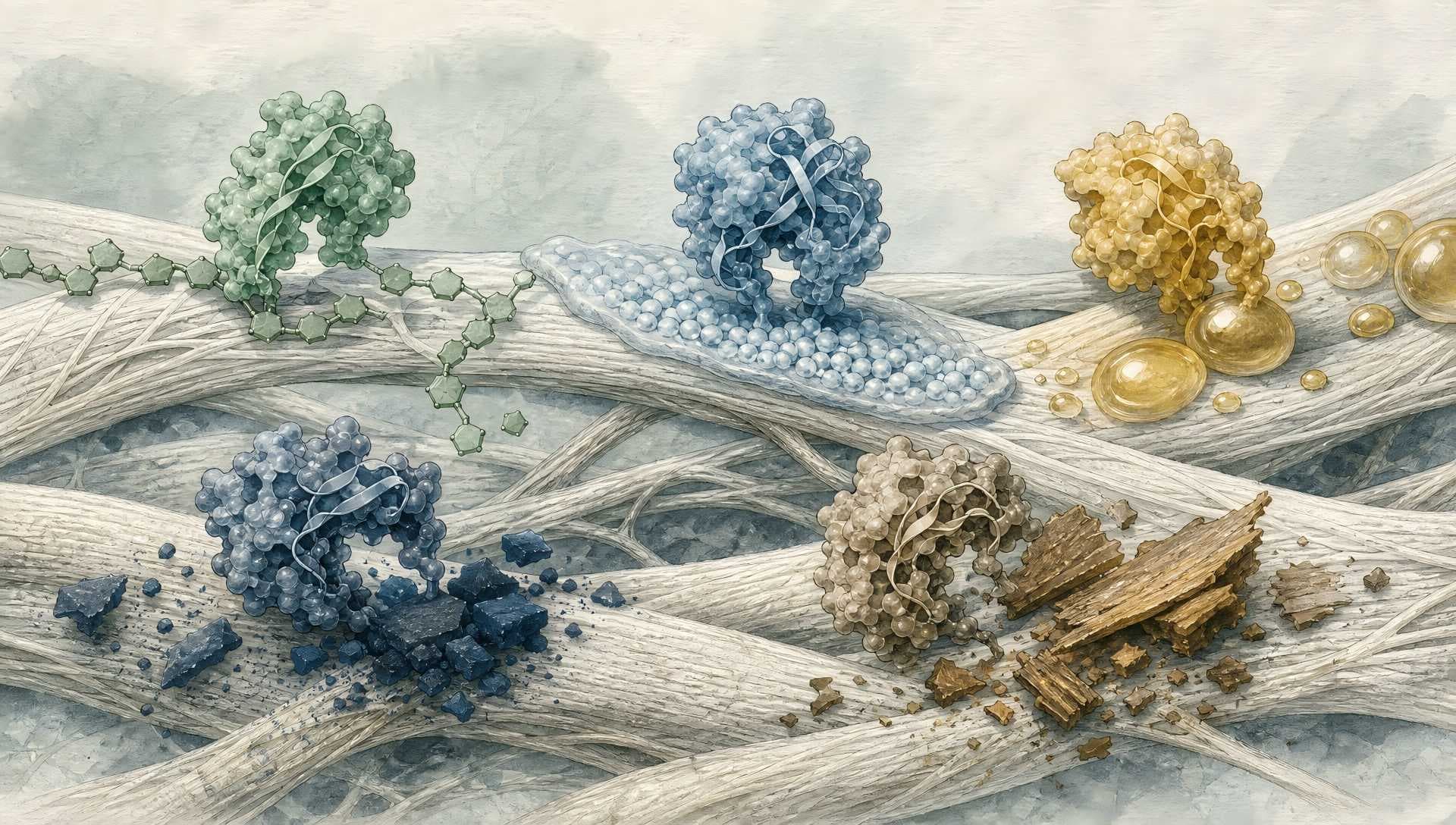
Papermaking problems arise at different material interfaces. Lignin and hemicellulose surround cellulose fibers, oils and wood extractives contribute to deposits, inks and adhesives complicate recycled-fiber cleaning, and starch viscosity affects sizing and coating. Papermaking enzymes are useful because substrate selectivity can target one part of this system instead of reacting indiscriminately with the entire furnish.
Selection should not begin by asking which enzyme is strongest. A more productive question is which substrate limits output or quality, where the catalyst will enter the process, whether temperature, pH, and residence time are compatible, and which pulp and sheet measurements define success. Only after the mill problem has been translated into a substrate and endpoint does an activity value become meaningful.
Papermaking enzyme types should follow the mill problem
Common groups include xylanase, cellulase, lipase, esterase, amylase, pectinase, and laccase. They are not interchangeable products. Xylanase recognizes xylan structures. Cellulase acts on cellulose chains or fiber surfaces. Lipase and some esterases target hydrolysable lipids and ester-containing deposits. Amylase changes starch chain length and viscosity. Laccase supports selected oxidative transformations.
Problem attribution comes first. A high bleaching load may call for closer examination of lignin and hemicellulose accessibility. Persistent ink after flotation may involve ink release, fiber surface condition, fines, or coating chemistry. Frequent machine deposits require separation of natural pitch, pressure-sensitive adhesives, sizing agents, and other sticky contaminants. If the substrate diagnosis is wrong, high standard activity may have little effect on the operating metric.
More enzymes do not automatically make a better blend. A combination can cover a complex substrate mixture, but it also increases the burden of controlling side activities, condition conflicts, and lot consistency. Each component should have a defined job, supported by single-enzyme controls, blend controls, and an untreated baseline.
Xylanase pulp bleaching is about accessibility, not direct whitening
Xylan is a major hemicellulose in plant cell walls and forms a complex network with cellulose and lignin. Xylanase cleaves selected glycosidic bonds in the xylan backbone. In pulp treatment, this action can alter surface and pore accessibility, which may improve the response of later bleaching stages. The enzyme is therefore better understood as a pretreatment or bleaching aid rather than as a direct equivalent of a bleaching chemical.
Xylanase pulp bleaching also requires attention to cellulase side activity. If a preparation contains substantial unintended cellulose-degrading activity, yield or fiber strength may be placed at risk. Development teams should examine not only brightness-related or kappa-related changes but also viscosity, fiber strength, drainage, and the response to subsequent bleaching stages. A color measurement alone does not describe overall pulp quality.
Industrial conditions impose another filter. Washed pulp can remain warm and alkaline, while residual process chemicals and metal ions can affect protein stability. Screening should move progressively toward realistic consistency, water chemistry, and mixing. A single activity value measured in an ideal buffer is not enough to select an industrial candidate.
MatwingsVenus™(晓鹜™) can organize pulp type, xylanase family, temperature and pH windows, possible side activities, and required measurements as a candidate-screening task. Database retrieval and protein function prediction can narrow the search, while actual fit for bleaching still requires testing in the intended pulp.
Cellulase paper deinking requires control of reaction depth
Recycled-paper systems combine ink attachment, hornified fibers, fines, coatings, and sticky contaminants. Controlled cellulase treatment can modify fiber surfaces and may help release ink particles. It may also change drainage in selected pulps. The same substrate, however, forms the structural backbone of paper. Excessive treatment can shift from surface modification to fiber damage, making dose, time, and mechanical action inseparable variables.
Cellulase paper deinking should not be judged by brightness alone. Residual ink area, flotation response, fines generation, yield, freeness, tensile strength, and tear strength provide a broader view. Printing technology, ink formulation, and coating chemistry alter deinking behavior, so a treatment developed for one recovered-paper stream should not be copied directly to another.
A practical first screen can compare low, medium, and high treatment levels against an untreated group under the same mechanical conditions. If improved cleanliness is accompanied by unacceptable strength loss or fiber loss, the reaction depth should be reduced or the enzyme composition reconsidered. The objective is balanced sheet quality rather than a single maximum reading.
Lipase pitch control starts with deposit identification
Pitch and stickies are often grouped under one operational complaint, but their chemistry can differ substantially. Triglycerides and related wood extractives, recycled-paper adhesives, coating components, and synthetic polymers do not respond to the same catalyst. Lipase primarily hydrolyzes selected ester bonds and is most relevant when the deposit contains an accessible lipid fraction. It cannot be assumed to remove every sticky material.
The first step in lipase pitch control is therefore deposit characterization. Sampling location, recurrence, physical appearance, and chemical composition help establish whether the target substrate is compatible with lipase action. Small-scale tests can then follow changes in free fatty acids, particle size, deposition tendency, foam behavior, and the circulating-water system. When non-ester polymers dominate, simply increasing the lipase dose is unlikely to address the core problem.
Compatibility with biocides, retention aids, drainage aids, defoamers, and water-closure conditions also matters. Process chemicals may inhibit the enzyme, while hydrolysis products can change surface activity or particle dispersion. A controlled baseline and staged scale-up are needed to separate raw-material variation from the treatment response.
Amylase surface sizing depends on a controlled viscosity window
Starch in papermaking is both a substrate and a functional material that affects flow, penetration, and film formation. Amylase can shorten starch chains and adjust a high-viscosity preparation to a range suitable for pumping, metering, or surface application. The goal is not maximum starch degradation. It is a reproducible molecular-weight and viscosity window that preserves required paper-surface performance.
Development of amylase surface sizing should monitor temperature, solids, reaction time, and the point at which activity is stopped. Temperature changes both starch gelatinization and enzyme rate. Without a controlled endpoint, viscosity may continue to drift in a tank or line. A complete evaluation also covers preparation stability, water absorption, surface strength, printability, and equipment cleanliness.
Online viscosity is valuable for identifying a deviation, but it does not establish the cause by itself. Starch lot, cooking history, dilution water, and enzyme activity can produce similar signals. Linking online trends with batch records, enzyme checks, and sheet testing creates a traceable decision chain.

Papermaking enzymes support xylanase pulp bleaching
Laccase and enzyme blends need a tightly defined task
Laccase catalyzes oxidation of selected phenolic and related structures. It has been explored for lignin modification, color management, fiber functionalization, and treatment of selected process contaminants. Its logic differs from that of hydrolytic enzymes and may involve dissolved oxygen, mediator chemistry, redox conditions, and side-reaction control. Any mediator choice must be assessed for process performance, residuals, cost, and the intended paper grade.
Enzyme blends can be appropriate when the substrate mixture is genuinely complex and one catalyst is insufficient. Recycled furnish, for example, may contain starch, fiber fines, and some ester-bearing contaminants at the same time. Split tests should establish the contribution of each component before blending. When optimal conditions differ widely, staged addition may be easier to control than one-tank treatment.
Papermaking enzymes screening and platform workflow require six decisions
The first decision is substrate relevance. Standard activity confirms that an enzyme can catalyze a reaction, but not that it can reach the target structure in real pulp. The second is process compatibility, including temperature, pH, ionic strength, oxidants, surfactants, and shear. The third is side activity, especially when fiber yield and strength require explicit lower limits.
The fourth decision is timescale. A short burst of activity does not guarantee useful stability over the residence period, and storage stability does not replace reaction stability. The fifth is a two-level endpoint covering both reaction changes and pulp or sheet properties such as drainage, strength, cleanliness, sizing, and printability. The sixth is scale-up practicality: addition point, mixing, residence time, inactivation, online monitoring, and response to an abnormal batch.
MatwingsVenus™(晓鹜™) can connect protein database retrieval, function prediction, and protein discovery around these constraints, helping teams rank candidates with explicit condition tags. When the objective is heat tolerance, alkaline stability, low side activity, or inhibitor resistance, experimental feedback can be connected to directed evolution and protein engineering tasks.
The platform organizes inputs, candidate lists, predictions, experiments, and next decisions rather than replacing mill trials. Outputs from MatwingsVenus™(晓鹜™) should move into bench and pilot validation, especially in real white water, pulp consistency, and process-chemical combinations. This preserves the speed of computational screening while maintaining the evidence boundary required for industrial use.

Papermaking enzyme screening tests process fit
Moving from a successful test to stable production
A bench result usually answers whether a measurable change occurred under one condition. Production validation asks whether that change can be reproduced when raw materials and equipment vary. Before scale-up, define sampling points, a baseline period, core quality measures, and stop criteria. Increase treatment volume in stages and change only a limited set of variables per round.
Economics should also be evaluated as a system. Enzyme purchase is one cost, while potential value may include changes in chemical demand, energy use, downtime for cleaning, fiber yield, wastewater load, and quality consistency. Storage, dilution, metering, and activity variation add management costs. Adoption should be based on the full production cycle rather than a single promising laboratory metric.
Technical communication needs a similar boundary. Biocatalysis should not be portrayed as an independent replacement for every conventional operation. Enzymes are selective process tools that work alongside pulping, bleaching, wet-end chemistry, mechanical treatment, and quality control. Clear operating conditions are more useful than broad claims.
FAQ: Common questions
Are more papermaking enzymes always better in a blend?
No. Different enzymes target different substrates, and adding components can create side activities, incompatible operating windows, and unnecessary cost. Identify the principal mill problem first, then use single-enzyme and blend controls to establish each contribution.
Can xylanase directly replace bleaching chemicals?
Its more defensible role is as a bleaching aid or pretreatment. Xylanase may improve accessibility in xylan-rich regions, but overall performance depends on pulp type, enzyme properties, and the bleaching sequence. Pulp quality must be evaluated as a whole.
Why can cellulase affect paper strength?
Cellulose is the structural foundation of the sheet. Controlled surface action may support deinking or fiber modification, whereas excessive hydrolysis can damage fibers. Dose and time must be controlled together with yield and strength measurements.
Can lipase remove every type of sticky deposit?
No. Lipase acts on accessible ester-containing substrates, while recovered-paper stickies can contain diverse synthetic polymers. Deposit characterization should precede enzyme selection.
How should an industrial papermaking enzyme engineering project begin?
Translate the need into measurable properties such as activity at a defined temperature and pH, low cellulase side activity, oxidant tolerance, or storage stability. Screen natural candidates against a real-pulp baseline before moving into mutation design and iterative testing.
Conclusion
The central principle for selecting papermaking enzymes is alignment among catalyst, substrate, and operating window. Xylanase-assisted bleaching, cellulase deinking, lipase pitch control, amylase sizing, and laccase oxidation each have distinct boundaries. A mill should identify the problem, verify performance with pulp and sheet measurements, and introduce enzyme discovery or engineering only after the bottleneck is clear. This turns a promising biocatalyst into a manageable process option.