
Composite NSP Enzyme: Multi-Enzyme Degradation of Non-Starch Polysaccharides for Quantifiable Feed Viscosity Reduction and Nutrient Release
Published on October 29, 2026
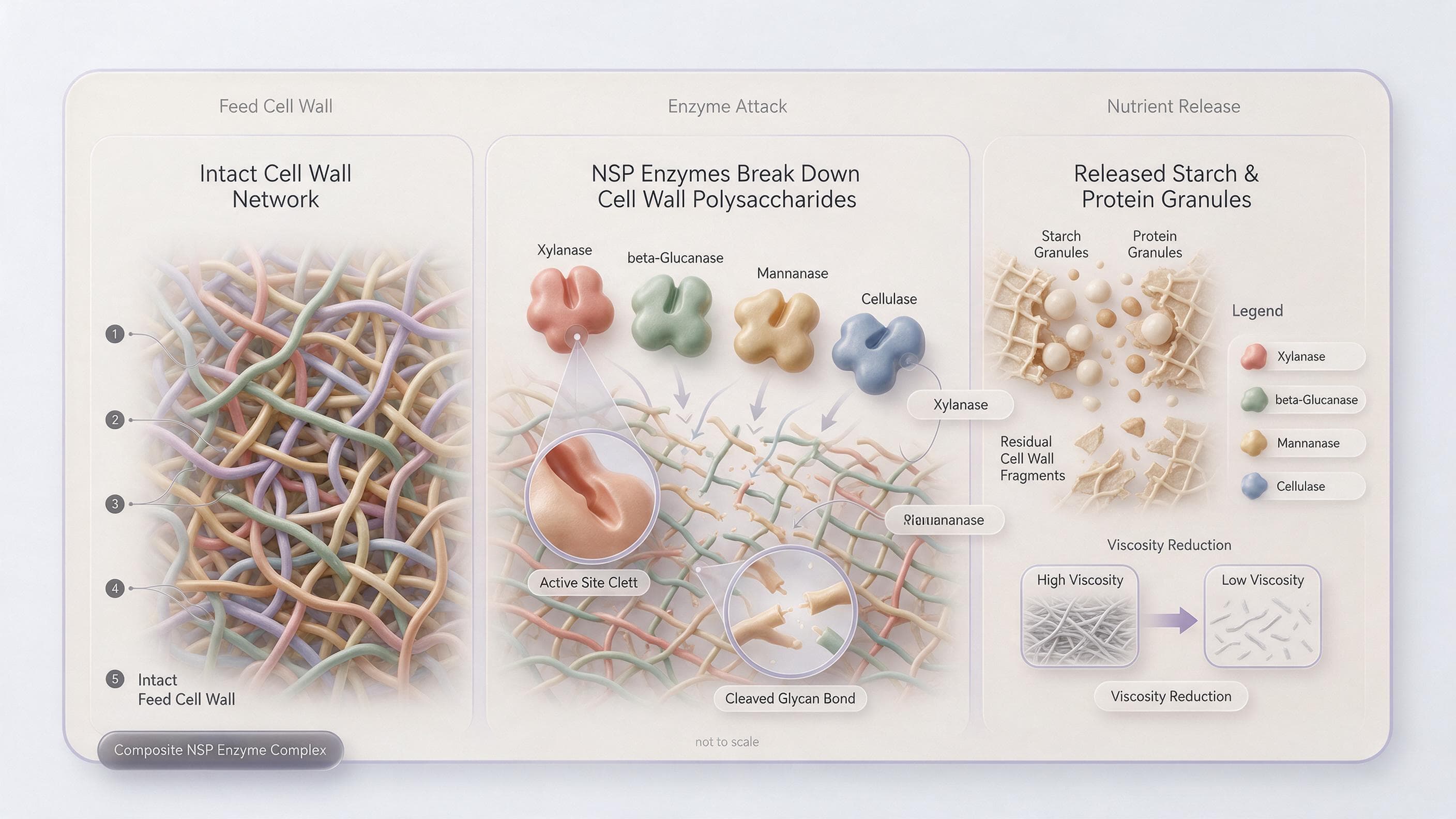
figure1. Composite NSP enzyme multi-enzyme degradation of feed cell-wall non-starch polysaccharides for nutrient release.
Category: F (Product & Material); Secondary: A (Enzymes & Proteolysis), G (Application & Scenarios)
1. Why Composite NSP Enzyme Is the Core Lever for Feed Viscosity Reduction and Nutrient Release
1.1 Non-Starch Polysaccharides: The Most Underestimated Nutritional Bottleneck in Feed
Non-starch polysaccharides (NSP) in plant-based feed are not broken down by the endogenous enzymes of monogastric animals. They encapsulate starch and protein and raise digesta viscosity, which is a key reason for reduced nutrient digestibility and disrupted gut fermentation.
By solubility, NSP divide into soluble and insoluble classes. Soluble NSP (arabinoxylan, β-glucan) forms a high-viscosity digesta that limits contact between digestive enzymes and substrate, making it the main target for viscosity reduction.
Insoluble NSP (cellulose and related fibre) wraps nutrients like a shell; the dense cell-wall network must be opened before the starch and protein inside can be released.
So the value of a composite NSP enzyme lies not in any single activity, but in whether it can cover the most troublesome NSP classes in a given diet.
1.2 Composite NSP Enzyme: From a Single Enzyme Spectrum to Multi-Enzyme Synergy
A composite NSP enzyme is not one enzyme but a multi-enzyme preparation built mainly from xylanase, β-glucanase and mannanase, usually combined with cellulase, pectinase and α-galactosidase.
A single enzyme targets only one polysaccharide backbone and struggles with the highly branched, variously substituted NSP. Multi-enzyme synergy opens main chains and side chains together, gradually dismantling the dense cell-wall network.
The gain appears in two ways: it directly lowers digesta viscosity, and it increases contact area between digestive enzymes and substrate so starch and protein are hydrolysed faster, raising energy and protein utilisation.
So when evaluating a composite preparation, the focus is not just whether an enzyme is present, but whether the activity ratio of each component matches the NSP structure of the target diet.
1.3 Three Backbone Mechanisms: Cleaving Xylan, β-Glucan and Mannan

figure2. Endo-1,4-beta-xylanase and beta-glucanase cleaving non-starch polysaccharide backbones at the catalytic site.
Endo-1,4-β-xylanase hydrolyses the β-1,4-xylosidic bonds of the arabinoxylan backbone, making it the priority enzyme for wheat and rye diets.
β-Glucanase cleaves the mixed β-1,3/1,4 linkages of β-glucan, targeting mainly the β-glucan present in barley and oats.
β-Mannanase hydrolyses β-1,4-mannan and galactomannan, which is especially relevant in soybean meal, palm kernel meal and similar ingredients.
These enzymes mostly attack the polysaccharide backbone endo-wise. Because they must recognise substrate subsites, the -1 and +1 subsites determine where the glycosidic bond is cleaved and how the product oligosaccharides are distributed.
NSP molecules such as xylan are highly branched. Side chains of arabinose, acetyl and ferulic acid outside the backbone also require accessory enzymes such as α-L-arabinofuranosidase and acetyl xylan esterase to be trimmed, so that the backbone enzymes can act more fully.
2. Start Selection with Indicators: Core Performance Parameters
2.1 How to Read Activity Units Without Playing a Numbers Game
The most common definition uses reducing sugar released per minute under a stated substrate, pH and temperature. For example, one unit (U) of xylanase means one micromole of reducing sugar (expressed as xylose equivalents) released per minute under the set conditions.
Different suppliers may define U with different substrates, temperatures and pH, so cross-comparison only makes sense under comparable assay conditions; otherwise the numbers mean nothing.
Composite preparations usually list fractional activities, namely the U/g of xylanase, β-glucanase and mannanase separately. Check each component rather than reading a single total activity.
2.2 Heat and pH Fit: Survival in Pelleting and the Digestive Tract
Feed pelleting and conditioning temperatures are often above 75-90°C, so thermostability directly decides whether the enzyme reaches the gut with enough active protein; heat-labile enzymes lose much activity during processing.
The enzyme also has to work across gastrointestinal pH, for example the acidic stomach and the near-neutral, mildly alkaline small intestine. A good composite NSP enzyme should combine heat tolerance with a broad pH range.
Heat tolerance cannot be judged from the nominal temperature alone; use the residual activity after pelleting or high-temperature treatment, and the retention rate under simulated intestinal conditions.
Also, a composite NSP enzyme is supplied as a multi-enzyme blend, and the optimal pH and temperature of each component are not always the same. Set evaluation conditions for each component separately so a single compromise condition does not mask the true performance of one fraction.
2.3 Viscosity Reduction and Nutrient Release: Outcome Indicators That Map to User Needs
High activity does not equal a good effect. What matters to producers is outcome indicators such as viscosity reduction and the rise in energy and protein digestibility.
In vitro simulated digestion (a two-step stomach-plus-small-intestine method) bridges the indicator and field results, letting teams screen enzyme spectrums, ratios and doses faster and cut animal-trial cost.
Focusing on outcome indicators turns enzyme selection from a parameter comparison into a prediction of production performance.
3. How to Measure the Indicators: From Standard Assays to a Built-in QA System
3.1 Substrate-Specific Activity Assay and Standard Controls
Measure each fractional activity on the matching backbone substrate, fixing pH, temperature, substrate concentration and reaction time, then quantify with the DNS reducing-sugar colorimetric method.
Include a no-enzyme control, an inactivated-enzyme control and a reagent blank to exclude substrate self-change and non-catalytic background.
Use the same batch of standard enzyme sample for comparison so results remain comparable across laboratories and batches.
3.2 Combined Activity Assay in a Simulated Digestive Environment
A standalone assay cannot answer whether the enzyme works in the feed. Simulate the digesta environment by passing through a gastric phase then an intestinal phase, observing viscosity change, soluble-sugar generation and nutrient release.
This step exposes what a single indicator can hide: an enzyme with very high standalone activity may have limited effect under real digesta viscosity and complex substituents.
Validate on a real diet or a close ingredient combination rather than a pure substrate, for results closer to the application.
3.3 Batch Consistency and Stability Verification

figure3. Composite NSP enzyme feed workflow: dosing, pelleting, digestion, viscosity reduction and quality control.
Batch consistency is key to stable production. Establish quality-control indicators such as fractional activity, moisture, particle size and microbial counts, and set an acceptable variation window.
Stability verification covers short-term high-temperature tolerance, long-term storage at ambient temperature and temperature changes, confirming the activity decay curve over time and conditions.
Only by placing activity, heat tolerance and batch variation in one QA system can you guarantee consistency from R&D and pilot scale to production and, finally, to every batch of feed.
4. Selection and Custom Paths Across Different Raw Materials and Needs
4.1 Enzyme-Spectrum Differences Between Corn-Soy and Wheat-Based Diets
Wheat and rye diets are high in arabinoxylan, so prioritise xylanase and pair it with β-glucanase; corn-soy diets lean on soybean-meal mannan, so β-mannanase and xylanase fit better.
Barley and oat diets are dominated by β-glucan, making β-glucanase the key target enzyme.
Define the ingredient structure and NSP composition first, then set the main enzyme and ratio, avoiding a one-size-fits-all generic composite enzyme.
4.2 Broilers, Grower-Finisher Pigs and Ruminants: Different Targets, Dose and Ratio
Broilers have short intestinal tracts and weak digestive capacity, so they are more sensitive to viscosity reduction and nutrient release, generally needing a broader spectrum and higher dose.
Grower-finisher pigs respond to enzyme spectrum and digesta viscosity depending on ingredients and gut microbiota, so adjust the dose gradually using in vitro modelling plus measurement.
Ruminants degrade NSP with their own rumen microbes, so the value of exogenous NSP enzyme differs from that in monogastrics and should be assessed separately rather than copying the dose.
4.3 How Standard Products and Custom Enzyme Spectrums Connect
When the ingredients are stable and the NSP composition is clear, a standard composite NSP enzyme is often enough; the focus is then on verifying activity, heat tolerance and viscosity-reduction results.
When ingredients vary, the formula is unique, or you need a more stable effect at a specific temperature and pH, a standard product may not match precisely.
At that point the custom spectrum path applies: define enzyme types, activity ratios and stability modification around the specific matrix, turning enzyme selection into enzyme design.
5. FAQ
Q1: Is More Composite NSP Enzyme Always Better?
No. There is an optimal inclusion range; beyond it, adding more enzyme only raises cost without extra degradation or nutrient release. Set the dose using in vitro simulated digestion and field results rather than applying a large dose blindly.
Q2: What Is the Difference Between a Composite NSP Enzyme and a Single Xylanase?
A single xylanase degrades only the xylan backbone and cannot handle β-glucan, mannan or other NSP; a composite NSP enzyme covers several backbones and side chains through synergy, suiting complex diets. Whether to use a composite depends on the NSP composition of the raw material.
Q3: Why Does the Same Enzyme Perform Differently in Different Feeds?
Because the NSP composition and content differ across ingredients. Wheat diets are dominated by arabinoxylan, barley by β-glucan and soybean meal by mannan. The enzyme spectrum must match the feed NSP structure, otherwise degradation and viscosity reduction decline.
Q4: Does Pelleting Heat Destroy Composite NSP Enzyme Activity? What Heat Tolerance Is Needed?
Yes. Pelleting and conditioning temperatures usually exceed the enzyme optimum, so enzymes with poor thermostability lose much activity during processing. Judge thermostability by residual activity after pelleting or high-temperature treatment and match it to the actual pelleting temperature.
Q5: How Can I Tell Whether a Composite NSP Enzyme Fits My Formula?
First confirm the feed NSP composition and the main enzyme need, then check fractional activity and heat/pH fit, and finally use simulated digestion to look at viscosity reduction and nutrient release. If the standard product or a custom spectrum is needed, consider the MATWINGS MALL custom tool-enzyme path.
6. How MATWINGS MALL Products and Custom Services Fit In
A standard composite NSP enzyme addresses general needs on a well-defined formula. When a company faces variable ingredients, a spectrum that does not match the diet, or the need for stable release at a specific temperature and pH, a standard product is often hard to match precisely.
MATWINGS MALL offers a custom tool-enzyme development service, oriented to R&D and production needs, spanning enzyme-spectrum design, stability adaptation and scale-up validation. Most projects trigger a custom need in the following scenarios.
6.1 Enzyme-Spectrum and Ratio Customisation: Matching the NSP Composition of a Specific Ingredient
Start by entering the ingredient structure and NSP composition, then define the main enzyme types and fractional-activity ratios to reduce the ineffective coverage of a generic composite enzyme. The service can design a spectrum around the matrix and verify it with in vitro simulated digestion, so the ratio is closer to the field.
Because matrices differ by project, the final spectrum and activity range must be determined by project measurement; verified performance results carry a mark for anything not yet confirmed.
6.2 Heat and pH Stability Modification: Adapting to Pelleting and the Gut Environment
Targeting pelleting heat and gastrointestinal pH fluctuation, work on thermostability and pH-tolerance improvement, and give verifiable evidence through residual activity after pelleting and simulated intestinal retention, rather than only a nominal activity figure.
6.3 Batch Consistency and Scale-Up: From R&D to Stable Production
Establish quality-control criteria for fractional activity, moisture, particle size and microbial counts, and support step-wise validation from bench to pilot so R&D batches remain comparable with production batches.
To take on these nodes, learn about the MATWINGS MALL dry-wet closed-loop platform, the expert centre and related product pages; specific results still require validation under project conditions.
7. Summary
The value of a composite NSP enzyme is to bring down the hardest-to-digest non-starch polysaccharides in the diet with multi-enzyme synergy, lowering viscosity, releasing nutrients and raising energy and protein utilisation.
Selection is not about comparing a single number, but about placing activity units, heat and pH fit, and simulated viscosity reduction and nutrient release into one evaluation.
When a standard product matches the ingredient, verify against the indicators; when the match is insufficient or custom needs arise, fill the gap through spectrum and stability customisation to move from usable to quantifiable, scalable and stably producible.
8. MATWINGS MALL Product Zone and More Industry Insights
Browse the MATWINGS MALL product zone, the dry-wet closed-loop platform and the expert centre for more industry insights and actionable services on enzyme-spectrum design, stability modification and activity testing and verification.