
Alcohol-Degrading Enzyme Is More Than ADH: Mechanism, Misconceptions and Selection of ADH and ALDH
Published on October 29, 2026
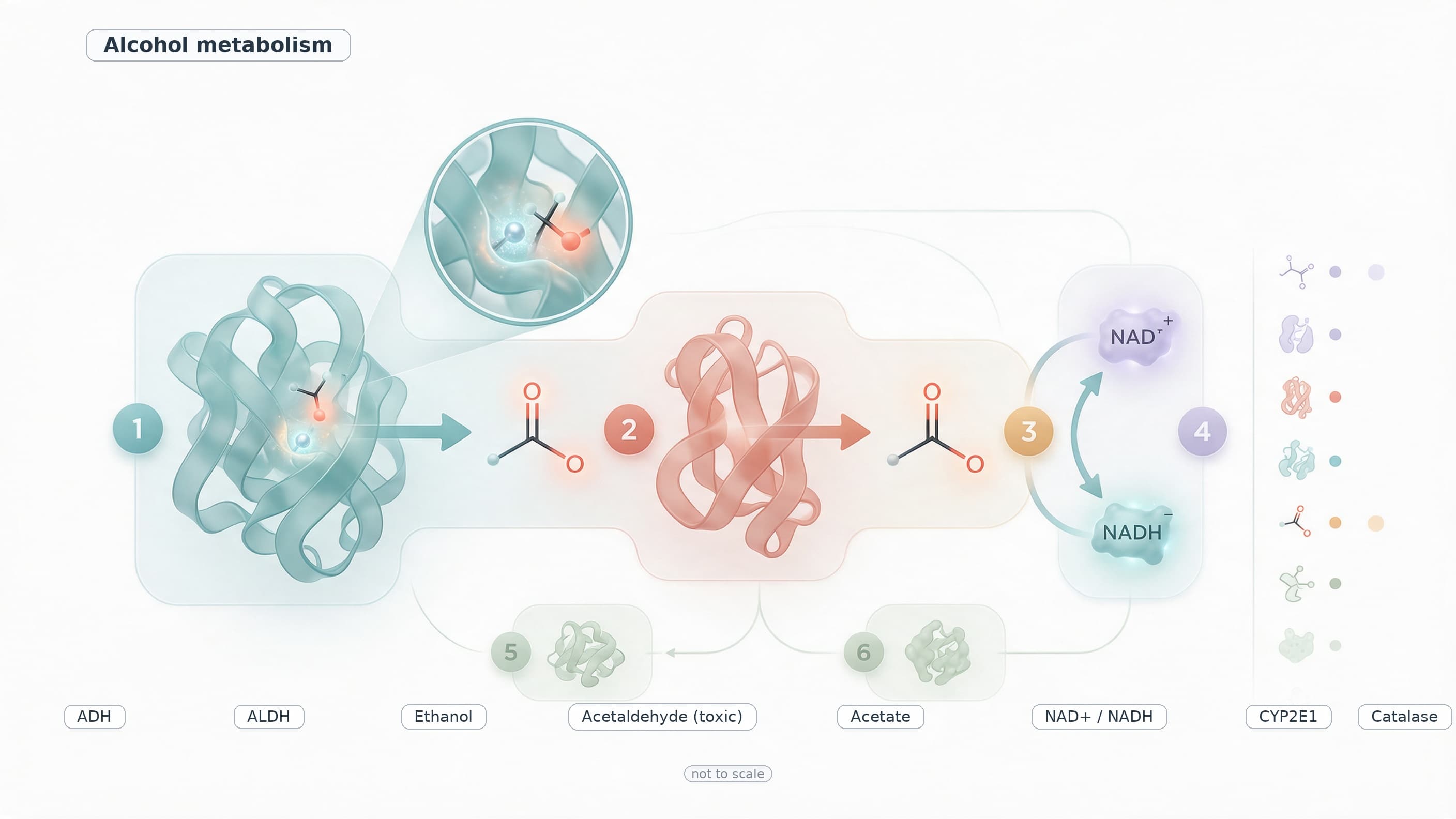
figure1. Overview of the alcohol-metabolism enzyme system: ADH and ALDH convert ethanol to acetate, with CYP2E1 and catalase as secondary pathways.
Category: Products & Materials | Enzyme Catalysis
1. Main Misconceptions: Does an Alcohol-Degrading Enzyme Really Work When Taken Orally?
1.1 Misconception One: Treating the Enzyme as a Single Enzyme
Most people hearing about an alcohol-degrading enzyme immediately assume it is alcohol dehydrogenase (ADH). The reality is more layered. An alcohol-degrading enzyme is a collective term for an oxidoreductase system whose main line is formed by ADH and aldehyde dehydrogenase (ALDH), plus secondary pathways such as cytochrome P450 2E1 (CYP2E1) and catalase. Talking only about ADH cuts the metabolic chain in half.
1.2 Misconception Two: The Enzyme Can Break Down Alcohol Directly in the Stomach
This is the most common misunderstanding. ADH and ALDH are proteins, and when taken orally they must pass two barriers: gastric acid and intestinal proteases. Most enzymes are degraded and inactivated before reaching the site of action, and even the few survivors rarely cross the intestinal barrier into blood to metabolize alcohol. Equating the ability of an enzyme to catalyze alcohol with the ability to sober up when swallowed misapplies in vitro reaction conditions to the body.
1.3 Misconception Three: A Stronger Enzyme Means a Higher Tolerance and Less Drunkenness
Higher activity does not mean higher tolerance. The rate of alcohol elimination is limited by metabolic flux, and the upper bound is set by the supply of the cofactor NAD+ (nicotinamide adenine dinucleotide) and by acetaldehyde clearance. Piling up high-activity ADH can instead accelerate acetaldehyde formation; if ALDH cannot keep up, acetaldehyde accumulates and causes flushing and palpitations, which is not sobering up but a metabolic-stress signal.
2. Tracing the Origin of the Misconceptions: The Real Pathway and the Two Key Enzymes
2.1 Main Line: ADH Oxidizes Ethanol to Acetaldehyde and ALDH Clears Acetaldehyde to Acetate
The main battlefield of alcohol metabolism is the liver.
l First, NAD+-dependent ADH oxidizes ethanol (C2H5OH) to acetaldehyde (CH3CHO);
l then ALDH oxidizes acetaldehyde further to acetate (CH3COO), which enters energy metabolism.
ADH turns alcohol into a toxic intermediate, while ALDH clears that intermediate before it accumulates.
2.2 Why Acetaldehyde Clearance Matters More Than Ethanol Oxidation
Acetaldehyde is a known carcinogen and the main source of flushing, nausea and palpitations. The common ALDH2 variant (rs671, Glu487Lys) in East Asian populations markedly reduces enzyme activity and acts in a dominant-negative way, causing the typical alcohol-flushing response. This shows the metabolic bottleneck is often in ALDH rather than ADH. When the goal is to reduce acetaldehyde exposure, focus on ALDH specific activity and low-Km behavior rather than on accumulating ADH.

figure2. Catalytic mechanism of ADH and ALDH: NAD+-dependent ethanol oxidation and acetaldehyde clearance, with acetaldehyde as the toxic intermediate.
2.3 The Easily Overlooked Secondary Pathways: CYP2E1 and Catalase
Chronic or heavy drinking induces CYP2E1, forming the microsomal ethanol oxidizing system (MEOS) with reactive oxygen species generation. Catalase is mainly found in certain tissues and microorganisms and contributes little to ethanol oxidation. In raw-material selection these pathways are boundary information: they affect the product profile and oxidative stress, but are usually not the core selling point of an alcohol-degrading-enzyme product.
3. The Correct Evaluation Logic: From Having Activity to Being Applicable
3.1 Specific Activity, Km and Vmax: Putting Three Readings into One Judgment
Specific activity (U/mg) reflects the catalytic capacity of unit mass of enzyme under saturating substrate and is the first choice for cross-comparison. Km (Michaelis constant) reflects affinity for the substrate: a low Km means the enzyme still works efficiently at low substrate concentration, while Vmax describes the upper limit at saturation. Deciding whether an alcohol-degrading enzyme suits a target scenario requires looking at all three, not only specific activity.
3.2 Optimum pH, Temperature and Metal-Ion Dependence
ADH is often a zinc-containing enzyme, while ALDH usually performs better in acidic or slightly acidic environments. Optimum pH and temperature differ markedly by source (yeast, microbial or recombinant). Selection should measure the target pH and temperature window and match it to the downstream system (such as fermentation broth or beverage matrix), avoiding a sudden activity drop under application conditions.
3.3 Unify Activity Assay and Unit Definition to Keep Batches Comparable
The definition of specific activity, substrate concentration, cofactor excess, reaction time and termination method all change the reading. The same U is not equivalent across vendors or methods. Establishing a unified assay caliber (substrate, temperature, pH, time and unit definition) is a prerequisite for batch comparability and the first metric to freeze before scale-up.
4. Differentiated Analysis by Scenario: What Each Application Demands from the Enzyme
4.1 Alcohol Detection and Biosensing: Fast, Accurate and Robust
Diagnostic and online-monitoring scenarios value response speed, detection limit and resistance to matrix interference. Such applications usually couple ADH with NAD+ generation or directly monitor acetaldehyde, requiring a stable cofactor supply, a defined working-concentration range, and a buffer design that resists interference from wine samples or fermentation systems.
4.2 Beverage De-alcoholization and Fermented-Food Acetaldehyde Control: Condition Compatibility and Controllable By-products
Beverage de-alcoholization can use ADH to convert ethanol to acetaldehyde, but acetaldehyde must not remain in the product and must be cleared by ALDH, otherwise flavor and safety risks increase. For acetaldehyde control in fermented foods (such as wine and yogurt), the emphasis is on ALDH selectivity and low-temperature compatibility; the key is avoiding too many dehydrogenase side reactions that alter flavor, rather than simply pursuing high activity.
4.3 Oral Food Ingredients: Oral Bioavailability Is an Unavoidable Hurdle
If the product is positioned as an oral supplement, reporting only in vitro activity is not enough. Gastric-acid stability, intestinal protease tolerance, cellular uptake and blood exposure all need measured evidence; otherwise the data can only be treated as in vitro. Such claims should distinguish between an enzyme's ability to catalyze alcohol in a reaction system and its ability to metabolize alcohol effectively in the body after oral intake; the two are not the same.
5. Engineering Implementation: From Enzyme Raw Material to a Scalable, Repeatable Process
5.1 Source and Expression: Yeast, Microbial and Recombinant
Yeast-derived ADH is mature and reliable, while microbial and recombinant systems offer more flexibility in sequence design, activity engineering and scale-up. Before choosing a source, fix the target reaction (remove ethanol or remove acetaldehyde), tolerance conditions and downstream purification burden, then decide whether to construct in-house or purchase a standard raw material.
5.2 Batch-to-Batch Consistency and Stability Engineering
The bottleneck for an alcohol-degrading-enzyme product is often not single-batch activity but batch-to-batch consistency. Specific activity, cofactor dependence, optimum pH and temperature, and storage stability should be brought into the same set of critical quality attributes, with gradient validation on heat-, freeze-thaw- and metal-ion-sensitive batches; where needed, stability engineering can reduce dependence on harsh conditions.
5.3 Purification, Lyophilization and Storage Must Align with the Assay Caliber
Purification and lyophilization change activity recovery and stability. Lyophilization protectants, buffer formulation, residual moisture and storage temperature all affect batch performance. Storage and assay should use the same caliber, avoiding a mismatch between reporting by assay values and accepting by storage conditions.

figure3. Production workflow of alcohol-degrading enzyme from feed, catalysis, purification and QC to finished product and scale-up.
6. How MATWINGS MALL Products and Custom Services Apply
6.1 How to Select Standard Alcohol-Degrading-Enzyme Raw Materials
If the target reaction is clear and conditions are routine, start with the standard enzyme raw materials listed on MATWINGS MALL, compare specific activity, Km, optimum pH and temperature and batch stability, run a pre-validation against the real application system, then freeze the vendor and lot.【To be verified】The specific specifications and inventory of in-stock alcohol-degrading-enzyme raw materials must follow the MATWINGS MALL product page.
6.2 Custom Tool Enzyme: When a Standard Product Cannot Meet Differentiated R&D
When a standard product cannot match the target reaction, source, activity range or tolerance conditions, rely on the MATWINGS MALL custom tool-enzyme development service. This service can revolve around sequence and activity customization, stability engineering, and a delivery chain from samples to scale-up. It is essential to fix the target reaction and unit caliber early and to provide the real substrate and working conditions, turning can-catalyze into an applicable, scalable, credible result. The service takes on R&D nodes, while specific indicators still depend on project measurement.
6.3 Delivery Chain from Sample to Scale-Up
A custom project usually runs through requirement confirmation, sequence and expression construct, activity and stability validation and a bench batch, then stepwise confirmation at pilot and scale-up. Keep a unified reference sample and assay caliber at each node to avoid drift from equipment or analytical variation during scale-up. The MATWINGS MALL expert center can help align parameters and diagnose problems, but success still depends on measured data under project conditions.
FAQ
Does an oral alcohol-degrading enzyme really sober you up?
Not simply. The enzyme is a protein, and after oral intake most is degraded by gastric acid and digestive proteases, so it can hardly enter blood to metabolize alcohol. Oral claims need measured evidence of gastric-acid stability, intestinal tolerance and blood exposure, not only in vitro activity.
Can ADH and ALDH replace each other?
No. ADH oxidizes ethanol to acetaldehyde, while ALDH clears acetaldehyde to acetate; the direction and substrate differ. To reduce acetaldehyde exposure, focus on ALDH high specific activity and low-Km behavior.
How is the activity unit of an alcohol-degrading enzyme defined and converted?
Specific activity is expressed in U/mg, but the same U is not equivalent across vendors because substrate, temperature, pH and time definitions differ. Before cross-source comparison, unify the assay caliber, then convert the readings.
Which enzyme is used for beverage de-alcoholization and what conditions matter?
ADH converts ethanol to acetaldehyde, but ALDH must be paired to clear the acetaldehyde, otherwise product risk rises. Control temperature, pH, cofactor supply and side reactions to avoid altering flavor.
How do I customize an alcohol-degrading enzyme with a specific source or sequence?
Use the MATWINGS MALL custom tool-enzyme service around sequence and activity customization, stability engineering and the sample-to-scale-up delivery chain. Fix the target reaction and unit caliber first, and provide the real substrate and working conditions.
Summary
An alcohol-degrading enzyme is not a single enzyme but an oxidoreductase system of ADH, ALDH and CYP2E1. Understanding the main line from ethanol through acetaldehyde to acetate, keeping the non-interchangeable roles of ADH and ALDH separate, judging with a unified specific-activity and Km caliber, and separating in vitro activity from oral or application scenarios are the core of selection. When a standard product cannot meet differentiated R&D, the MATWINGS MALL custom tool-enzyme service offers an implementation path, but all indicators still depend on project measurement.
More Industry Insights
To learn more about tool enzymes in functional foods, beverage de-alcoholization and fermentation industry, visit MATWINGS MALL for technical content and custom tool-enzyme solutions.