
What Is the ProtT5 Protein Model? How Does It Read the "Language of Proteins"?
Published on October 29, 2026
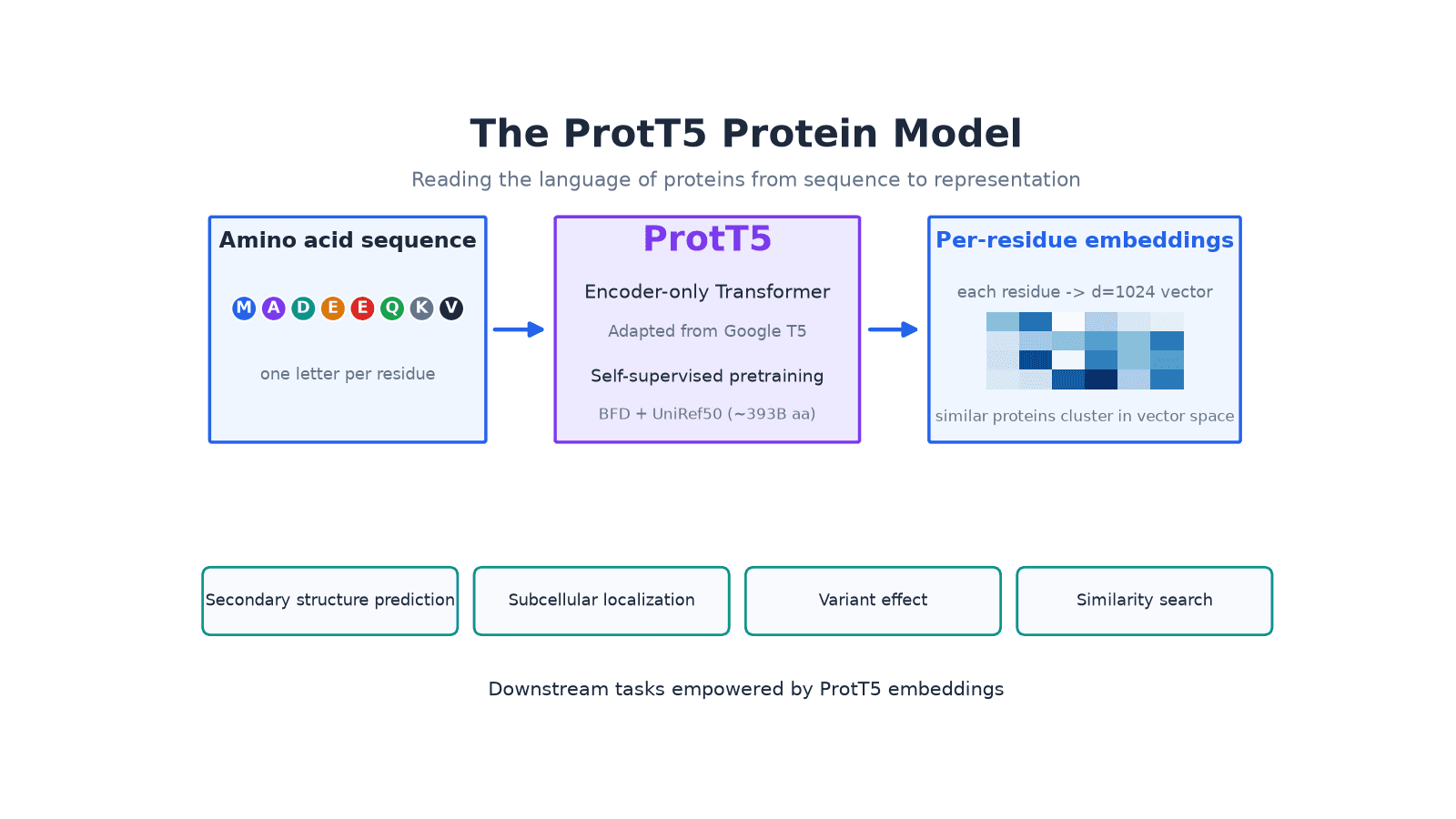
Figure 1 The ProtT5 protein model: from sequence to high-dimensional representation
Introduction
Proteins are the "machines" of life, and their "manual" is written in the amino acid sequence. In the past, predicting the structure and function of a protein required extensive alignments and evolutionary trees — time-consuming, and dependent on whether the target protein had "relatives." The ProtT5 protein model changes this: like a "linguist" that has read hundreds of millions of sequences, it extracts digital representations rich in structural, functional, and biophysical information from a single amino acid sequence. This article explains its principles, capabilities and limits, and its real use in protein engineering. Whether you are new to protein engineering or a practitioner looking to speed up R&D with AI, this article offers actionable understanding.
Background and mechanism: why does the ProtT5 protein model treat proteins as a "language"?
Proteins can be learned as a "language" because evolution has "written" structure and function into amino acid sequences; the ProtT5 protein model self-learns these rules from vast unlabeled sequences without manual annotation. Over the decades we have accumulated a staggering amount of sequence data, but only a small fraction carries experimentally validated functional annotation. Traditional methods rely on multiple sequence alignments (MSA) — finding "evolutionary relatives" for each protein and inferring function from their conserved information. This is slow, and it fails for "orphan proteins" with no known homologs. ProtT5 takes another route: first "read," then "understand." Here, "reading" means the model practices repeatedly on unlabeled data — randomly masking a stretch of amino acids and reconstructing it; with practice, it learns the "grammar" of sequences on its own. This is like a person reading many articles and grasping syntax and word order without being told the rules. "Understanding," in turn, means these learned patterns transfer to judgments about structure and function, without relabeling huge datasets for each new task — the value of the "unsupervised pretraining + downstream fine-tuning" route.
Principles and architecture: how does ProtT5 "translate" a sequence into numeric vectors?
The ProtT5 protein model adapts Google's T5 architecture and keeps only the encoder, pre-trained in a self-supervised way through span-based denoising on large-scale sequences, mapping each amino acid to a 1024-dimensional vector (embedding), so that "similar" proteins are encoded close together in vector space.
· Borrowing T5 with an encoder-only design: ProtT5 treats a protein sequence as a "sentence" but uses only the encoder, so memory requirements are about half those of the full model, making inference more resource-efficient.
· Self-supervised learning: during pretraining, a block of amino acids is randomly "masked," and the model must reconstruct it from context. Through repeated practice, the model is forced to understand the internal "grammar" of sequences, capturing structural, functional, and biophysical features.
· Residue-level embeddings: given a sequence, ProtT5 outputs a 1024-dimensional vector for every amino acid, assigning each one an "attribute coordinate" that compresses the contextual information into a numeric array.
· Context-dependent: the same amino acid in a different sequence context is encoded into a different vector, because the encoder characterizes it in the context of the whole sequence, not just on its own. This is like judging a word's meaning by its surrounding sentence; ProtT5 uses "attention" so every amino acid can "see" the whole sequence, making its representation "context-aware" and naturally suited to capturing local and global protein relationships.
· Natural clustering of representations: when whole-protein embeddings are placed in a vector space, proteins with similar function or structure cluster together — the basis for similarity search and function prediction.

Figure 2 ProtT5 encoder architecture and residue-level 1024-dimensional embeddings
Measurement and selection: what can ProtT5 do, and how to evaluate and choose it?
The ProtT5 protein model performs strongly on downstream tasks — predicting secondary structure, subcellular localization, membrane/water solubility, binding residues, and variant effects without evolutionary information — so it is often chosen as a general-purpose representation engine in structure prediction, function annotation, and engineering screening.
· Research-validated strengths (sources: the original ProtTrans study and downstream papers): secondary-structure prediction that first surpassed alignment-based methods without using evolutionary information; subcellular localization and membrane vs. soluble discrimination; binding-residue identification, variant-effect assessment, and conservation estimation; embedding-driven similarity retrieval and downstream fine-tuning (e.g., post-translational-modification site prediction).
· Selection considerations: large models need a GPU; for fast or small-batch use, choose a lighter option or use precomputed embeddings (protT5 embeddings for some organisms are available to download). ProtT5 recognizes only uppercase amino acids and cannot directly handle non-canonical or lowercase representations. When the target protein lacks homologs and traditional MSA fails, ProtT5-class models are often more valuable.
· How to evaluate: in practice, researchers feed ProtT5 embeddings as features into a lightweight classifier or regression head, then compare against a baseline on the same benchmark set, rather than relying on a single number. For sparsely labeled tasks, this "leveraging a general representation for small-sample learning" approach is often more cost-effective and makes it easier to trace whether a prediction difference comes from the model itself or from data distribution.
Conditions and workflow: engineering considerations and deployment route
Using the ProtT5 protein model in real engineering requires balancing compute, batching, precision, and the downstream task; its output (embeddings) must feed into a dedicated model or retrieval system, and generation time can be greatly reduced on a GPU through batching and half-precision (fp16).
· Compute cost (reference only; source: the ProstT5 paper on embedding generation): on a single RTX A6000 (48 GB) with batching and fp16, generating human-proteome embeddings takes about 35 minutes, roughly 0.1 s per protein; actual time varies with sequence length and hardware.
· Engineering uses of embeddings:
· as features for downstream predictors (secondary structure, localization, modification sites, etc.);
· building similarity retrieval: index protein embeddings and use vector similarity to find functionally or structurally related proteins (e.g., ProtT5 paired with a vector-search engine as demonstrated by AWS);
· zero-shot / few-shot assessment of mutation effects and function.
· Deployment route: pretrained ProtT5 → extract residue-level / whole-protein embeddings → choose downstream model per task → transfer-learn from a small labeled set → validate with small-batch wet-lab experiments and close the loop.
· Scale and resource trade-offs: ProtT5 comes in multiple sizes (e.g., XL, XXL); larger versions usually give stronger representations but demand more memory. With limited resources, use half-precision, batch inference, or precomputed official embeddings to balance cost and accuracy. Start with a small proof-of-concept before scaling to the full pipeline to avoid a large upfront investment.

Figure 3 ProtT5-driven protein engineering active-learning loop
From sequence to design: how MatwingsVenus®(晓鹜®) integrates ProtT5-class AI models
MatwingsVenus®(晓鹜®) embeds ProtT5-class protein language models as an AI engine in its protein-engineering loop, connecting "sequence representation" with "generative design" and "wet-lab validation" to accelerate the development of valuable proteins with a data-driven approach. The MatwingsVenus®(晓鹜®) platform, under Matwings Technology, uses protein language models as part of intelligent design: on one hand, it uses embeddings for rapid representation and function pre-assessment of candidates, filtering out low-potential sequences; on the other, it combines AI-recommended designs with wet-lab feedback into an active-learning loop of "predict → validate → re-optimize," reducing blind experiments and improving R&D efficiency.
· Integration style (schematic, not specific product parameters): embedding-driven sequence assessment + generative / directed-evolution design suggestions + wet-lab data feedback, working in concert.
· Value: turning "lucky-dip" random screening into evidence-based "precise navigation." For users, this integration turns "guesswork from experience" into "screening with quantitative rationale": the AI-provided sequence representation can explain why a sequence is worth trying, making each experiment more valuable and helping teams focus on the most promising directions.
FAQ
What is the difference between the ProtT5 protein model and ESM-2?
Both are mainstream protein language models. ProtT5 is based on the T5 architecture (encoder) with denoising-style self-supervised pretraining, known for residue-level 1024-dimensional embeddings and strong representation without multiple sequence alignments; ESM-2 is another popular family. The right choice should be based on task, data, and compute compared via benchmarks, not a simple claim of one being better.
Does using ProtT5 require a lot of labeled data?
No. ProtT5 is a self-supervised pretrained model, so extracting embeddings requires no manual annotation; you only need a small labeled set for transfer learning if you train a downstream predictor on top of its features.
Can ProtT5 directly predict the 3D structure of a protein?
It mainly outputs embeddings and downstream structure/function-related predictions; it does not directly generate atomic-coordinate structures, which are usually handled by dedicated structure-prediction models (e.g., AlphaFold-class methods). ProtT5 acts more as a "sequence feature engine" providing high-quality input to structure-related tasks.
Can I use the ProtT5 model for free?
ProtT5 and its variants (e.g., ProtT5-XL-UniRef50) are released with open weights and are available on platforms such as Hugging Face for research and engineering use; commercial use should be checked against the specific license of the model version.
Conclusion: the role and value of the ProtT5 protein model
With its powerful sequence-representation ability, the ProtT5 protein model is regarded as a key AI engine "from sequence to knowledge" in protein engineering; its value lies in turning vast unlabeled sequences into computable, retrievable, transferable high-dimensional features. In short, ProtT5 translates the "language of proteins" into high-dimensional numbers a computer can understand, letting structure, function, and evolutionary information be discovered without manual annotation. It shows unique value in large-scale representation, similarity retrieval, and downstream prediction, especially for target proteins lacking homologs. MatwingsVenus®(晓鹜®) is integrating such AI capabilities into an intelligent protein-engineering loop for more efficient, evidence-based protein R&D.