
Monellin Sweet Protein: From a Natural Sweet Protein to an Engineering-Based Sugar-Reduction Solution
Published on October 27, 2026
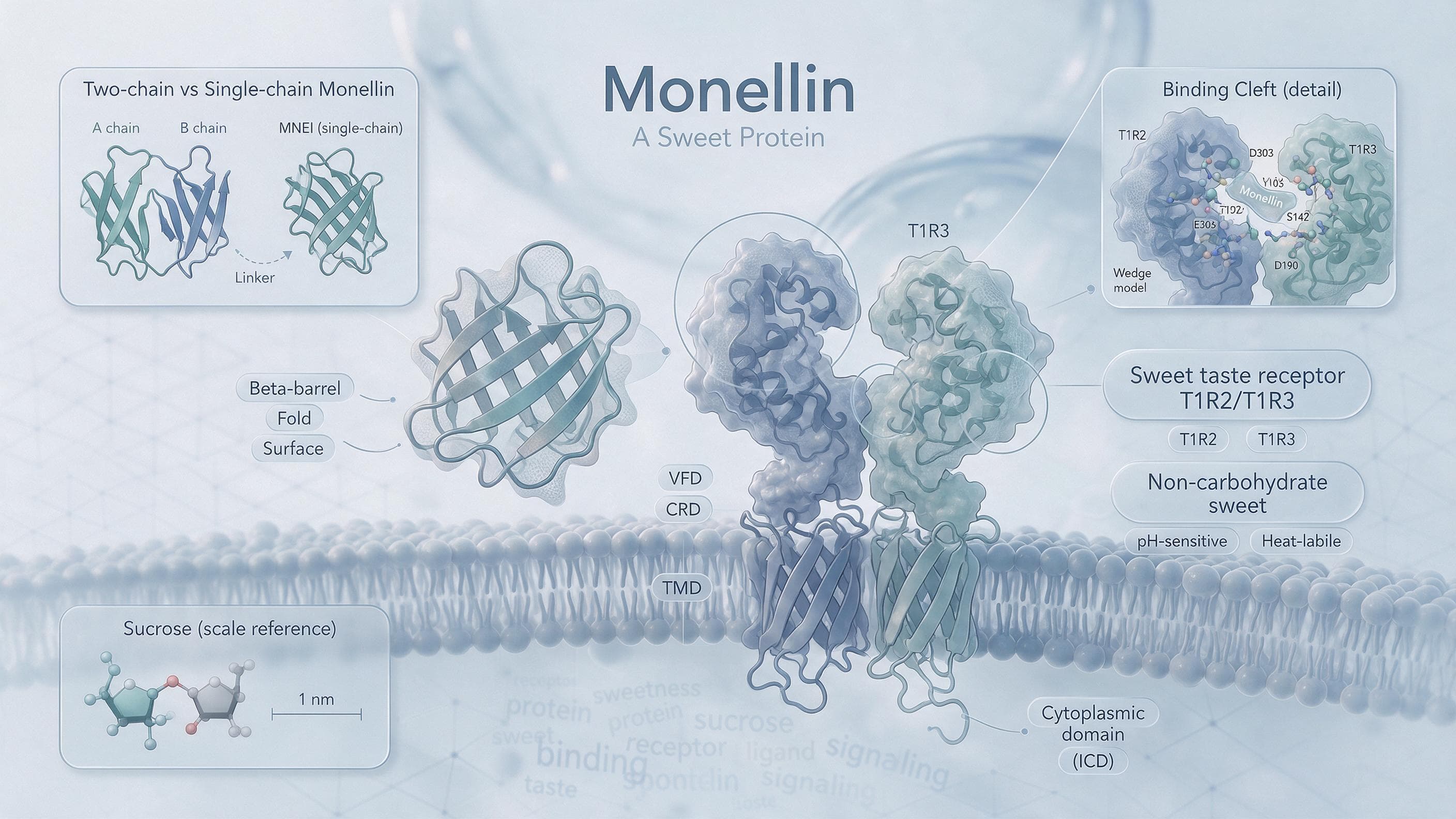
figure1. Overview of the Monellin sweetness mechanism: binding of the sweet protein to the T1R2/T1R3 sweet taste receptor
Category: E Structure/Mechanism/Sequence Analysis (Primary); G Application/Scenario (Secondary)
1. Four Common Misconceptions About Monellin
1.1 Misconception 1: A natural sweet protein means naturally stable
A natural origin does not mean structural stability, and Monellin is a typical case of "natural but fragile." It is extracted from a West African berry (Dioscoreophyllum cumminsii, commonly called the serendipity berry), and its sweetness background is natural, but the molecule itself readily denatures under high temperature and low pH. This shows that "natural" only describes the origin, not thermodynamic stability or process tolerance; treating "natural" as "stable" is a common trap in sugar-reduction R&D.
1.2 Misconception 2: A higher sweetness multiple means better taste
The sweetness multiple only reflects an intensity level and cannot represent taste quality. Monellin can be hundreds to thousands of times sweeter than sucrose, but it also shows slow sweetness onset and persistent lingering aftertaste; substituting only by multiple leads to a cloying finish. Judging taste requires the sweetness-time profile, onset and aftertaste, and synergy with the food matrix, based on sensory evaluation rather than a single multiple.
1.3 Misconception 3: All sweet proteins are the same and Monellin can easily replace sucrose
Different sweet proteins differ completely in structure, mechanism and application boundaries, and Monellin cannot replace sucrose at equal amounts. Monellin, thaumatin, brazzein and miraculin vary in origin, sweetness, stability and mechanism; meanwhile sucrose also contributes volume, texture, Maillard reaction, freezing point and moisture retention, which a sweet protein cannot provide. Treating them as equivalent or expecting a direct replacement leads to choosing the wrong molecule and wasting validation effort.
1.4 Misconception 4: Sugar reduction only means swapping the sweetener
Sugar reduction is a system-level engineering task, not simply replacing the sweetener. After adding Monellin, the system pH, processing temperature, food matrix, synergistic effects and compliant labeling all need to be reconsidered; the whole formulation, process and claims need redesign, otherwise the result is "swapped sweetener, lost taste and stability."
2. Molecular Truth Behind the Misconceptions: Monellin Structure and Sweetness Mechanism
2.1 Molecular structure and sequence features of Monellin
Monellin consists of two non-covalently associated chains, an A chain (about 44 residues) and a B chain (about 50 residues), folding into a beta-barrel-like structure; the single-chain MNEI variant links B and A through a short dipeptide into about 96 residues, becoming the mainstream engineering carrier. The sequence composition directly determines its folding stability and expressibility, explaining why different "sweet proteins" vary so much in heat tolerance and yield.
2.2 How Monellin binds the T1R2/T1R3 sweet taste receptor
Monellin does not mimic a sugar molecule; instead, it "wedges" into the large outer cleft of the T1R2/T1R3 receptor to activate downstream sweet taste signaling. Positively charged surface residues form electrostatic matches with the negatively charged receptor region, and several sulfate ions help stabilize the interface, jointly shaping its sweetness. This makes it a true "non-carbohydrate sweet" with a clean taste and minimal effect on blood glucose.

figure2. Structural basis of Monellin recognition by the T1R2/T1R3 sweet taste receptor: electrostatic complementarity and conformational dynamics
2.3 Sweetness and taste: why lingering aftertaste is a challenge
Monellin has slow onset and persistent aftertaste, and its sweetness changes markedly with pH, rooted in its binding-unbinding kinetics with the receptor. This property gives a clean sweetness but also makes the lingering aftertaste a formulation hurdle. Two improvement directions are protein engineering to alter the binding interface, and blending with other sweeteners to buffer or mask the finish.
3. Building Correct Evaluation Logic: Monellin's Real Performance Boundaries
3.1 How to evaluate stability: temperature, pH and storage
Evaluating Monellin requires more than sweetness; one must assess thermal denaturation temperature, the pH-sweetness curve and storage stability. Monellin denatures and loses sweetness at high temperature and low pH, and is essentially tasteless below pH 2 or above pH 9; only by including these can one judge real usability in a process. A single "sweetness multiple" cannot reflect true applicability.
3.2 Monellin vs. thaumatin vs. artificial sweeteners: how to choose
Each sweetening option has its own boundaries. Monellin has a clean, natural sweetness but weaker thermal stability; thaumatin has relatively better heat tolerance and a natural taste; artificial sweeteners are low-cost and stable but may carry off-notes or controversy. Selection should compare actual pH, temperature, cost and compliance point by point, rather than ordering based on the "natural" label alone.
3.3 Regulation and labeling: compliance for natural sweet proteins
As a novel food ingredient or food additive, Monellin must meet target-market regulations, and claims such as sugar-free or low-calorie should be made cautiously. [To be verified: the specific approval status and permitted scope in each major market]. Confirm the compliance path before R&D selection to avoid developing a product that cannot be sold.
4. Engineering to Application: Turning Monellin into a Usable Sugar-Reduction Solution
4.1 How protein engineering and directed evolution improve Monellin stability
Modifying Monellin surface residues, reinforcing disulfide bonds, or stabilizing the core fold through protein engineering and directed evolution is the mainstream route to improve heat and pH tolerance. The single-chain MNEI is easier to express and screen than the natural two-chain form, and studies have produced variants with boiling resistance and enhanced sweetness. Design must preserve the sweetness-related binding site, balancing activity and stability.
4.2 Impact of expression system and purification on cost
Monellin can be expressed in Escherichia coli, Pichia pastoris, Bacillus subtilis and tobacco chloroplasts; the host, codon optimization, secretion signal and purification method jointly determine yield and cost. Host choice should weigh expression level, folding quality, endotoxin level and downstream purification difficulty, which directly affects whether the sweet-protein ingredient can be supplied at scale and low cost.

figure3. Modular bioprocessing workflow for Monellin: fermentation, purification, quality control and finished product
4.3 Tiered performance requirements across applications
Different applications impose different requirements on Monellin. Sparkling drinks and RTD teas are typically low-temperature and neutral-to-slightly-acid, requiring moderate heat stability; baking and heated drinks require high heat stability; tabletop sweeteners require long shelf life and fast sweetness onset. Defining performance indicators by scenario is more efficient than a one-size-fits-all selection and avoids both under-engineering and over-engineering.
5. How MATWINGS MALL Products and Custom Services Deliver
5.1 Can't a standard sweet protein fit? MATWINGS MALL custom tool-enzyme/protein development
When commercial Monellin or natural sweet proteins lack sufficient stability at a given pH, temperature or food matrix, or when sweetness, aftertaste and expression cost cannot match a differentiated formulation, off-the-shelf products often cannot directly meet the need. In such cases, MATWINGS MALL custom tool-enzyme/protein development services can address the issue in a targeted way.
Custom development at MATWINGS MALL centers on the target performance, supporting mining of natural sweet proteins, directed modification of existing molecules, and multi-objective performance optimization, while treating substrate specificity, heat tolerance, pH tolerance, sweetness and yield as variables to develop variants suited to a specific process. Its dry-wet integrated pipeline combines dry-lab sequence analysis and structure assessment with high-throughput wet-lab construction and activity/stability testing, with results continuously feeding back into iteration, helping shorten development cycles and reduce screening trial-and-error cost.
The service covers requirement breakdown, scheme design, strain construction, protein expression and purification, functional verification and supporting process advice, with small-sample delivery available, suitable for research, synthetic biology and industrial catalysis at different levels. Each scheme comes with a complete design and validation evidence chain, enabling R&D teams to assess fit and control risk through sample validation and per-batch quality checks, supported by a professional team that fine-tunes solutions for complex catalytic scenarios and special process conditions.
Note: This is a general description of the custom service oriented to differentiated R&D needs; specific suitability and indicators require project-specific evaluation, and the service can support, enable or help shorten cycles and reduce trial-and-error cost without constituting an absolute guarantee.
5.2 Off-the-shelf or custom development: decision points for Monellin R&D
The key is to separate the "R&D stage" from the "performance gap." During exploration and validation, if a commercial sweet protein meets basic functions, use off-the-shelf to lower the threshold; once formulation is being finalized and performance is insufficient at a specific pH, temperature or matrix, or a differentiated sweetness and aftertaste is needed, move to custom development. The judgment standard is whether the standard product meets stability, sweetness and cost requirements under the target conditions; if any is missing, consider custom development.
Related Products and Services: MATWINGS MALL offers recombinant proteins, tool enzymes, diagnostic enzymes, purification tools and other product zones; custom development needs can be explored in the wet-lab zone for the validation pipeline, or consult the expert center for professional judgment, while the dry-wet closed-loop business page shows the end-to-end design-to-validation solution.
6. FAQ: Monellin R&D and Application
6.1 How many times sweeter than sucrose is Monellin?
Several hundred to several thousand times, commonly reported at 800 to 2000 times sweeter than sucrose, with some reports up to about 3000 times depending on the comparison standard. The exact multiple depends on the comparison compound, concentration and sensory method, so R&D teams should base decisions on their own sensory evaluation.
6.2 Why is Monellin sensitive to heat and acid?
Because Monellin is a protein, its folding and surface charge change with temperature and pH; high temperature and low pH denature the protein and destroy the sweetness-binding conformation, causing loss of sweetness, with essentially no sweetness below pH 2 or above pH 9. This makes it more suited to cold, neutral-to-slightly-acid systems, while hot-processing scenarios require engineering.
6.3 What is the difference between Monellin, thaumatin and brazzein?
They differ in origin, structure and stability. Monellin is a two-chain or single-chain small protein with a clean taste but weak thermal stability; thaumatin has relatively better heat tolerance and a natural taste; brazzein is smaller and also highly sweet. Selection should compare against the target matrix and process temperature point by point.
6.4 Which food and beverage products can use Monellin?
It is mainly suited to categories with lower heat-processing demands and neutral-to-slightly-acid pH, such as sparkling drinks, RTD teas, dairy, desserts and tabletop sweeteners; hot-processed or strongly acidic systems require protein engineering to improve stability. Specific usable categories still require compliance and formulation validation.
6.5 How can the lingering aftertaste of Monellin be improved?
Protein engineering can alter its receptor-binding interface to weaken the aftertaste; it can also be blended with other sweeteners or flavor compounds for synergy and buffering. These two paths are often combined and need iterative sensory evaluation.
6.6 What engineering approaches improve Monellin stability?
Common approaches include modifying surface and core residues, introducing or reinforcing disulfide bonds, single-chain engineering (such as MNEI), and optimizing recombinant expression systems plus cultivation/purification parameters. The goal is to raise thermal denaturation temperature, broaden the pH range and preserve sweetness.
6.7 What preparations are needed to develop a Monellin product?
You need a clear sweetness target, stability and pH range, expression host and purification route, cost and compliance assessment, plus quantifiable sensory and stability indicators. It is advisable to validate on a small sample before scaling up, to reduce trial-and-error cost.
7. Conclusion: Monellin's Sugar-Reduction Value and Engineering Direction
7.1 Core judgment on Monellin's sugar-reduction value
As a natural sweet protein, Monellin offers a non-carbohydrate, mechanistically novel sweetness path for sugar-reduction and low-sugar products. Yet whether its value can be realized depends on whether R&D teams correctly understand its structure, mechanism and performance boundaries, and use protein engineering to solve the two bottlenecks of stability and aftertaste. By adding evaluation dimensions beyond "natural" and "high sweetness," teams can turn Monellin from a concept into a scalable ingredient.
7.2 Practical advice for Monellin engineering and selection
From off-the-shelf selection to custom development, sugar reduction is a system-level project; choosing the right molecule, evaluating the right indicators and engineering correctly are what truly bring health and flavor together. It is advisable to define indicators by scenario first, then decide between a standard product and custom development; MATWINGS MALL can support sugar-reduction and sweet-protein R&D with tools that help teams complete the validation from molecule to process.
MATWINGS MALL Product Zone: MATWINGS MALL offers recombinant proteins, tool enzymes, purification tools, peptides, growth factors and cytokines, which can be browsed and consulted by R&D direction.
More Industry News: Stay tuned for updates on protein engineering, enzyme development and sugar-reduction applications for more R&D and selection guidance.