
ESM2 Protein Language Model: How AI Reads Protein's “Evolutionary Language”
Published on October 29, 2026
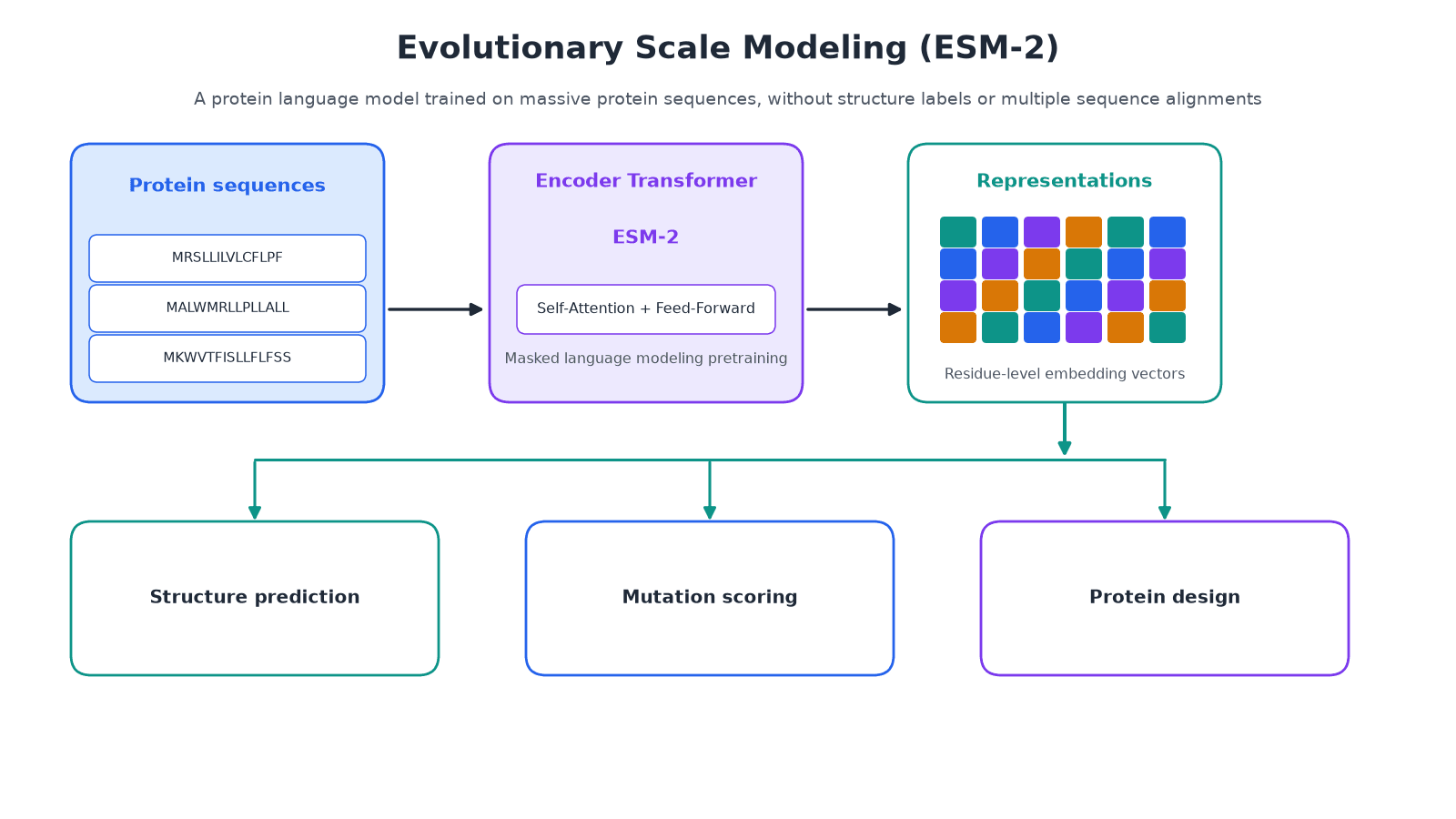
Figure 1 ESM2 protein language model: from sequence to representation to applications
Category:D (AI / Algorithm / Platform) | Secondary C (Directed Evolution / Protein Engineering)
Proteins are the “executors” of life, and the amino-acid sequence is their native “language.” Historically, understanding a protein meant relying on abundant homologous-sequence alignments (multiple sequence alignments, MSA) or costly experiments. Today, a class of techniques called protein language models treats the amino-acid sequence as a “sentence” and lets AI self-learn the “evolutionary grammar” from enormous known-sequence corpora, so that structural and functional signals can be read even without any structural input. The ESM2 protein language model is a representative of this direction.
This article unpacks ESM2 in plain terms: what it is, how it is trained, what it can do, where its boundaries lie, and how it enters real protein-engineering workflows and lands on the MatwingsVenus® (晓鹜®) platform as a “design-and-verify, verify-and-iterate” intelligent loop.
Why Did Protein Language Models Suddenly Take Off?
Protein language models treat protein sequence as language and self-learn the rules between amino acids from massive known sequences, capturing functional and structural signals without extra structural input.
Traditional structure prediction and function annotation depend heavily on multiple sequence alignments: find many homologs, then infer conserved sites and co-evolution signals from their similarities and differences. But when a target is an orphan protein, has few homologs, or comes from a metagenomic sample, the alignment often runs out of evidence.
Protein language models take a different path: instead of hunting homologs for each protein, they first learn, as a whole, the huge corpus of sequences nature already provides. They treat sequence as language and learn the “evolutionary grammar” from amino-acid co-occurrence and context. This is like a model that has read enormous text and can infer the meaning of an unusual word from its context. ESM-2 (Evolutionary Scale Modeling) is the protein language model family Meta AI's FAIR team built along this line.
· Traditional: relies on MSA and homology search; often limited for orphan or novel targets.
· Language model: self-supervised learning over massive sequences, “internalizing” structural and functional signals without MSA.
· ESM-2 is an encoder-only Transformer and belongs to the ESM protein language model family.
Core Principle and Architecture of the ESM2 Protein Language Model
ESM-2 is an encoder-only Transformer pretrained on large deduplicated UniRef50 sequences with masked language modeling, encoding each residue as a context-rich, structure- and function-bearing vector.
ESM-2 uses a BERT-style “masked language modeling” objective: randomly mask some amino acids in a sequence and ask the model to fill them in from context. To fill them correctly, the model must learn dependencies between residues — which residues tend to co-occur, which positions matter for structural stability. Over repeated training on massive sequences, these regularities are distilled into a high-dimensional vector per residue, that is, its “embedding representation.”
ESM-2 is an encoder-only Transformer whose scale ranges from about 8 million up to 15 billion parameters, with layers and hidden dimensions growing accordingly. Larger models usually capture structural and functional signals better. Crucially, these representations are learned self-supervised on sequence alone: no alignment, no structure labels — yet they can be “cashed in” by downstream tasks.
· Masked language modeling: mask residues → let the model fill them in → learn context dependencies.
· Model scale: about 8M to 15B parameters (6–72 layers, hidden size 320–5120).
· Output: one representation vector per residue, a “base” for downstream structure/function/design tasks.
· Path difference: ESM-2 uses “single sequence + pretraining”; AlphaFold2 primarily uses MSA.

Figure 2 Masked language modeling: mask residues and learn from context
What Can ESM-2 Do? Where Are Its Boundaries?
ESM-2 supports structure prediction, function annotation, variant-effect and fitness scoring, and protein design, but faces boundaries on complex interactions, absolute accuracy and unseen paradigms.
The best-known application is structure prediction. ESMFold, built on ESM-2 representations, folds a 3D structure directly from a single sequence without MSA (Lin et al., Science 2023). This makes it notably faster and naturally scalable: Meta released the ESM Metagenomic Atlas, disclosing hundreds of millions of predicted structures. Speed and accuracy are often traded off: without MSA, the ESM-2 route is less accurate than AlphaFold2 on some targets, while reports suggest it can be tens to hundreds of times faster.
For mutation and fitness, ESM-2 also supports “zero-shot” variant-effect scoring: mask a site and compare how the predicted probability changes to roughly gauge a mutation's impact, with no experimental labels required. This is often used to shortlist candidates in directed evolution. In addition, its embeddings can be fine-tuned for function annotation, solubility, localization, protein-protein interaction and many other tasks, and are a common base feature for protein design models.
· Structure prediction: ESMFold folds from a single sequence; fast and scalable.
· Mutation/fitness: zero-shot scoring aids directed-evolution screening; can also fine-tune downstream predictors.
· Representation reuse: one embedding vector, fed to many structure/function/design tasks.
· Boundaries: limited single-sequence information; very long sequences and multi-chain complexes, and absolute numerical accuracy, often need more experimental evidence; “good representation” ≠ “correct answer.”
From Representation to Protein Design: How ESM-2 Enters an Engineering Flow
In practice, ESM-2 embeddings serve as features for fitness predictors or design models, then iterate through a “score → screen → wet lab → feedback” active-learning loop.
A model alone is not the final product. To truly empower R&D, ESM-2 typically needs an “embed → predict → verify → retrain” engineering chain: feed protein sequences into ESM-2 for representations, let fitness/property predictors rank candidates, pick top variants for wet-lab assays, then feed experimental data back to retrain or re-rank. This is “active learning,” keeping a limited experiment budget focused on promising hits.
Combined with directed evolution, the model can suggest which sites and which substitution directions are likelier to improve function, turning “blind trial-and-error” into “guided search.” Combined with structure prediction, ESMFold provides a coarse structure for docking, interface analysis or design. It is worth stressing that data quality, task alignment, fine-tuning setup and threshold calibration all strongly affect the outcome — this is both how to use ESM-2 well and where to judge its boundaries.
· Main chain: sequence → ESM-2 embedding → fitness/property prediction → ranking → wet lab → data feedback → iteration.
· Directed evolution: model guides mutation sites and directions, reducing the number of experiments.
· Structure linkage: ESMFold coarse structure → docking/interface/design analysis.
· Process points: data quality, task alignment, fine-tuning and threshold calibration determine real gains.

Figure 3 A protein-language-model-driven predict–verify–iterate R&D loop
How Do Protein Language Models Land on MatwingsVenus® (ai protein)?
MatwingsVenus® (晓鹜®) wraps protein language models such as ESM-2 into a “design-and-verify, verify-and-iterate” intelligent R&D loop, letting users orchestrate deep research, protein design and automated wet-lab experiments via natural language.
MatwingsVenus® (晓鹜®), developed by Matwings Technology, is a lightweight AI bio-design platform that builds an R&D loop around protein design, experiment delivery and expert collaboration. According to its official description, the platform integrates hundreds of millions of real labeled sequences from NCBI, UniProt, MGnify and others, and provides many professional tools, expert-tuned Skills and certified experts, so users can decompose and orchestrate tasks through natural-language dialogue.
In such an architecture, protein language models play the role of the “representation and zero-shot scoring” base: given a candidate sequence, ESM-2-class models can first provide structural or fitness signals without experimental data, helping the agent shortlist directions. The agent then auto-connects the design to wet-lab steps such as gene synthesis, protein expression, purification and functional assay, and feeds results back to the AI model for iteration. This is the “design-and-verify, verify-and-iterate” dry-wet loop, turning “large model + few experiments” into a workable R&D approach. (Specific product parameters and leaderboard performance follow the latest official statements.)
· Positioning: a lightweight AI bio-design platform from Matwings Technology, driven by conversational agents.
· Base: hundreds of millions of real protein-label sequences (NCBI, UniProt, MGnify, etc.) + professional tools/Skills/experts.
· Loop: design → wet lab (expression/purification/functional assay) → data feedback → redesign.
· Link: ESM-2-class protein language models supply representation and zero-shot scoring, supporting prediction and design with the in-house foundation model.
FAQ
Q1: What is the difference between ESM-2 and AlphaFold2?
ESM-2 is a protein language model pretrained self-supervised on massive sequences, yielding structure and function representations from a single sequence; AlphaFold2 uses multiple sequence alignments as its core evidence for structure prediction. Each trades off differently: the ESM-2 route is faster and more scalable, but typically less accurate on complex interactions and absolute precision than MSA-rich AlphaFold2.
Q2: How much compute does ESM-2 need?
It depends on model size. ESM-2 spans versions from about 8 million to 15 billion parameters: small models suit fast embedding and downstream fine-tuning on ordinary GPUs; the 15B version is demanding in memory and compute and is usually used for high-quality representation. Engineering often uses a medium model as a feature base.
Q3: Can ESM-2 directly design new proteins?
Strictly, ESM-2 is a representation model and cannot directly generate new sequences; but it can supply structural, functional or fitness signals and is widely used as a base for protein design models or for zero-shot candidate screening. “De novo generation” typically requires specialized generative models plus wet-lab validation.
Q4: Can I use ESM-2 without coding skills?
Yes. Conversational platforms such as MatwingsVenus® (晓鹜®) wrap underlying models into agent capabilities: users express needs in natural language (e.g., structure prediction, enzyme mining, directed evolution) and the platform orchestrates tools and returns results; complex design and research collaboration can also reach expert consultation. The barrier drops from “know how to code” to “know how to ask.”
Conclusion
The ESM2 protein language model lets AI treat amino-acid sequence as language, self-learning transferable structural and functional representations from massive sequences. It delivers two things: the “speed and scalability” of doing structure prediction and mutation scoring without MSA, and a clear boundary — single-sequence information is limited, so accuracy and applicability need experimental evidence to calibrate.
The real value lies in wiring the model into a “predict — verify — iterate” loop: let AI point a direction first, confirm it with wet-lab experiments, and let data flow back to refine the model. This is the “design-and-verify, verify-and-iterate” practice of MatwingsVenus® (晓鹜®) and the key step that moves protein language models from “able to compute” to “able to use.”
One-sentence conclusion:The ESM2 protein language model lets AI read protein's evolutionary code directly from amino-acid sequence, enabling structure prediction, mutation scoring and protein design without multiple sequence alignments.